Last updated: October 2026
Choosing a hotel SEO agency is harder than choosing one for most other businesses, because a hotel's website is only one of several places a guest can book. The same room can be sold through your own site, through online travel agencies, through a phone call and through booking links that Google shows beside the map. A good agency understands that split and works to move guests toward the channel that costs you least. A weak one sends you a ranking report and calls it a day.
This guide is written for independent hotels, bed and breakfasts and small groups. It covers what the work should include, which Google features actually apply to lodging, what structured data can and cannot do, how to measure direct bookings honestly, and how to question an agency before you sign anything. It names no vendors and quotes no prices, because both change and neither tells you whether the work is any good.
What a Hotel SEO Agency Should Actually Do
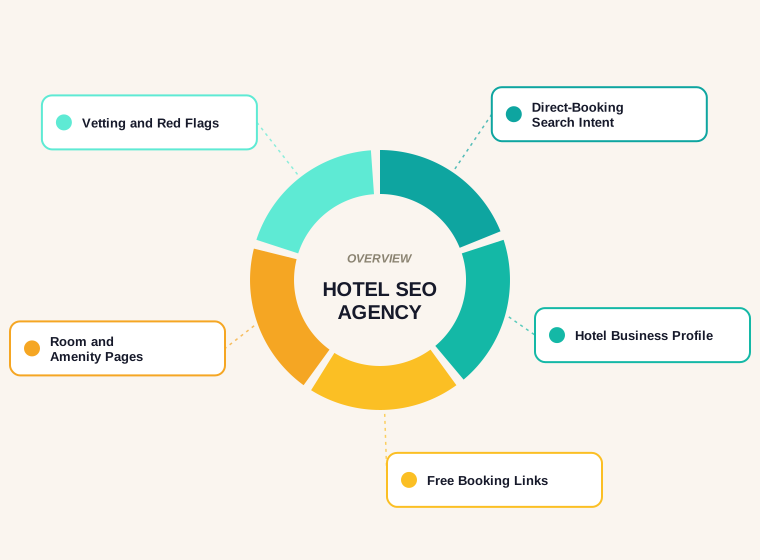
Strip away the sales language and hotel SEO has five jobs. First, make your property easy to find when someone searches for a place to stay in your town. Second, make sure the information Google shows about your hotel is correct. Third, make the website convincing and fast enough that a visitor books there instead of going back to a third-party site. Fourth, build the reviews and local references that tell Google and guests the hotel is real and well run. Fifth, report on direct bookings, not just rankings.
If a proposal is mostly about keyword positions and blog volume, it is missing the point. Rankings are a means. The end is a reservation made on your own booking engine, with no commission attached.
Direct-Booking Searches Worth Winning
Hotel searches fall into a few families, and each needs a different page. Knowing which ones you can realistically win is the first thing an agency should show you.
- Hotel plus city searches, such as "hotels in [town]". These are the most competitive and are usually dominated by large aggregators and map results. A small property rarely wins the organic spot here, but it can win the map and booking link results.
- Proximity searches, such as "hotels near [landmark, venue or hospital]". These are often more winnable because the intent is specific and fewer pages answer them well.
- Room-type searches, such as family room, accessible room or suite with a view. A page that describes a room properly can catch these.
- Amenity searches, such as pet friendly, free parking, breakfast included or pool. Guests with a hard requirement search this way and convert well.
- Brand searches, where someone types your hotel name. This is where direct bookings are won or lost, because the guest already knows you and only needs a fast, trustworthy route to book.
Our guide to local keyword research explains how to find and rank these phrases without guessing. A competent hotel SEO agency should hand you a short list built this way, tied to specific pages, rather than a spreadsheet of thousands of terms.
Google Business Profile for Hotels
For most small hotels, the Business Profile is the single biggest lever, because it controls what appears on the map, in the knowledge panel and beside the booking links. Google publishes a dedicated Business Profile guide for hotels, and it contains several details that generic local SEO advice misses.
Google says that if you have a verified hotel profile, you can edit your services and amenities in the "Hotel details" section. It also notes that to edit all amenities from your dashboard, the profile must be claimed and verified. Amenities that Google has pulled in from elsewhere can be corrected there if they are factually wrong.
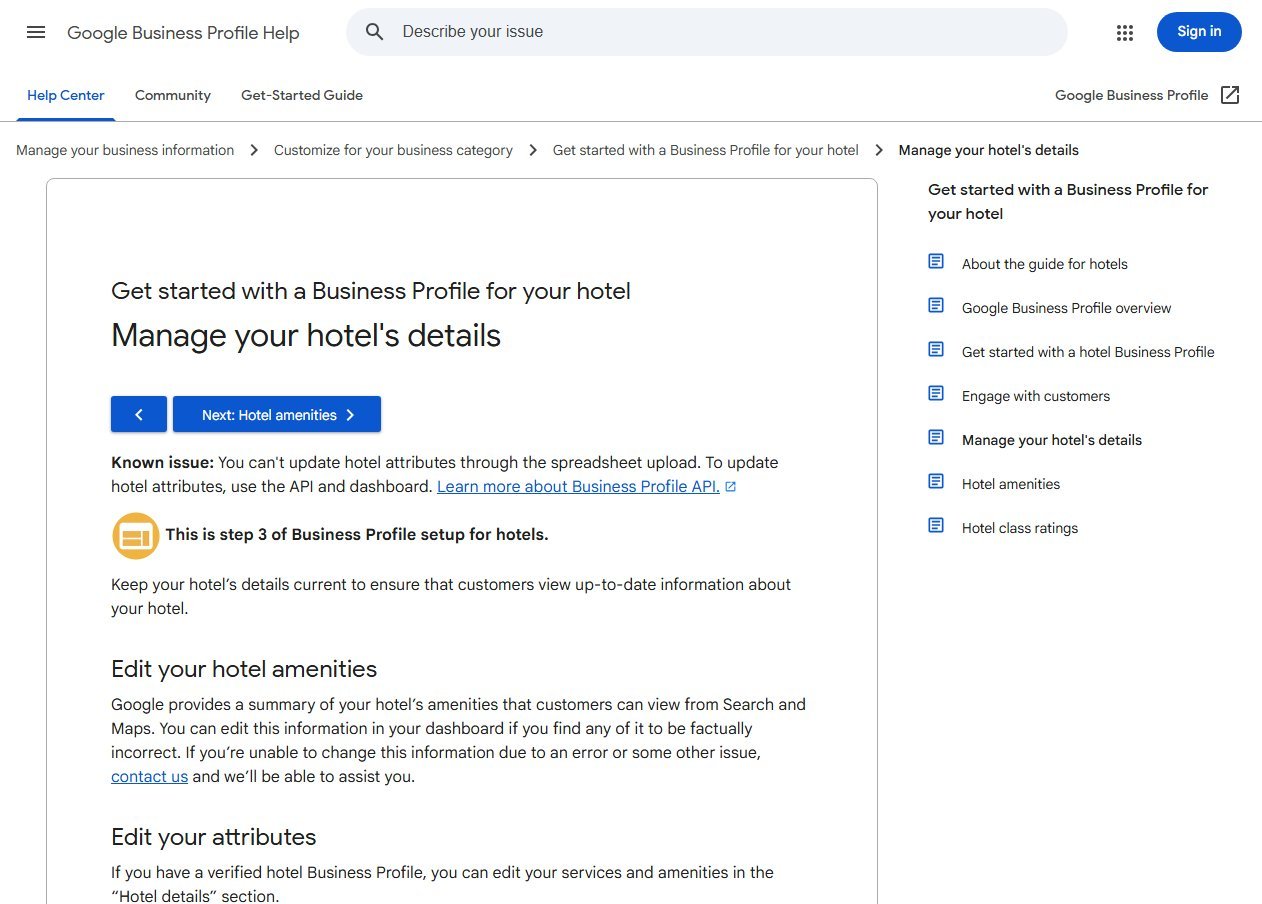
Two other points on that help page are worth knowing. Hotel highlights, the small icons for things like free Wi-Fi or pet friendly, are described by Google as not guaranteed for every hotel, so you cannot force them to appear. And hotels cannot edit their business hours, because Google treats them as open around the clock for guests. If an agency promises to "optimise your opening hours" for a hotel, they have not read the documentation.
What an agency can usefully do here is audit the profile for accuracy, fix wrong amenities, choose the right category, keep photos current and make sure the website link goes to a page that helps someone book. The broader mechanics, such as name rules and duplicate listings, are covered in our local SEO for small business guide and apply to hotels as much as to any other business.
Google's Hotel Features: How Eligibility Really Works
This is the area where hotels most often get misled. The prices and booking buttons that appear next to a hotel on Google do not come from your website's markup, and they cannot be won by SEO alone. Google's Business Profile guide says pricing and booking information come from Google Hotel Ads and free booking links.
Google's help page on hotel free booking links describes how they work. Your booking site can appear when people search for hotels, showing your site name or hotel name with the room rate for the selected dates, and clicks on those links carry no cost. The page states that existing Hotel Center partners taking part in Hotel Ads are automatically eligible, provided they have a bid in a hotel campaign, available rates and a landing page.
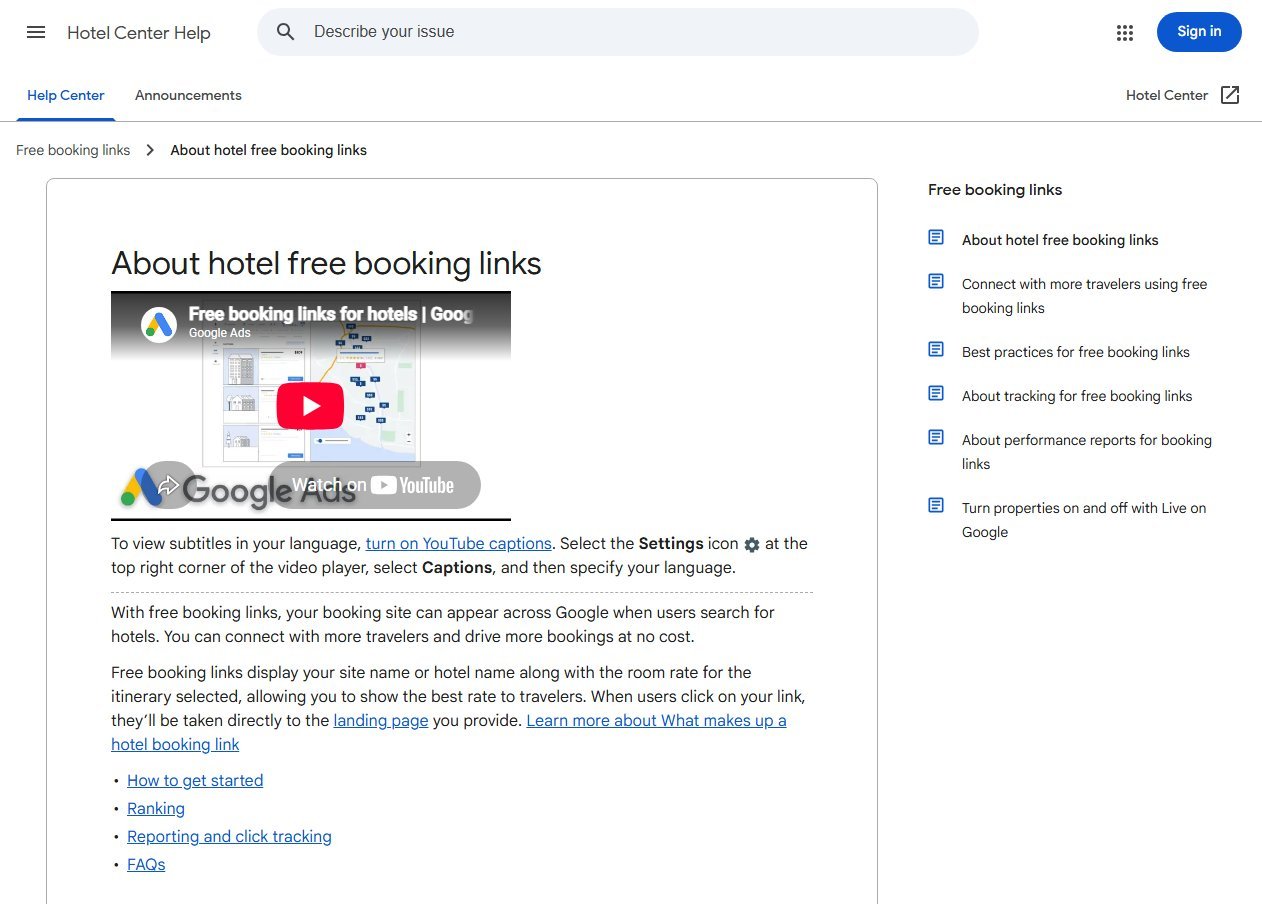
For a hotel that is not already a Hotel Center partner, Google points to a starter guide. That guide says individual hotel owners must own commercial properties offering lodging and guest services provided by on-site staff, and it describes connectivity partners as the businesses that receive or manage rates, rooms and availability, such as booking engines and property management systems. In practice, this means the first question for a small property is often a technical one: does your reservation system already send rates to Google? Ask your booking engine provider before you ask an agency.
Ranking among free booking links is not something an SEO can buy. Google says it considers consumer preference, the value offered to the user, landing page experience and the historical accuracy of the prices you supply, and that bids have no impact on the ranking of free booking links. So the levers you control are honest, accurate rates and a landing page that does not frustrate people. A hotel SEO agency can help with the second; the first is your responsibility.
Room-Type and Amenity Pages That Earn Bookings
Most independent hotel websites describe every room on one page, with a gallery and a "from" price. That page answers nobody's specific question. A guest with two children wants to know whether the family room has two beds or a sofa bed, what the real size is and whether a cot fits. A guest with a mobility need wants to know about step-free access, shower type and lift size.
A dedicated page for each room type, written around those questions, serves both the searcher and the booking. Include the details a person would otherwise phone to ask: bed configuration, occupancy, size, view, what is included and what is not. Amenity pages work the same way. If you take dogs, say which rooms, what the charge policy is and what is nearby for walks, rather than a single line saying "pet friendly".
The test is whether a guest could decide to book without leaving the page to ask a question. Agencies that produce thin, near-identical copy across room pages are creating the kind of content Google's own spam policies describe as scaled and unhelpful, and it will not hold up.
Structured Data for Hotels: What It Does and Does Not Unlock
Hotel owners are often told that markup will put prices and stars into search results. The reality is narrower. Google's documentation on local business structured data says that search results may show a knowledge panel with details about a business, and it advises using the most specific LocalBusiness sub-type possible. The required properties are the name and the address. A lodging type from schema.org sits under that umbrella, so marking up your hotel's name, address, phone number and links is sensible housekeeping that helps Google confirm the facts.
What the markup does not do is create the live price and availability results described above. Those come through Hotel Center and your connectivity partner, not from tags on your page. Google's structured data gallery, when checked for this article, lists a vacation rental feature but no hotel-specific rich result, so nobody can honestly promise you stars or room prices in the results from schema alone.
That gives you a simple test. An agency that includes tidy markup as one small task in a technical clean-up is doing the right thing. An agency that sells schema as the reason your hotel will outrank larger competitors is overselling.
Mobile Speed and the Booking Flow
A large share of hotel research happens on a phone, often on a weak connection, and a slow booking journey loses guests quietly. Google's guidance on Core Web Vitals measures loading, responsiveness and visual stability, and the company says these align with what its core ranking systems seek to reward. For a hotel, the practical version is simpler: the room photos must load quickly, the date picker must respond when tapped, and the page must not jump around while someone is trying to press the button.
Ask an agency to test the whole path on a mid-range phone, from the home page through room selection to the booking engine, and to tell you where the delay sits. Often the problem is oversized photo galleries, an autoplaying hero video or a booking widget loaded from a slow third party. An agency may not control the booking engine, but it can tell you whether the engine is the weak point and what to ask its provider to change.
Reviews: The Strategy Behind the Stars
Guests read reviews before they read your description. A sound strategy is boring and consistent. Ask every guest, in the same way, at the end of the stay. Reply to reviews, good and bad, in a courteous and specific tone. Fix recurring complaints at the property, because no amount of marketing outruns a noisy room.
Do not offer discounts, upgrades or free breakfast in exchange for a review, and do not route only happy guests to a review link. Google's policies prohibit incentivised reviews and attempts to manipulate ratings, and a suspended profile costs far more than a few missing stars. If an agency proposes buying reviews or publishing reviews from people who never stayed, walk away.
Local Content Written Honestly
Guests want to know what there is to do near the hotel, and a well-made local guide can earn visits and links. The honest version is based on what your staff actually recommend: the breakfast spot they send people to, the walk they do on their day off, the festival that fills the town in one particular week.
The dishonest version is a page of generic "top attractions" copied from other sites, or a set of near-identical pages for every village within thirty miles. Google's spam policies discourage large sets of pages that exist only to catch searches, and guests can tell. Write fewer pages, with specifics only a local would know, and keep dates and opening times current. Events pages need a sensible lifecycle too: update them each year rather than leaving last season's festival live.
Seasonality and Planning the Year
Hotel demand moves in waves, and search interest moves ahead of it. People research a summer holiday months before they book, and plan a winter break well before the date. Content and page improvements aimed at a peak season need to be live well before that peak, not during it, because new pages take time to be crawled and to build any visibility.
A useful agency will build a calendar around your own occupancy data: when the gaps are, which midweek or shoulder periods you want to fill, and which events drive stays. Package pages, such as a winter weekend or a walking break, can be refreshed each year and kept live so they keep their history, rather than being deleted and rebuilt.
Measuring Direct Bookings Against Online Travel Agency Bookings
This is where most hotel SEO reporting falls apart. Rankings and traffic are easy to chart. Reservations are harder, and the number that matters is how many bookings arrive through your own booking engine, compared with those that come through online travel agencies and their commissions.
Insist on reporting that connects website visits to completed bookings. That means conversion tracking set up in the booking engine, with the booking confirmation tied back to the source of the visit. Ask for these measures, month by month and compared with the same month last year because of seasonality:
- Organic visits to the booking engine, and completed direct bookings from organic search.
- Actions from the Business Profile, such as website visits, calls and direction requests, which Google reports in the profile's performance data.
- Clicks from free booking links, which Google says can be viewed in the Hotel Center account where you have one.
- The share of total bookings arriving direct versus through online travel agencies, taken from your own property management records, not the agency's estimate.
Expect imperfect attribution. A guest might find you on a map, check a third-party site, then book direct a week later. A good agency explains that limit up front and relies on your reservation data to cross-check any claim.
How to Vet a Hotel SEO Agency
A sales call tells you little. The questions below tell you much more, and an honest agency will be comfortable answering all of them.
- Who will actually do the work, and who will I speak to each month?
- How will you connect your work to direct bookings in my booking engine?
- What do you check in my Business Profile, and what do you not control?
- How do you handle the booking engine, and do you coordinate with its provider?
- Which of your hotel clients can I speak to, and what did you change for them?
- What will you not do, such as buying links or reviews?
- What do I own at the end: the content, the analytics accounts, the profile access?
On contracts, look for plain terms. Prefer a clear scope with a review point over a long lock-in. Make sure you keep ownership of your Business Profile, analytics, search console and written content, and that you hold the logins yourself. Our SEO audit cost guide is a useful reference for understanding what an initial audit should contain before any retainer starts.
Red Flags That Should End the Conversation
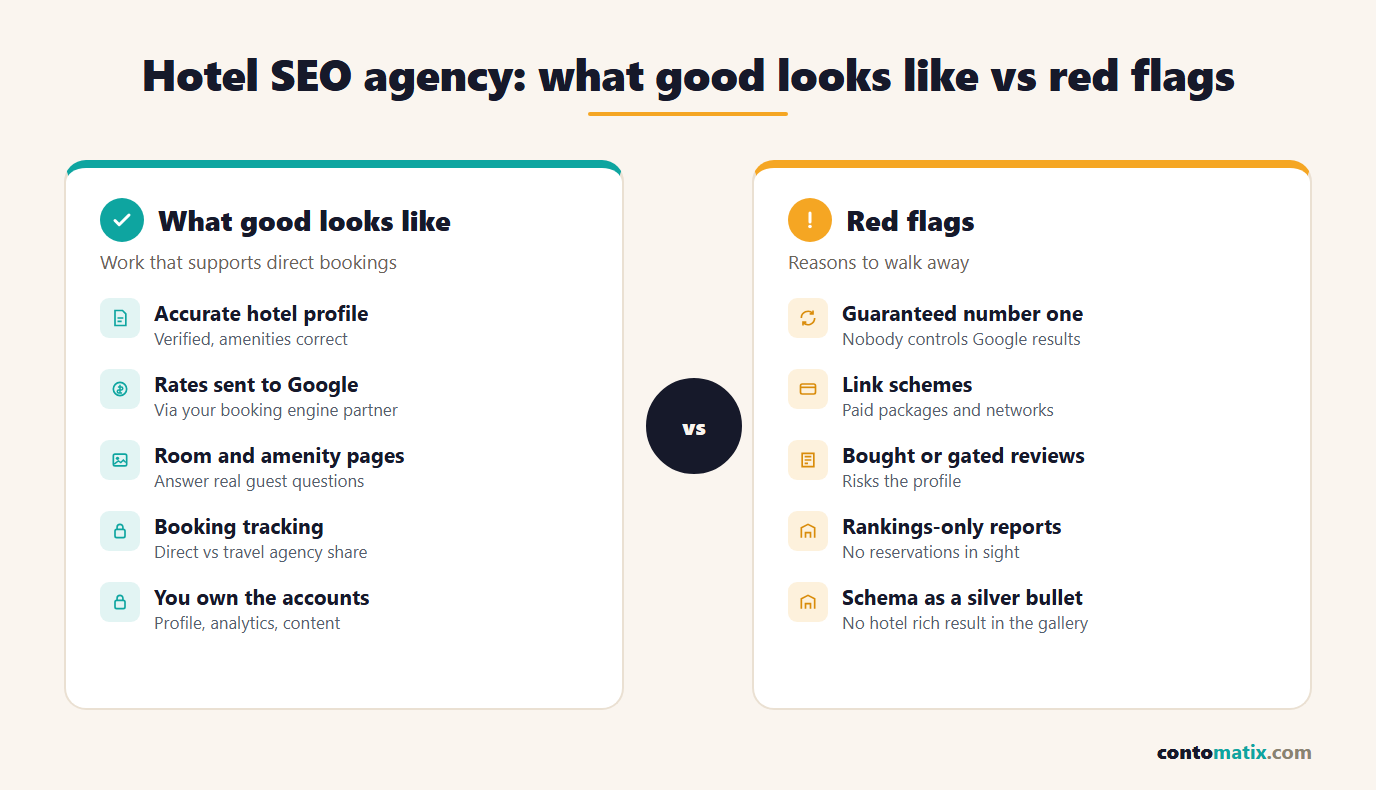
- A guaranteed number one ranking. Nobody controls Google's results, and the person promising it is either misleading you or planning to rely on a narrow phrase nobody searches for.
- Link schemes. Paid link packages, private networks and mass directory submissions are what Google's link spam policy targets, and the damage lands on your site, not theirs.
- Reports with no bookings in them. Traffic and keyword counts without reservations is a way of hiding that nothing is changing.
- Taking over your accounts. If they register your Business Profile under their own login, you may struggle to get it back.
- Fake or bought reviews. This risks your profile.
- Claims that markup alone will put prices or stars in search results. As covered above, it will not.
- Pressure to sign today. Good work does not need a countdown.
Pricing Models Without the Numbers
Hotel SEO agencies generally charge in one of a few ways, and each has trade-offs. A monthly retainer pays for ongoing work and suits properties that need steady content, reviews support and reporting. A fixed-scope project, such as an audit and clean-up, suits a hotel that has a team able to carry on afterwards. Hourly or ad-hoc consulting works for a specific question, such as why a booking page is slow. Some agencies propose performance-linked arrangements, and these need careful reading, because "per booking" can reward the agency for bookings that would have happened anyway, such as people searching your own name.
Price alone is a poor guide. A cheap retainer that delivers templated blog posts is worse value than a smaller scope that fixes your profile, room pages and tracking. Compare scopes and deliverables, not totals, and ask what happens if you want to stop.
A Checklist Before You Hire
- Confirm your Business Profile is claimed, verified and accurate, including the amenities in the hotel details section.
- Ask your booking engine provider whether it already sends rates to Google for free booking links.
- Set up conversion tracking so completed direct bookings are recorded and tied to their source.
- List the five or six searches you most want to win, by room type, amenity and nearby landmark.
- Test the booking journey on a mid-range phone and note where it is slow.
- Write down your own direct share of bookings today so you can compare it later.
- Prepare your agency questions and your list of things you will not accept, including bought links and reviews.
- Agree who owns the accounts, content and reports before the work begins.
Quick Recap
- A hotel SEO agency's job is to move bookings to your own site, so judge it on direct reservations, not rankings alone.
- Google's hotel Business Profile lets verified owners edit hotel details and amenities, but hours cannot be edited and highlights are not guaranteed.
- Prices and booking links in Google come through Hotel Ads and free booking links, not website markup, and bids do not affect free booking link ranking.
- Structured data helps confirm your facts, but Google lists no hotel-specific rich result in its search gallery.
- Create real pages for room types, amenities and local interests, written from what guests actually ask.
- Ask every guest for a review, offer nothing in return, and avoid agencies that guarantee rankings or sell links.
If you want a second pair of eyes on how a property currently shows up in search before you talk to any provider, the team at Contomatix is happy to take a look and tell you what is worth fixing first.
Frequently Asked Questions
Do small hotels need a hotel SEO agency?
Not always. A property with a verified profile, accurate rates and a fast website may be fine on its own. An agency helps most when you lack the time or skills to maintain the profile, pages and tracking, or when direct bookings are well below where you want them.
What should a hotel SEO service include?
At minimum: a Business Profile audit, keyword research for room, amenity and nearby-landmark searches, dedicated room and amenity pages, a mobile speed check of the booking path, a review process and reporting tied to direct bookings.
How does a hotel get free booking links on Google?
Google says existing Hotel Center partners using Hotel Ads are automatically eligible. Hotels without an account are pointed to a starter guide, and rates are generally supplied through a connectivity partner such as a booking engine. Ask your reservation system provider first.
Can SEO improve my ranking in free booking links?
Only indirectly. Google lists consumer preference, value to the user, landing page experience and price accuracy as signals, and says bids have no effect. Accurate rates and a good landing page are the parts you can influence.
Does hotel schema markup give me star ratings or prices in Google?
Not by itself. Google's local business documentation covers knowledge panel details and recommends the most specific sub-type, but live prices come through Hotel Center. Its structured data gallery lists no hotel-specific rich result.
Can I change my hotel's opening hours on Google?
No. Google's hotel guide states hotels cannot edit their business hours because they are open around the clock for guests. You can edit amenities and attributes in the hotel details section once the profile is verified.
How do I tell direct bookings from online travel agency bookings?
Use your property management or booking engine records, which show the booking source, and set up conversion tracking on your own booking engine. Compare the direct share month by month and against the same month last year.
How long does hotel SEO take to work?
Profile corrections can show quickly, while new pages and review growth take months, and results follow your seasons. Treat any promise of fast, guaranteed results as a warning sign.
Is a guaranteed first-page ranking realistic?
No. Nobody outside Google controls rankings. A guarantee usually means a very narrow phrase or a tactic that risks a penalty.
What is the safest way to pay a hotel SEO agency?
Choose a clear scope, regular reporting tied to bookings and a review point, and keep ownership of your accounts and content. Be careful with performance-based fees that credit the agency for bookings you would have received anyway.