Last updated: October 2026
Almost every quote you will ever see for an SEO review is a bet on the same unknowns, and that is why SEO audit cost is so hard to pin down from the outside. Two businesses can ask for "an audit" and receive proposals that look nothing alike: one is a few automated pages, the other is weeks of analysis with a developer-ready action plan. Both are called an audit. Only one of them may be what you needed.
This is a buyer guide, not a price list. Prices vary with the site, the provider and the deliverables, so any number published without that context is a guess, and this article does not invent one. Instead it explains what pushes a quote up or down, which pricing models exist, how to compare proposals fairly, what should make you walk away, and how to run a useful audit yourself with free Google tools before spending anything.
What an SEO Audit Is Supposed to Contain
Before you can judge a quote, you need to know what a complete audit covers. A proper review looks at several layers, in an order that matters, and ends with a ranked list of what to fix. Our own website SEO audit checklist walks through that order in detail; here is the short version of what you are paying for.
- Technical health. Can search engines crawl the site, render its pages and index the ones that matter? This covers robots rules, sitemaps, canonical tags, redirects, status codes, mobile rendering and page speed.
- On-page signals. Titles, headings, internal links, structured data and whether each page matches what a searcher actually wants.
- Content. Which pages earn traffic, which are thin or duplicated, and which compete with each other for the same query.
- Links. The quality and spread of the sites linking to you, and whether anything risky is in the profile.
- Local or ecommerce layers where they apply: business profile accuracy for a local firm, or faceted navigation and product variants for a shop. Ecommerce has enough quirks that we wrote a separate ecommerce SEO audit guide.
- Prioritised recommendations. The part many cheap audits skip: an ordered list saying what to fix first, who should fix it and roughly how much effort it takes.
If a proposal lists only the first bullet, or lists everything but promises no prioritised output, treat it as an incomplete scope rather than a bargain.
The Pricing Models You Will Actually Meet
Providers package audits in a handful of ways. Knowing the model tells you more about the quote than the figure at the bottom does.
- One-off fixed fee. A single price for a defined scope and a report at the end. This is the easiest to compare, provided the scope is written down. The risk is that anything outside the scope becomes an extra.
- Scoped to site size and type. The provider looks at your site first, such as how many pages it has, how it is built and which markets it serves, and then quotes. Larger and more complicated sites get larger quotes because there is simply more to examine.
- Hourly or day-rate. Flexible and transparent, but open-ended. It suits a narrow question, such as "why did traffic fall after the migration", better than a general review.
- Bundled into a retainer. Some agencies fold the first audit into the opening months of ongoing work, so the cost is hidden inside the monthly fee. That can be fair, but ask what happens to the audit if you leave.
- Free automated audit. A tool scans your URL and emails a score. This is useful as a first look and worthless as a plan, because it cannot tell which of its findings matter to your business.
None of these is automatically better. A small local business with a modest site is usually well served by a one-off fixed scope. A large site mid-migration may need a day rate with a clear ceiling. What matters is that you can see what is included before you agree.
What Pushes SEO Audit Cost Up or Down
Because every site is different, the honest answer to "how much will it cost" is that the quote follows the work. These are the factors that change how much work there is.
- Site size. A forty-page brochure site can be reviewed far faster than a catalogue with tens of thousands of URLs. More pages means more to crawl, sample and check.
- How the site is built. Sites that rely heavily on JavaScript to show their content take longer, because the reviewer has to check what a crawler actually sees after rendering, not just the raw HTML.
- International or multilingual setup. Several languages or regions add hreflang, canonical and market-targeting checks on top of everything else.
- Ecommerce complexity. Filters, sort orders, product variants and out-of-stock pages create URL sprawl that needs careful handling.
- Depth of the review. A surface check of the main templates costs less than a full crawl, log analysis, competitor gap work and a content-by-content assessment.
- Deliverables. A summary call, a written report, a spreadsheet of URLs, a developer-ready ticket list and a walkthrough meeting are all different amounts of effort.
- Implementation support. An audit that stops at the report costs less than one where the provider briefs your developers, answers questions and checks the fixes afterwards.
- Urgency. A rushed turnaround is rarely priced the same as a relaxed one.
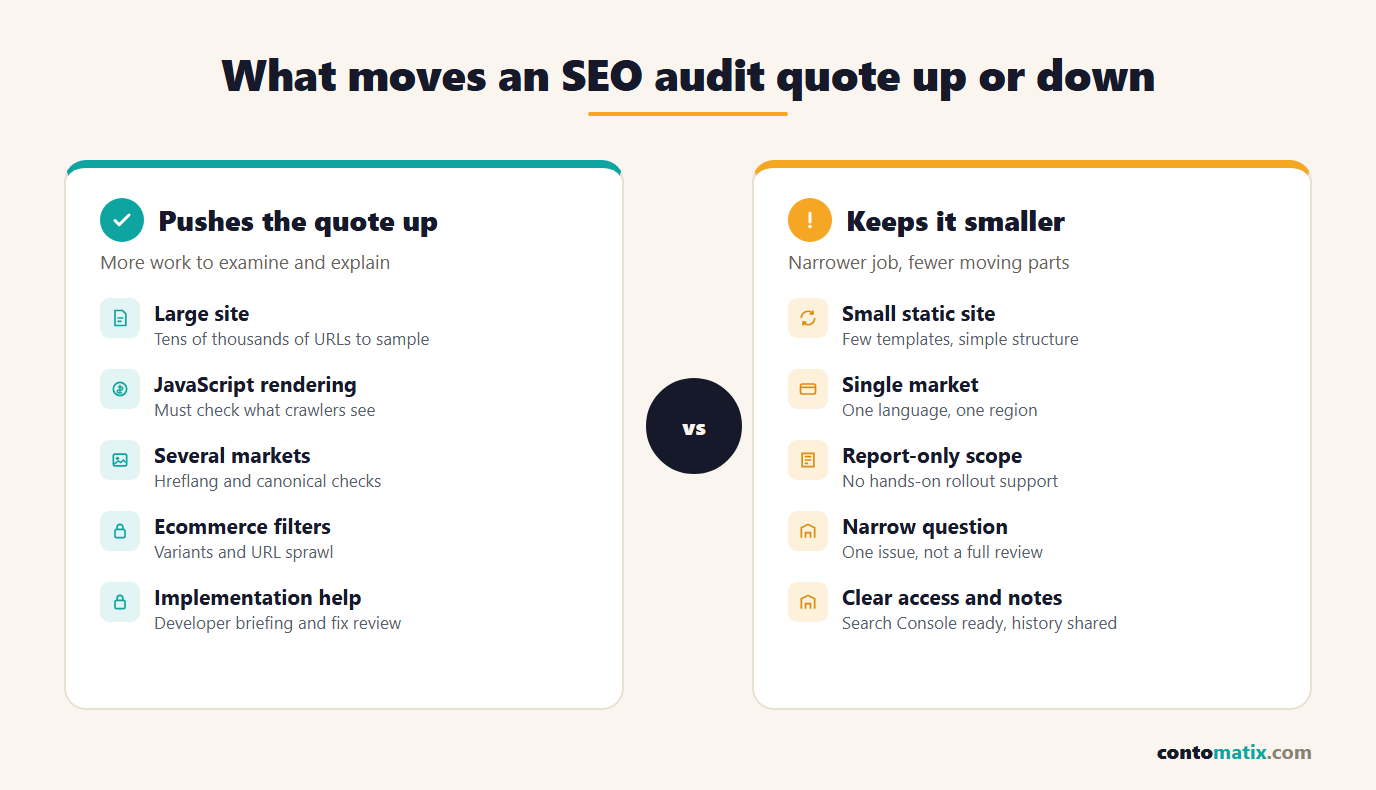
Notice that none of these factors says anything about how good the provider is. That is the trap: two quotes can differ simply because one provider assumed a smaller job than the other. Always compare scope before you compare numbers.
Who Does the Audit Matters Too
The same scope can be priced very differently depending on who delivers it. A freelancer specialising in audits, a boutique consultancy, a large agency and an in-house hire all have different overheads and different strengths.
A specialist freelancer often gives you direct access to the person doing the analysis. A larger agency may bring a team, including developers and content people, which helps when fixes are complicated. An in-house hire makes sense when audits are a regular need rather than a one-time event. None of these is inherently the right choice, and our guide to picking a technical SEO agency covers how to weigh them. The point for budgeting SEO audit cost is simple: ask who will actually do the work, and how many hours of senior time are in the proposal.
How to Compare Quotes Fairly
Comparing SEO audit cost by the bottom-line total alone is how people end up paying for the wrong thing. Put each quote through the same short test.
- Line up the scope. Does each one cover technical, on-page, content and links? Does either skip rendering checks, or international setup, even though your site needs them?
- Check the sample size. "We review your site" is vague. "We crawl every URL and manually review these templates" is specific.
- Compare deliverables line by line. Written report, URL spreadsheet, prioritised roadmap, call, developer notes. If one quote lists fewer, the lower price may simply reflect that.
- Ask what is out of scope. The extras are where cheap quotes become expensive ones.
- Look for the follow-up. Is there a review after fixes ship, or does the relationship end at delivery?
- Ask about timeline and revisions. A quote with no delivery date is a quote with no commitment.
When two quotes cover the same scope and one is far higher, ask the provider to explain the difference. A good answer names specific work: more rendering checks, deeper content analysis, a longer handover. A vague answer about "expertise" tells you little.
Red Flags That Should Slow You Down
Some warning signs show up in proposals again and again. If you see several of them together, keep looking.
- A resold automated report. If the sample looks like a raw export from a crawler with the logo swapped, you are paying for software output anyone could run.
- No prioritisation. Hundreds of issues with no ranking leave you unable to act. The value of an audit is in the ordering.
- Guaranteed rankings. Google's own guidance on hiring an SEO states that no one can guarantee a number one ranking, and warns against anyone who claims a special relationship with Google.
- Pressure to buy the same day. A fair scope survives a few days of consideration.
- A request for broad access up front. The same Google page advises granting only read access to Search Console at the audit stage, not write access.
- No named person. If you cannot find out who will do the analysis, you cannot judge their experience.
- Secrecy about methods. A provider should be willing to explain what they check and why.
Google also suggests asking for examples of previous work and for business references from past clients. A provider who cannot share either, even in anonymised form, is asking you to take quality on trust.
What to Ask For Before You Pay
A few requests separate serious providers from the rest, and they cost nothing to make.
- A sample deliverable. Ask to see a redacted audit from a past engagement. You are looking for clear structure, a ranked action list and explanations a developer could follow.
- A written scope document. It should name what is covered, what is excluded, the number of revision rounds and the delivery date.
- The tools and methods in plain terms. You do not need brand names, just an honest account of what is automated and what is reviewed by a person.
- Who owns the output. The report and any spreadsheets should be yours to keep and share with other providers or your own developers.
- What happens after delivery. A handover call, answers to follow-up questions and a check once fixes go live are worth asking about at the start.
Treat the answers as part of the evaluation. A provider who responds quickly and specifically to these requests is showing you how the engagement will feel.
The Free Option: Run a First-Pass Audit Yourself
Before you commit any SEO audit cost to a provider, it is worth doing a basic review with Google's free tools. You will learn what your site looks like to a search engine, and you will be a far better buyer for it. Even if you still hire someone, you can narrow the brief to the problems you found.
Start in Search Console with the page indexing report, which shows how many URLs Google has crawled and indexed, and why others were left out.
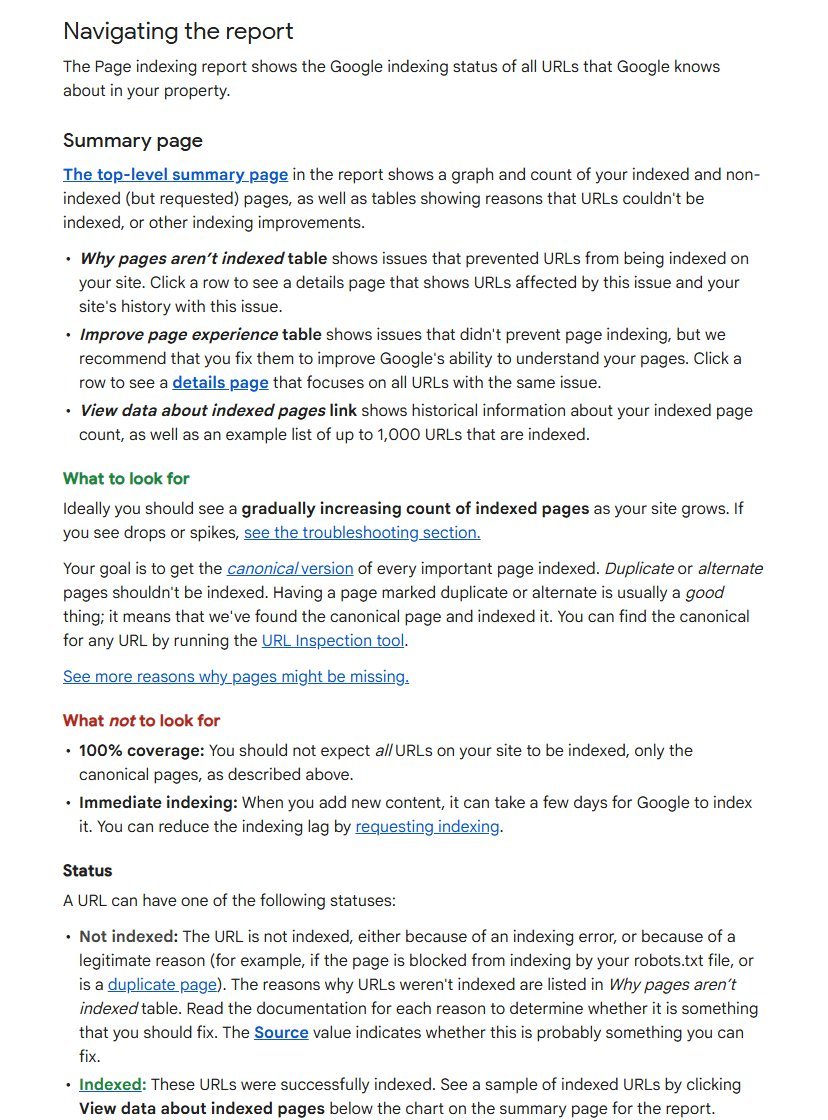
Google's page indexing report documentation says the goal is to get the canonical version of every important page indexed, and that you should not expect every URL on a site to be indexed. Compare the number of indexed pages with the number you believe you have. A large gap is the first finding of any audit, whether you or a paid provider does it.
From there, the free toolkit covers a lot of ground:
- URL Inspection in Search Console shows how Google sees a single page, including its canonical choice and whether it can be indexed.
- The performance report shows which queries and pages already earn clicks, and where a page sits in the results.
- The Rich Results Test checks whether structured data on a page is valid and eligible for enhanced results.
- PageSpeed Insights and Lighthouse report on speed and experience, which the next section explains how to read.
What the free route cannot do is crawl a very large site at scale, analyse server logs, or turn findings into a prioritised plan tailored to your business. Those are the places where paying for expertise starts to make sense.
Reading Speed Data Without Being Fooled
Speed results are the part of a DIY audit most likely to mislead, because one report shows two different kinds of data. The documentation for PageSpeed Insights explains the split clearly.
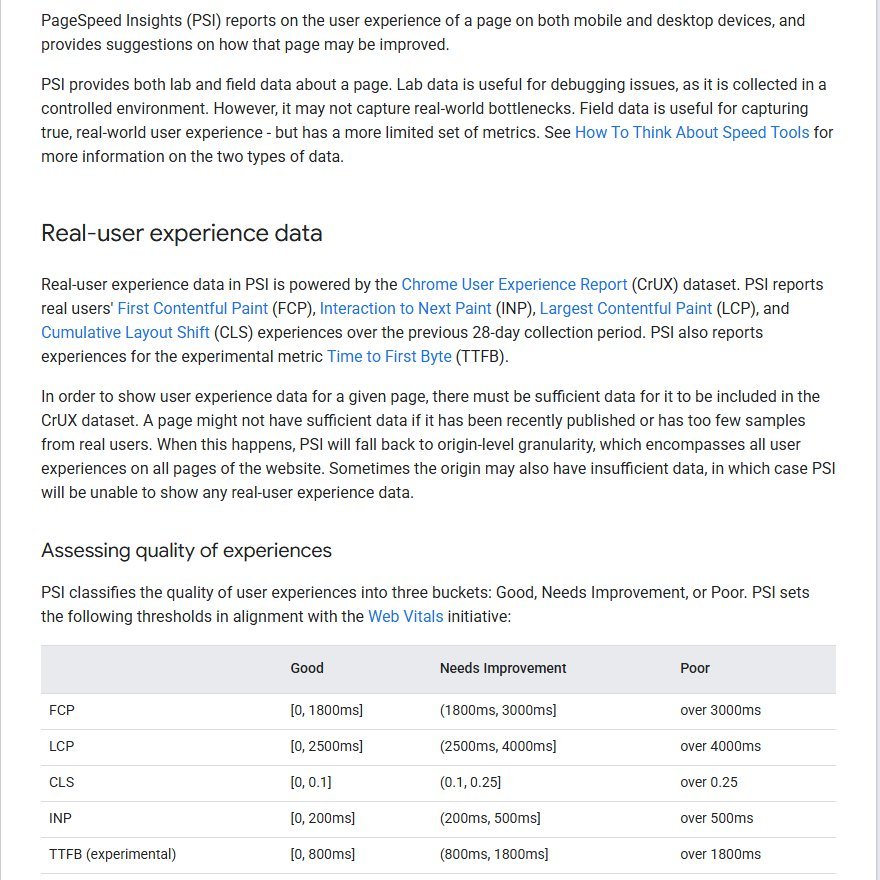
According to Google's PageSpeed Insights documentation, lab data is collected in a controlled environment and is useful for debugging, while field data reflects real-world user experience over the previous 28-day period. The same page lists the Good thresholds: Largest Contentful Paint up to 2500 milliseconds, Interaction to Next Paint up to 200 milliseconds and Cumulative Layout Shift up to 0.1.
This matters when you are reading an audit report. A provider who presents a single lab score as proof of a ranking problem is oversimplifying. A newer or smaller page may have no field data at all, and the documentation notes that PageSpeed Insights can fall back to site-wide data or show none. Ask any provider to say which kind of data each speed finding is based on.
What You Should Have in Your Hands After the Audit
Whatever you paid, the output should let you act. Judge the delivery against this list.
- A prioritised action list. Each item has a clear problem, a recommended fix, an estimate of effort and a reason it matters.
- Evidence, not assertions. Example URLs, screenshots or data from Search Console that show each problem exists on your site.
- Quick wins separated from projects. Some fixes take an hour, others need a development sprint. The report should say which is which.
- Developer-ready detail. Instructions precise enough that someone else can implement them without guessing.
- A baseline. Current indexed pages, key rankings or clicks and a few speed measurements, so you can see whether fixes helped.
- A conversation. A walkthrough where you can ask questions, plus clarity on how follow-up questions are handled.
If you finish reading the report and still do not know what to do on Monday morning, the audit has not done its job, regardless of the price attached to it.
Checklist Before You Request or Accept a Quote
- Run the page indexing report and note the gap between indexed pages and pages you expect to rank.
- Write down your site type, approximate page count, number of languages or markets and platform, so quotes are based on the same facts.
- Decide what you need at the end: a report only, or help getting fixes shipped.
- Ask each provider for a sample deliverable and a written scope.
- Confirm who will do the analysis and how much senior time is included.
- Check what is out of scope and what extras might be added.
- Grant read-only access to Search Console until you are comfortable.
- Confirm you own the final output and can share it with your developers.
- Ask what a post-fix review looks like and whether it is included.
Quick Recap
- SEO audit cost follows the work involved, so quotes are scoped to your site rather than fixed in advance, and any published figure without context is a guess.
- Common pricing models are a one-off fixed fee, a quote scoped to site size, hourly or day rates, retainer bundles and free automated scans.
- Site size, JavaScript rendering, international setup, ecommerce complexity, depth, deliverables and implementation help all move the price.
- Compare scope and deliverables line by line before comparing totals.
- Red flags include resold automated reports, no prioritisation and guaranteed rankings, which Google says no one can promise.
- Ask for a sample deliverable, a written scope and a named analyst before you pay.
- A free first pass with Search Console, URL Inspection, the Rich Results Test and PageSpeed Insights makes you a better buyer.
- After the audit you should hold a prioritised, evidence-backed, developer-ready plan.
Where Contomatix Fits
Contomatix offers SEO audits too. As with everything above, a quote depends on the size and type of your site and what you want delivered, so we scope each one first and put the scope in writing rather than publishing a fixed price.
Frequently Asked Questions
How much does an SEO audit cost?
It depends on the site and the provider, so no honest single figure exists. Quotes are scoped to site size, technical complexity, depth of review and deliverables. The sensible approach is to describe your site clearly and ask providers to quote against the same written scope.
Why do SEO audit quotes differ so much?
Often because the scopes differ. One provider may assume a surface review of the main templates while another plans a full crawl, content analysis and a developer-ready plan. Compare what is included before comparing totals.
Is a free SEO audit worth anything?
As a first look, yes. Automated scans can surface obvious errors quickly. They cannot judge which issues matter for your business, so treat the output as a starting list, not a plan.
What affects the cost of an SEO audit most?
Site size and how the site is built are usually the biggest drivers, followed by international setup, ecommerce complexity, the depth of analysis and whether implementation support is included.
Should the audit price include fixing the problems?
Not normally. Most audits end with a report and recommendations, and implementation is a separate piece of work. Ask each provider whether fixes, developer briefings or a post-fix review are included or priced separately.
Can I do an SEO audit myself?
Yes, a basic one. Search Console, URL Inspection, the Rich Results Test and PageSpeed Insights are free and cover indexing, rendering, structured data and speed. Large sites and deeper analysis are where specialist help adds the most.
What should I do if a provider guarantees rankings?
Walk away. Google's guidance says no one can guarantee a number one ranking and warns against anyone claiming a special relationship with Google.
What access should I give someone auditing my site?
Start with read-only access to Search Console. Google's guidance for audits suggests holding back write access at this stage. Widen access only if the work requires it and you understand why.
How long does an SEO audit take?
It varies with the size and complexity of the site. A small site can be reviewed quickly, while a large catalogue or an international site takes longer. Ask for a delivery date in the written scope.
How often do I need an SEO audit?
A full review once or twice a year suits most sites, with lighter monthly checks of indexing and Search Console. Audit sooner after a migration, redesign, platform change or unexplained traffic drop.