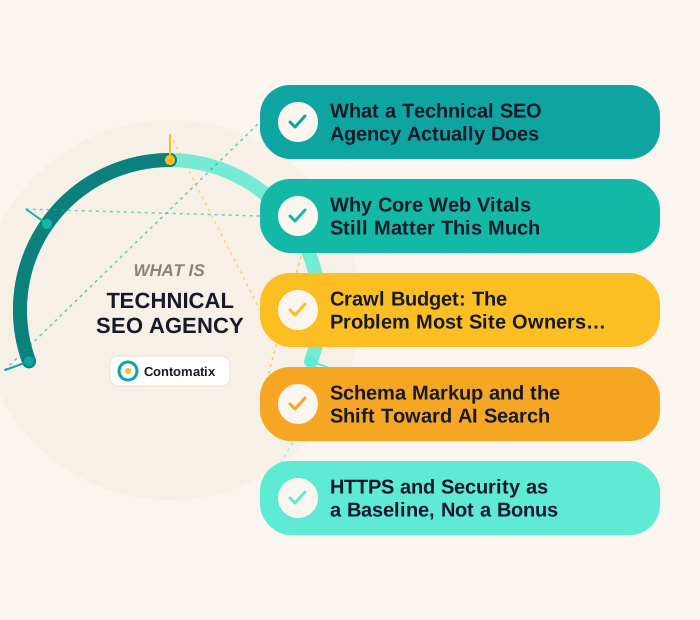
A technical SEO agency focuses on the infrastructure layer of a website — crawlability, indexing, site speed, structured data, and the dozens of underlying signals that determine whether Google can find, understand, and confidently rank a page in the first place. It's a different discipline from content or link building, and it's often the layer that quietly caps a site's performance no matter how much work goes into the rest of the strategy.
The scale of the problem is larger than most site owners realize. Only 33% of all websites currently pass Google's Core Web Vitals threshold, and on mobile specifically, just 42% of origins pass all three metrics — meaning the majority of sites are competing with a real, measurable technical disadvantage before a single piece of content gets written. This guide covers what a technical SEO agency actually does in 2026, the specific problems this work solves, and what to look for when hiring one.

What a Technical SEO Agency Actually Does
Technical SEO covers everything that determines whether a search engine can properly crawl, index, and understand a site — separate from the quality of the content itself or the strength of its backlink profile. That includes site architecture and internal linking structure, crawl budget management, indexing control (robots.txt, canonical tags, noindex directives), Core Web Vitals and page speed, structured data (schema markup), HTTPS and security configuration, and mobile usability.
A useful way to think about the distinction: content and links tell Google a page deserves to rank; technical SEO determines whether Google can actually see that page clearly enough to make that judgment in the first place. A brilliant piece of content sitting behind a crawl error or an accidental noindex tag never gets the chance to compete at all.
This is also why technical SEO work often produces some of the most disproportionate results relative to effort of any SEO discipline. Fixing a single misconfigured canonical tag or removing a stray noindex directive can restore visibility to pages that were already well-written and well-linked, but simply invisible — a fix measured in hours that can unlock rankings that months of additional content or link-building work would never have touched, because the underlying pages were never eligible to rank in the first place.
Why Core Web Vitals Still Matter This Much
Site speed and page experience remain one of the more measurable technical ranking factors available, and the gap between sites that handle it well and sites that don't is wide. Pages in the top quartile for Largest Contentful Paint (under 2.5 seconds) see roughly 24% higher organic click-through rate than pages failing Core Web Vitals thresholds, based on Google Search Console data. Interaction to Next Paint (INP) has also become the most commonly failed Core Web Vitals metric since replacing First Input Delay as the responsiveness measure in March 2024, catching many sites that had already "fixed" their older FID scores off guard. The aggregate pass rates behind these figures are what make the opportunity concrete: when two-thirds of the web is failing a measurable standard, clearing it is a genuine differentiator rather than table stakes.
Mobile performance specifically remains the dominant gap. With the majority of search traffic happening on mobile devices, a site optimized for desktop speed but sluggish on mobile is failing the metric that matters most for the bulk of its actual visitors.
The shift from FID to INP as the responsiveness metric caught a genuinely large number of sites off guard specifically because the two measure different things in practice. FID only measured the delay before a browser began responding to a user's first interaction, while INP measures responsiveness across every interaction throughout the entire page visit — meaning a site with one snappy initial click but sluggish behavior afterward (a common pattern on pages with heavy JavaScript execution, third-party scripts, or complex interactive elements) can pass the old metric comfortably while failing the current one. Sites that treated their FID score as a solved problem and moved on are often the ones now discovering INP failures they didn't know existed.
Crawl Budget: The Problem Most Site Owners Never See
Crawl budget — the finite amount of attention Googlebot allocates to crawling a given site — becomes a genuine constraint once a site grows past a certain size. Sites with 10,000 or more pages lose up to 30% of their crawl coverage to duplicate, low-quality, or blocked URLs, meaning Googlebot spends real crawl budget on pages that were never going to rank instead of the pages that actually matter. Log file analysis across sites generally shows that roughly 29% of Googlebot's crawl activity goes to pages that don't even appear in search results at all — a substantial amount of wasted crawling that a technical audit is specifically designed to identify and redirect.
The practical fix usually involves a combination of consolidating near-duplicate content, adding proper canonical tags where legitimate variations need to exist, and using robots.txt or noindex directives deliberately rather than as an afterthought. None of this is exotic technical work, but it requires actually pulling and analyzing server log files rather than relying solely on Search Console's sampled data — a step many standard SEO engagements skip entirely, since it requires server access and a level of technical depth that content- or link-focused SEO work doesn't typically involve.
Redirect chains compound this problem. Redirect issues affect the overwhelming majority of websites in some form, and each additional hop in a redirect chain both dilutes the PageRank being passed through and adds unnecessary crawl overhead — a small, easily overlooked technical debt that accumulates significantly on larger, older sites.
Redirect chains tend to accumulate for a predictable reason: a URL gets redirected once during a site redesign, then redirected again during a later CMS migration, and again during a domain or URL-structure change, with nobody going back to update the original redirect to point straight to the final destination. Each individual redirect might seem harmless in isolation, but a page reached through three or four hops is meaningfully slower to load and dilutes more authority than the same page reached directly — an accumulation problem that only shows up clearly when someone actually audits the full chain rather than spot-checking a handful of URLs.
Crawl budget issues also compound with site age and content volume in a way that makes them easy to underestimate. A five-year-old site that's published thousands of blog posts, spun up seasonal landing pages that were never removed, or generated faceted-navigation URLs from an ecommerce filter system can easily be carrying tens of thousands of low-value URLs that Googlebot dutifully continues crawling — time and resources that could otherwise go toward discovering and re-crawling the pages that actually drive rankings and traffic.
Indexing Issues: Why a Page Can Be Invisible Even When It's Live
One of the more counterintuitive realities of technical SEO is that a page can be perfectly reachable by a human visitor and still sit entirely outside Google's index because of a conflicting technical signal — an accidental noindex tag left over from a staging environment, a canonical tag pointing to the wrong URL, or a robots.txt rule blocking a resource Google needs to render the page properly. These issues are especially common after a site migration, a CMS change, or a redesign, when technical settings get copied, misconfigured, or simply forgotten in the process.
We've seen the same "invisible until measured" pattern show up in other technical decisions covered on this blog — see our guide on B2B ecommerce ERP integration for how a similarly invisible sync issue can quietly undercut a system that looks fine on the surface. This is also where on-page SEO and technical SEO overlap directly — a technical audit identifies exactly which pages are blocked or miscategorized, and on-page work then ensures the pages that should be indexed are structured to actually earn rankings once they're visible again.
Schema Markup and the Shift Toward AI Search
Structured data has quietly become one of the more underused technical SEO levers available. Only about 17% of the top 10 million websites implement any form of schema markup at all, which means sites that do it correctly hold a real competitive advantage rather than fighting for parity with every competitor. Common errors among sites that do attempt schema include missing required fields, incorrect nesting, or markup that doesn't actually match what's visible on the page — mistakes that can neutralize the benefit or, in worse cases, trigger a manual action.
Schema has also taken on a new dimension in 2026 specifically: it's increasingly how AI-driven search experiences like Google's AI Mode and answer engines such as Perplexity decide what to cite and quote directly. A 2026-appropriate technical audit checks not just whether schema exists, but whether it presents one consistent organization identity and whether the site's structure is genuinely built to be quoted by an AI system, not just crawled by a traditional bot.
This shift matters practically because AI-driven answer engines don't necessarily follow the same ranking logic as traditional blue-link search results. A page can rank reasonably well in classic organic search while still being poorly positioned to get cited directly inside an AI-generated answer, if its structured data doesn't clearly identify who's speaking, what the content actually claims, and how it relates to the broader site's established entity. Consistent Organization and Article schema across a site — the same name, the same logo reference, the same author and publisher relationships — is a low-cost way to reinforce that identity signal across every page an AI system might encounter.
HTTPS and Security as a Baseline, Not a Bonus
HTTPS adoption among top-ranking pages is close to universal at this point — 95.6% of pages in Google's top 10 results use HTTPS, rising to 97.2% for position one specifically. That level of near-total adoption means HTTPS itself isn't really a competitive advantage anymore; it's simply table stakes, and a site still running on unsecured HTTP in 2026 is signaling a technical neglect that likely extends to other areas of the site as well.
Beyond the base HTTPS certificate itself, mixed-content issues — a secure page that still loads some images, scripts, or embeds over an insecure HTTP connection — are a common, easily missed problem that can trigger browser security warnings even on a site that technically "has HTTPS." A full technical audit checks every resource on a page, not just the top-level connection, since a single insecure embedded script can undermine an otherwise properly secured site.
What a Proper Technical SEO Audit Actually Covers
- Crawlability — robots.txt configuration, XML sitemap accuracy, and internal linking structure that gives Googlebot a clear path through the site
- Indexing control — canonical tags, noindex directives, and duplicate content from unmanaged URL parameters
- Core Web Vitals — Largest Contentful Paint, Interaction to Next Paint, and Cumulative Layout Shift, measured on mobile specifically
- Structured data — schema markup accuracy and consistency across the site's key page types
- Security and infrastructure — HTTPS configuration, mixed-content issues, and mobile usability
Good keyword research and content strategy depend on all of this working correctly underneath — there's little value in targeting the right keywords if the pages built around them are structurally invisible to the systems deciding whether they deserve to rank.

Choosing a Technical SEO Agency
Given how specialized this work is, a capable technical SEO partner should be able to walk through specific findings from an actual crawl of your site — not just a generic checklist — and explain in concrete terms how a given fix connects to a measurable outcome (crawl efficiency, Core Web Vitals score, indexing status). A generic, templated audit report that could apply to any site is a reliable warning sign that the work wasn't actually based on your site's specific crawl data. If you're evaluating your site's technical foundation, get in touch and we can walk through what a realistic technical audit and fix plan looks like for your specific site.
It's also worth asking a prospective partner how they prioritize fixes once an audit is complete, since a full technical audit on any established site can easily surface dozens or hundreds of individual issues. A good agency doesn't hand over an exhaustive list and leave the prioritization to you — it identifies which handful of fixes will move the needle fastest (usually the issues affecting the most pages or blocking the highest-value content) and sequences the work accordingly, rather than treating every item on the list as equally urgent.
Ongoing monitoring matters just as much as the initial audit, since technical SEO isn't a one-time project any more than content or link building is. A site redesign, a plugin update, a new third-party script, or a CMS migration can silently reintroduce the exact issues an earlier audit fixed, which is why the strongest technical SEO relationships include some form of recurring monitoring — even a simple monthly Core Web Vitals and crawl-error check — rather than a single audit delivered once and never revisited.
What does a technical SEO agency do?
It focuses on the infrastructure layer of a website — crawlability, indexing, site speed, structured data, and security — that determines whether search engines can properly find, understand, and rank a page, separate from content quality or backlinks.
How is technical SEO different from on-page SEO?
On-page SEO focuses on content, keywords, and page-level optimization for a specific search intent. Technical SEO focuses on the underlying infrastructure — crawlability, indexing, speed, and schema — that determines whether that on-page work can actually be seen and ranked.
What's included in a technical SEO audit?
Crawlability (robots.txt, sitemaps, internal linking), indexing control (canonicals, noindex, duplicate content), Core Web Vitals, structured data accuracy, and security/HTTPS configuration.
Do I need a technical SEO agency if my site looks fine?
Often yes — many technical issues (crawl budget waste, indexing conflicts, failing Core Web Vitals) are invisible to a normal site visit and only surface through a proper crawl and analytics review, even on a site that looks and functions fine to a human visitor.
How much does technical SEO cost?
Costs vary by site size and issue complexity, but they should be weighed against the fact that technical problems can silently cap the return on every other SEO investment — content and link building can't fully pay off on a site with unresolved crawlability or indexing issues.
Is schema markup really worth the effort?
Yes — only about 17% of top websites implement it at all, and it's increasingly how AI search tools decide what to cite, making correctly implemented schema a genuine competitive advantage rather than a minor technical detail.
Related Reading
- Want this done for your own site? See our technical SEO service.
- For a fully verified international example, see our roundup of digital marketing agencies in Sydney.
- For a regional example, see our guide to SEO in Concord, NC.