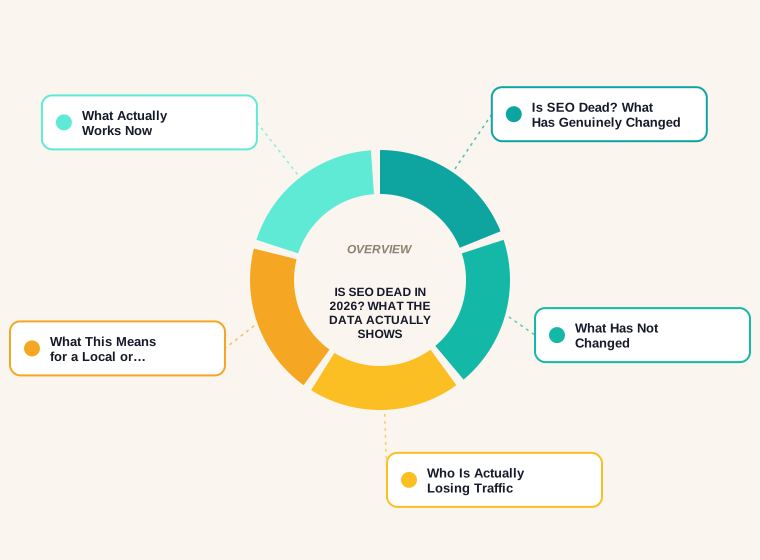
Is SEO dead? Some version of this question gets asked every few years — first mobile, then voice search, then featured snippets, now AI Overviews and chatbots. Each time, the honest answer was the same: no, but the parts of it worth doing keep changing, and the businesses that keep asking the question in binary terms miss what actually shifted.
2026 is a genuinely different moment than the earlier scares, because AI Overviews and AI-mode search results now sit above the traditional ten blue links for a meaningful share of queries. That is a real structural change. It is not evidence that search traffic stopped mattering.

Is SEO Dead? What Has Genuinely Changed
Zero-click searches are real and growing. For simple factual queries — conversions, definitions, quick lookups — AI Overviews increasingly answer the question directly on the results page, and click-through to any website drops accordingly. If your traffic strategy depended on informational queries like "what is X," that traffic is under genuine pressure.
Commercial and local intent behaves differently. Someone searching "seo company near me" or "best plumber in [city]" is not looking for a summarized answer — they are looking to compare options and take an action. AI Overviews handle these queries far more conservatively, because the user's actual need is a decision, not a fact.
Being cited inside an AI Overview is a new, real channel. Google still has to source its summaries from somewhere, and the sites cited inside AI Overviews are still ranking well organically — being the source an AI Overview quotes is functionally a new form of visibility that did not exist five years ago.
What Has Not Changed
People still use Google billions of times a day, and organic search remains one of the largest sources of website traffic on the internet, AI Overviews included. The fundamentals of what makes a page rank — genuinely useful content, technical health, real authority — have not been replaced, they have been raised. Thin, generic content that used to scrape by on volume alone is what is actually dying, not search itself.
Local search in particular has barely been touched by the AI Overview shift. Map pack results, Google Business Profile signals, and local citations still function almost exactly as they did two years ago, because "near me" and location-specific commercial searches are precisely the category AI Overviews handle most conservatively.
Who Is Actually Losing Traffic
Sites built around thin, templated informational content — pages that exist only to answer a simple factual query with minimal added insight — are the ones seeing the sharpest declines, because that is exactly the content type AI Overviews now summarize directly on the results page.
Sites with genuine depth, original research, first-hand expertise, or a strong commercial and local footprint are seeing far less impact, and in some cases are gaining ground as thinner competitors lose visibility. The shakeout is real, but it is a redistribution toward quality, not a collapse of search traffic overall.
What This Means for a Local or Service Business
If your SEO strategy is built around informational blog content competing on generic factual queries, expect real pressure and plan around it. If it is built around local visibility, Google Business Profile optimization, and commercial-intent terms that lead directly to a call or a booking, the AI Overview shift has changed remarkably little so far.
This is precisely why local SEO fundamentals — the kind covered in our city-specific search engine optimization guides — remain some of the most durable SEO work available in 2026: local commercial intent is the category least disrupted by AI-generated summaries.
What Actually Works Now
Content that adds something an AI summary cannot. Original data, direct experience, specific local detail, genuine expertise — the things a language model cannot simply synthesize from existing web content are exactly what continues to earn clicks and citations.
Technical fundamentals, still non-negotiable. Site speed, mobile usability, and clean indexing remain baseline requirements. None of that changed with AI Overviews; it was never optional.
Local and commercial-intent focus over informational volume. A page that helps someone choose a provider or take an action is far more resistant to being summarized away than a page that only answers a simple factual question.
Google's own guidance on creating helpful, reliable content has not fundamentally shifted its priorities — it has simply become a harder bar to clear now that thin content has less room to hide.
Will AI Replace SEO Entirely?
No, and the "will AI replace SEO" framing itself is slightly off — it treats AI answers as a separate channel replacing search, when in practice AI Overviews, ChatGPT, and Perplexity all still have to find content somewhere before they can summarize or cite it. That's still a crawling, indexing, and relevance problem, which is what SEO has always been. What's actually changing is which signals matter most for winning that spot: an Ahrefs analysis of 75,000 brands found branded web mentions correlating with AI Overview visibility roughly three times more strongly than raw backlink counts — a real shift in weighting, not evidence the underlying discipline has been replaced by something else.
The version of this question worth actually answering isn't "will AI replace SEO" but "will AI replace the specific way I'm currently doing SEO." For a site built on thin, templated pages targeting simple factual queries, the honest answer is that AI Overviews are already doing exactly that job better and for free — that traffic isn't coming back. For a site built on genuine expertise, original data, and technical fundamentals, AI systems still need to find and cite something, and that's still winnable work, just measured differently than a decade ago.
Is It Still Worth Investing in SEO?
Yes, with a caveat: investing in the version of SEO built around thin informational content chasing search volume is a weaker bet than it was five years ago. Investing in the version built around genuine local and commercial visibility, real expertise, and technical health is arguably a better bet than ever, because the competitors relying on thin content are the ones losing ground.
The question "is SEO dead" usually gets asked by people whose specific content strategy is under pressure. The honest answer depends entirely on which strategy that is.
The Historical Pattern Behind Every "Is X Dead" Cycle
This is not the first time a search-adjacent shift has triggered a wave of obituaries for SEO. Mobile-first indexing was going to make desktop-optimized sites irrelevant overnight. Voice search was going to collapse traditional keyword targeting into a handful of conversational queries answered by a single assistant. Featured snippets were going to strip away organic clicks entirely for informational content. Each prediction captured something real about a genuine shift in how people searched, and each one turned out to be an overcorrection about what that shift would actually do to the underlying discipline.
The pattern worth noticing is not that the concerns were baseless — mobile experience, conversational query structure, and snippet-optimized content are all genuinely important today, in large part because of those earlier shifts. The pattern is that each shift changed which specific skills mattered most within SEO rather than eliminating the need for search visibility altogether. AI Overviews fit the same shape: a real structural change that rewards a different set of skills, not evidence that the underlying need to be findable in search has gone away.
What Would Actually Have to Be True for SEO to Die
Treating the question literally is useful. For search engine optimization to become genuinely irrelevant, one of a few things would need to happen: search engines would need to lose the overwhelming majority of query volume to some other discovery mechanism, commercial and local buying decisions would need to be resolved entirely inside a chat interface without any need to compare independent sources, or the business model funding search itself would need to disappear. None of these are close to true today. Search engines still process an enormous volume of daily queries, and even AI-native products still need to source and cite information from somewhere, which keeps content quality, structure, and technical crawlability relevant regardless of which interface ultimately displays the answer.
The more honest framing is that SEO is not a single fixed activity that either survives or dies as a unit. It is a bundle of skills — technical crawlability, content quality, authority signals, local relevance — and different pieces of that bundle are rising or falling in importance at different rates. Judging the whole discipline as "alive" or "dead" based on one piece of it losing ground is the same category error each earlier scare made.
How to Judge Whether AI Overviews Are Actually Hurting Your Site
Rather than relying on general anxiety about the topic, a business can check this directly using data it already has access to:
- Segment Search Console data by query type. Compare click trends for informational, "what is" style queries against commercial and local-intent queries over the same period. A decline concentrated in the informational segment points toward AI Overview displacement specifically, rather than a broader ranking problem.
- Check impressions alongside clicks, not clicks alone. Rising impressions with falling clicks on a specific query type is a strong signal that the page is being summarized rather than losing rankings outright.
- Look at whether your content gets cited inside AI Overviews for relevant queries, where visible. Being the cited source is a different outcome than being displaced by one, even though both can show up as reduced click volume in the same report.
- Separate branded and non-branded query performance. A decline concentrated in non-branded informational queries with branded and commercial queries holding steady suggests a narrower, more manageable problem than a sitewide one.
This kind of segmented diagnosis produces a far more useful answer than the binary "is SEO dead" question ever could, because it tells you specifically which part of your content strategy needs to change rather than leaving you to guess.
Frequently Asked Questions
Is SEO dead because of AI Overviews?
No. Organic search still drives enormous traffic overall. AI Overviews have reduced clicks on simple factual queries specifically, while local and commercial-intent search remain far less affected.
What type of content is losing traffic to AI Overviews?
Thin, generic informational content built to answer simple factual questions is losing the most ground, because AI Overviews summarize exactly that type of query directly on the results page.
Does local SEO still work in 2026?
Yes, largely unchanged. Map pack results and "near me" style commercial searches are the category AI Overviews handle most conservatively, since the user's actual need is a decision, not a summary.
Should I stop investing in SEO content?
Not entirely, but the type of content worth investing in has shifted toward original insight, real expertise, and commercial or local relevance rather than generic informational volume.
What is a zero-click search?
A search where the user gets their answer directly on the results page — often via an AI Overview or featured snippet — without clicking through to any website.
Can a website still get traffic from being cited in an AI Overview?
Yes. Being the source an AI Overview cites is a real, relatively new form of visibility, and sites cited this way tend to also rank well organically for the same query.
Has technical SEO become less important?
No. Site speed, mobile usability and clean indexing remain baseline requirements for ranking at all, regardless of how the results page itself has changed.
What should a local business actually prioritize in 2026?
Google Business Profile optimization, local citations, and commercial-intent content that helps someone choose and contact the business — the areas least disrupted by AI-generated summaries.
Related Reading
- If search traffic feels less reliable, diversifying channels helps — see the top email marketing company in Contra Costa.
- If AI Overviews have you rethinking strategy, see how it plays out for a specific market like search engine optimization in Camden, NJ.
Contomatix builds SEO around what is actually still working in 2026 — local visibility, technical health, and content with real depth rather than volume. Want a free audit of where your site stands right now?
Get a free audit →