Search engine optimization Camden NJ businesses need has to hold two contradictory facts at once. The city's population is 71,413 and declining, median household income is $40,546, and the poverty rate is 30.16% — among the highest of any city its size in the country. At the same time, the Camden waterfront is now home to Subaru of America's US headquarters, Holtec International, American Water, and The Michael's Organization, part of a well-documented corporate relocation wave into the city over the past decade.
A generic local SEO template written for "a small New Jersey city" misses both halves of that story, and misses the specific opportunity each one creates.

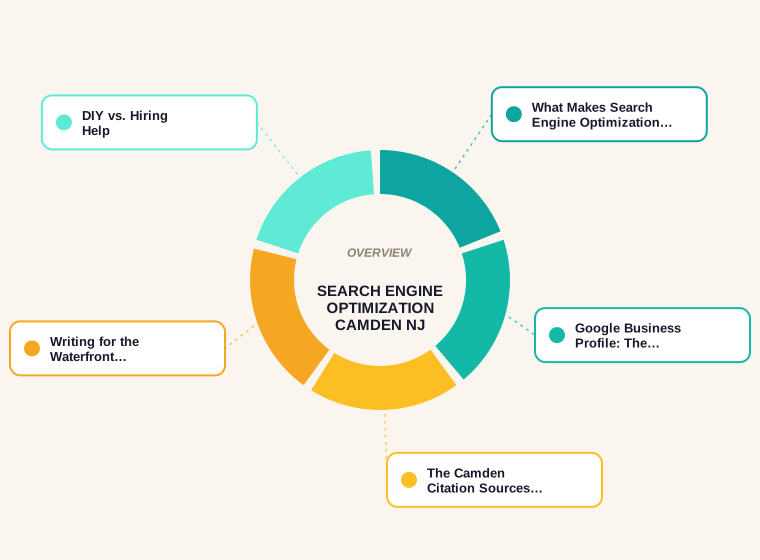
What Makes Search Engine Optimization Camden NJ Different
Two buyer populations with almost no overlap. Residential, household-facing businesses serve a market with real income constraints — pricing transparency and value messaging matter more here than in wealthier South Jersey suburbs. Businesses selling into the waterfront corporate anchors (Subaru, Holtec, American Water, Cooper University Hospital's expansion) are competing for an entirely different, much higher-value B2B and professional-services market.
Camden is a Philadelphia-adjacent market, not an isolated one. Sitting directly across the Delaware River from Philadelphia, a meaningful share of search demand — both from customers and from businesses evaluating Camden as a location — crosses the river. Ignoring that regional context in service-area setup leaves real visibility on the table.
The corporate relocation story is genuinely under-covered in local content. Almost nothing written about "Camden SEO" or "Camden business" acknowledges the waterfront redevelopment specifically. A business that writes real, current content about what's actually happening — the Walter Rand Transportation Center, the Beacon redevelopment, Cooper's expansion — has almost no competition for those searches.
Google Business Profile: The Field-by-Field Setup
For local, household-facing businesses, the map pack drives more calls than the website. The fields are not equally weighted:
- Primary category — outweighs every other field combined. Choose the single most specific category matching your core service.
- Service areas — list Camden alongside Collingswood, Cherry Hill and Pennsauken if genuinely served, and consider whether Philadelphia-side customers are realistically part of your market.
- Services with descriptions — each service gets its own text field, and most local competitors leave this blank.
- Business description — 750 characters. Name the specific neighbourhood or corridor, not just the city.
- Photos — a fresh monthly set correlates with measurable engagement.
- Hours — keep these accurate; an out-of-date listing is one of the most common causes of a frustrated one-star review.
Google's own guidelines for representing your business are the authority on what belongs in each field.
The Camden Citation Sources That Actually Exist
- Camden Community Partnership — Ferry Terminal Building, 2 Aquarium Drive, Suite 310, Camden, NJ 08103, (856) 757-9154. The economic development body most directly connected to the waterfront redevelopment and local business community.
- New Jersey Division of Revenue and Enterprise Services — the legal entity registration every other citation has to match exactly.
- Camden County records — the correct county on every listing.
Five accurate citations from real, checkable local bodies outperform fifty auto-submitted directory entries.
Writing for the Waterfront Corporate Market
If your business sells into Subaru of America, Holtec International, American Water, Cooper University Hospital or their supplier and vendor networks, standard local SEO undersells what you need. Those buyers search on capability, credentials and track record, often as part of a formal procurement process rather than a casual Google search — and content built for that audience looks nothing like a typical local-service page.
DIY vs. Hiring Help
A single-location, household-facing Camden business can genuinely handle the Google Business Profile setup, the Camden Community Partnership relationship, name-address-phone consistency, and a review request built into how jobs close. Given local income levels, that groundwork is worth doing thoroughly before paying for anything more.
Paid help earns its place once you need sustained content or technical work, particularly to reach the waterfront corporate market. Our agency versus freelancer comparison covers what each model realistically delivers.
Common Mistakes in This Market
The recurring ones: writing generic "small city" content that ignores the waterfront redevelopment entirely, positioning on premium pricing in a market where value messaging converts better for residential customers, treating B2B content for the corporate anchors like ordinary local SEO, and ignoring Philadelphia-side search demand given the city's direct riverfront position.
Is It Worth It for a Camden Business?
For household-facing businesses, yes — most local competitors still leave real gaps in their Google Business Profile and citations, and closing them is a genuine, low-cost advantage. For businesses selling into the waterfront corporate anchors, the opportunity is real but requires content built specifically for procurement-driven B2B buyers rather than a repurposed local SEO page.
Building a Local Content Calendar Around the Waterfront Story
Most Camden business content stops at generic service pages, which leaves an obvious gap: nobody is writing regularly about what's actually changing in the city. A simple recurring content approach fills that gap without requiring a large marketing budget:
- One update per quarter on waterfront redevelopment progress — the Beacon project, Cooper's campus expansion, transit changes around the Walter Rand Transportation Center — written from the angle of what it means for a specific type of local business, not as generic news reporting.
- A page addressing the corporate-relocation angle directly for any business that could plausibly serve Subaru, Holtec, American Water or their vendor networks, even briefly, since almost no competitor content currently acknowledges this audience exists.
- Neighborhood-specific pages rather than one citywide page — a business serving both the waterfront district and residential neighborhoods further from the river should treat them as genuinely different audiences with different content, not one generic city page trying to speak to both.
Content built around a real, current, locally specific story consistently earns more organic visibility than a templated "why choose us in Camden" page, simply because there's so little existing competition for it.
Reading Reviews for What They Actually Reveal
In a market with real income constraints, review content tends to focus heavily on value and fairness rather than luxury or exclusivity — and that's useful information beyond just reputation management. Read through a competitor's reviews (or your own) looking specifically for recurring language about pricing transparency, payment flexibility, or turnaround time. Those recurring phrases are often the exact terms prospective customers are searching for, and they rarely show up in a standard keyword research tool built around national search volume.
A response to a review is also a content opportunity most businesses skip. A thoughtful, specific reply — naming the service performed, not just a generic thank-you — gives Google additional relevant text tied to the business profile, and gives a prospective customer reading through reviews a clearer sense of what working with the business is actually like.
Setting Realistic Expectations for a Two-Sided Market
A Camden business serving both audiences — household customers and waterfront corporate buyers — should expect very different timelines and effort levels from each. Local, household-facing visibility can improve within weeks through Google Business Profile optimization alone, since so many local competitors leave basic fields incomplete. Earning visibility with corporate procurement buyers is a longer, relationship-driven process that content and SEO can support but rarely drive on their own — credentials, referrals, and direct outreach typically matter more than organic search for that specific audience.
The Technical Basics Worth Getting Right First
Before content or citations, a handful of technical fundamentals determine whether any of that work can even register. These are worth checking early rather than assuming they're already handled:
- Mobile page speed — a majority of local searches happen on a phone, and a slow-loading service page loses a share of visitors before they ever see the content built for them.
- A single, consistent business name-address-phone format used identically across the website, Google Business Profile, and every citation — inconsistent formatting (a suite number present in one listing and missing in another) is a common, easily overlooked source of confusion for both customers and search engines.
- Schema markup for local business type, service area, and — where applicable — the specific services offered, giving search engines explicit structured information rather than requiring them to infer it from page copy alone.
- A dedicated page per major service rather than one page listing everything briefly — each service page can then target its own specific search terms and be linked from the relevant neighborhood or corridor content.
None of this is glamorous work, but skipping it undermines everything built on top of it — content and citations only compound if the technical foundation can actually support them.
Comparing Camden to Nearby South Jersey Markets
A business considering whether to expand service areas beyond Camden should think about neighboring markets on their own terms rather than assuming a single regional strategy fits all of them. Cherry Hill and Collingswood carry different income profiles and buyer expectations than Camden proper, and content or pricing messaging that works well for one can undersell or overshoot in another. Treating each area's Google Business Profile service-area listing as a deliberate decision — not just a wide radius drawn on a map — keeps messaging aligned with what each specific audience actually responds to.
Tracking Whether Local SEO Work Is Actually Paying Off
A Camden business investing in any of the above should track a small, specific set of numbers rather than watching overall website traffic alone. Calls and direction requests logged directly from the Google Business Profile insights panel are usually the clearest early signal, since they reflect map-pack visibility more directly than organic sessions do. Ranking position for the primary service category term, checked from a Camden-based location rather than wherever the business owner happens to be searching from, is the second number worth a monthly glance. For a business also pursuing the waterfront corporate market, the more relevant measure is simpler and slower: whether inbound inquiries from that segment are increasing at all quarter over quarter, since that audience rarely converts through the same channels or on the same timeline as local household searches.
Frequently Asked Questions
Why does Camden have both declining population and major corporate investment?
The city's broader residential population and income figures reflect long-standing economic challenges, while the waterfront has separately attracted major corporate relocations including Subaru of America's US headquarters, Holtec International and American Water over the past decade. Both trends are real and largely separate from each other.
Should I target Camden alone or include Philadelphia-side demand?
Consider it directly. Camden sits across the Delaware River from Philadelphia, and a meaningful share of relevant search demand can cross the river depending on your business type.
How much does SEO cost in Camden, NJ?
Local packages for a single-location household-facing business typically run a few hundred dollars a month. Given local income levels, be sceptical of pricing imported from wealthier South Jersey suburbs.
Is local SEO relevant for a business supplying Subaru or Holtec?
Only partly. Those buyers typically evaluate suppliers through formal procurement processes based on capability and credentials, which needs different content than standard local SEO.
What's the most relevant local citation source in Camden?
Camden Community Partnership, based at the Ferry Terminal Building on the waterfront, is the economic development body most directly connected to the city's current redevelopment and local business community.
How long does SEO take to show results in Camden?
Google Business Profile improvements can show within weeks. Broader organic rankings typically take three to six months.
Should pricing be prominent on service pages here?
For residential, household-facing services, generally yes — clear, upfront pricing converts better than premium positioning given local income levels. B2B content for corporate buyers works differently.
What content opportunity is most under-used in Camden right now?
Genuinely current content about the waterfront redevelopment — the Beacon project, Cooper's expansion, the Walter Rand Transportation Center — which almost no local business content currently covers, despite real, ongoing search interest.
Contomatix works with businesses navigating markets with real economic contrasts — Google Business Profile setup, citations, and content built for the actual audience you're trying to reach. Want a free audit of where your Camden business stands right now?
Get a free audit →