Search engine optimization Eugene businesses need is shaped by a number most local marketing advice ignores: this city is growing at 0.03% a year. Effectively, it is not growing at all.
That changes the whole exercise. In a boom market a share of demand is genuinely unclaimed each year, and you can grow by catching new arrivals. Here, with 178,675 residents and a flat population, almost every customer you gain is one a competitor lost. It is a zero-sum market, and the tactics that suit it are different.

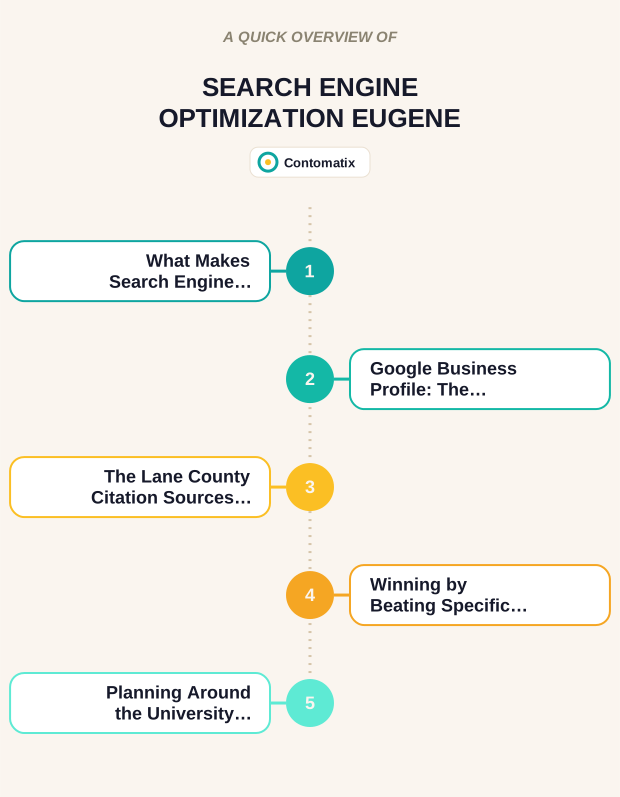
What Makes Search Engine Optimization Eugene Different
Displacement, not capture. Growth has to come from outranking someone. That makes the competitive audit — who currently ranks, and what specifically they are doing better — far more valuable than generic best-practice work.
The university sets the rhythm. The University of Oregon employs over 10,000 people and is the largest employer in the city. Its calendar drives seasonal swings in housing, food, retail, storage and services that a flat annual content plan will miss entirely.
Price sensitivity is real. Median household income is $66,562 with a 19.04% poverty rate — a very different profile from the affluent suburban markets most SEO advice is written for. Pages that lead with premium positioning and hide pricing convert badly here.
Portland is not the threat people assume. It is roughly 110 miles north — far enough that Portland firms do not dominate local terms the way a neighbouring metro usually would. The real competition is other Eugene and Springfield businesses, which makes local differentiation more important than regional defensiveness.
Google Business Profile: The Field-by-Field Setup
In a zero-sum market the map pack is where displacement actually happens. These fields are not equally weighted:
- Primary category — carries more ranking weight than everything else combined. Check what the businesses currently outranking you have chosen; it is public, and it is often the whole explanation.
- Service areas — list Springfield, Junction City, Creswell, Cottage Grove and Veneta if you serve them. Lane County is the real market, not the city line.
- Services with descriptions — each service has its own text field. Most competitors leave them empty, which makes filling them in a cheap advantage.
- Business description — 750 characters. Name neighborhoods: Whiteaker, South Eugene, Bethel, Churchill, River Road.
- Photos — fresh photos monthly correlate with engagement, and engagement is measurable.
- Hours and special hours — set them around university breaks and holidays, when trading patterns shift noticeably.
Google's guidelines for representing your business define what is permitted in each field.
The Lane County Citation Sources That Actually Exist
- Eugene Area Chamber of Commerce — the most relevant general local citation available.
- Travel Lane County — the destination marketing body, which matters for hospitality, food and anything visitor-facing.
- Oregon Secretary of State business registry — the legal entity name every other citation must match exactly.
- Lane County records — the correct county on every listing.
- Trade associations — for wood products and manufacturing suppliers, industry bodies outweigh general directories. The region remains a significant softwood lumber and plywood producer.
Five accurate citations beat fifty auto-submitted ones. In a displacement market, consistency is what separates you from the competitor who never checked theirs.
Winning by Beating Specific Competitors
This is the part that differs most from a growth market. Instead of broad content programs, work competitor by competitor:
- List the businesses ranking in the top three for your main terms.
- Open their profiles: primary category, review count, review recency, photo count, services filled in.
- Open their top-ranking page and count what it actually answers that yours does not.
- Fix the specific gaps rather than adding generic pages.
Most local businesses never do this, which is exactly why the exercise works.
Planning Around the University Calendar
Demand does not move smoothly through the year. Housing, moving, storage, furniture, food and personal services all spike around the September intake and drop in June.
Content aimed at the autumn intake needs to be published in July, not September. By the time the searches are happening, ranking positions are already settled. This is the single most common timing error in a university town.
Measuring Whether It's Working
- Profile calls and direction requests — the nearest thing to a revenue signal in local search.
- Average position on your named target terms — in a displacement market this matters more than impressions, because you are tracking whether you passed a specific competitor.
- Review velocity versus theirs — relative, not absolute. You need to be credible against whoever ranks above you.
DIY vs. Hiring Help
A single-location business here can genuinely run the profile, the Chamber listing, name-address-phone consistency, and a review process. In a price-sensitive market that matters — the cheapest effective option is often the right one.
Paid help earns its place once you need sustained content or technical work. If you are shortlisting, our hand-verified list of Eugene SEO companies checked every website by hand, and our agency versus freelancer comparison sets out what each model realistically delivers.
We have run the same hand-verification process across other Pacific Northwest and Mountain West markets, including Bend, Spokane Valley, and Coeur d'Alene, if you are comparing options across the wider region.
Common Mistakes in This Market
The recurring ones: running a flat content calendar in a seasonal city, ignoring Springfield and the rest of Lane County, leaving services blank on the profile, positioning on premium in a price-sensitive market, and worrying about Portland competitors who are not actually competing for these terms.
The most costly is doing generic best-practice work without ever looking at who is ranking above you. In a flat market that is the only question that matters.
Is It Worth It for a Eugene Business?
Yes — arguably more than in a growth market, because the work compounds. In a city where the customer pool is fixed, a competitor who takes the top of the map pack keeps it, and the businesses that get there first tend to stay.
The flip side is that doing nothing is not neutral. Someone else improving means you decline, even if nothing on your side changed.
A Do-It-Yourself Audit Checklist for a Displacement Market
Before spending on outside help, a business owner can genuinely work through this list in an afternoon and learn more than most generic SEO advice would offer:
- Search your own main term and open the top three results. Note their Google Business Profile category, review count and recency, and whether their services are filled in.
- Compare your own profile against those three, field by field. The gap is usually visible immediately, and closing it is the cheapest available improvement.
- Check whether your service area includes Springfield and the rest of Lane County if you genuinely serve those areas — an incomplete service area list quietly removes you from a meaningful share of nearby searches.
- Read your own top page as if you were the searcher. Does it answer the question completely, or does it assume the reader already knows what you offer?
- Check your review request process. If reviews only arrive when a customer is unusually happy or unhappy, you are leaving a steady, ongoing signal on the table.
What to Ask Before Hiring Help in a Price-Sensitive Market
Given the income profile here, the ROI bar for any paid help is higher than in a wealthier market. A few direct questions worth asking any prospective provider:
- Can you show me the competitive gap you'd close first, specifically? A provider who has actually looked at your market should be able to name it immediately, not describe a generic process.
- What would you flag as not worth doing yet? A provider willing to say a service is not worth paying for right now is more trustworthy than one who pitches the full package regardless of budget.
- How do you account for the university calendar in your content timing? If they have not thought about it, they have not actually studied this market.
Technical SEO Foundations Worth Confirming
A few technical basics matter regardless of budget: confirm the site loads quickly on mobile, since a meaningful share of local searches happen on phones; confirm LocalBusiness structured data is present and accurate, including service area and hours; and confirm there is no duplicate content between service pages, which is a common issue when pages are built from the same template with only the service name changed. None of this requires a large budget, but all of it is easy to get quietly wrong.
Content Formats That Actually Win a Displacement Search
In a market where growth means taking share from a specific competitor, the content that moves the needle tends to be more direct than generic blog advice suggests. Comparison-style pages that honestly answer "how do I choose between X and Y kind of provider" outperform vague educational posts, because the searcher is already past the awareness stage and is actively comparing options. Detailed pricing and process pages — what genuinely happens at each step, what it costs, and why — perform well here specifically because price sensitivity is high and a business that answers the cost question directly earns trust that a vaguer competitor does not.
Locally-specific proof also matters more here than in a growth market: a photo from an actual Eugene or Springfield job, a review naming a specific neighborhood, or a service page that mentions a real local landmark signals genuine local presence in a way that generic stock content cannot fake.
A Note on AI-Generated Search Answers in This Market
Local, transactional searches — the kind that dominate a displacement market like this one — remain among the search categories least affected by AI-generated summary answers, since a searcher choosing a specific local provider is looking for a decision, not a synthesized fact. That means the fundamentals covered above are not at meaningful risk of being replaced by an AI answer any time soon; if anything, the competitive-analysis approach described earlier becomes more valuable as informational content elsewhere on the web gets summarized away and local decision-stage content becomes relatively more visible by comparison.
Frequently Asked Questions
Does a flat population make SEO less worthwhile?
No, but it changes the approach. With growth at 0.03% a year, new customers come from competitors rather than new arrivals, so competitive analysis matters far more than broad content programs.
How much does SEO cost in Eugene?
Local packages for a single-location business typically run a few hundred dollars a month; competitive or multi-location work runs into the low thousands. Given local income levels, be skeptical of pricing imported from larger metros.
Should I worry about Portland agencies and businesses?
Less than you might expect. Portland is around 110 miles away and does not dominate local terms here. Your real competition is other Eugene and Springfield businesses.
How does the university calendar affect timing?
Substantially. Demand spikes around the September intake and falls in June. Content targeting the intake needs to be live by July — publishing in September is too late to rank in time.
Should I list Springfield as a service area?
If you serve it, yes. Lane County is the practical market. Businesses listing only Eugene are invisible for a meaningful share of nearby searches.
How do I find out why a competitor outranks me?
Open their Google Business Profile and compare primary category, review count and recency, photo count and whether services are filled in. Then compare their ranking page against yours for what it actually answers.
How long does SEO take to work here?
Profile fixes can show within weeks. Organic rankings generally take three to six months, and displacing an established competitor can take longer than entering an uncontested market.
What should I fix first?
Compare your Google Business Profile against the top three businesses ranking for your main term. The gap is usually visible in minutes, and closing it is the cheapest available gain.
Contomatix works with businesses in flat or contested markets, where growth means outranking someone specific — competitive audits, map pack work, and content timed to the local calendar. Want a free audit of where your Eugene business stands right now?
Get a free audit →