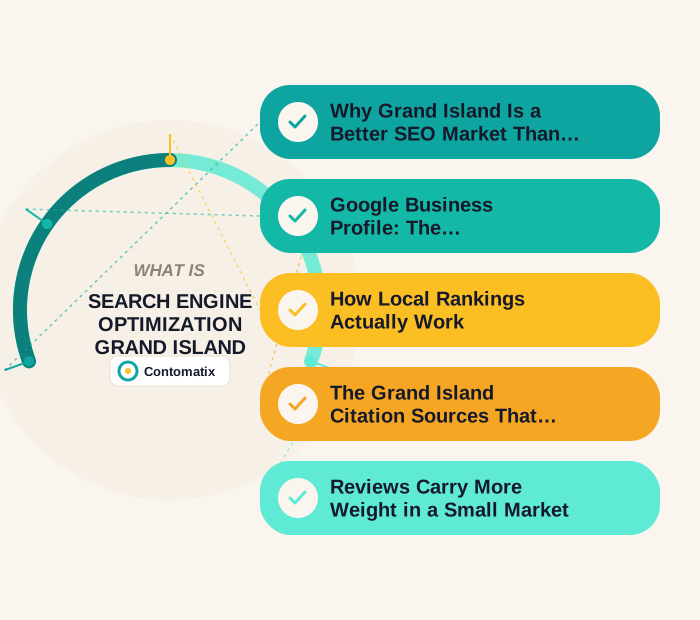
Search engine optimization Grand Island businesses need looks different from what an agency in Omaha or Denver would sell them. With a 2026 population of roughly 54,200 and steady growth of about 0.5% a year, Grand Island recently crossed the 50,000 threshold that upgraded it to metropolitan statistical area status — joining Omaha and Lincoln as one of Nebraska's three MSAs.
That matters for local search in a specific way: the city is now big enough that most service categories have real competition, but still small enough that a business doing the fundamentals properly can own the map pack rather than fight for scraps.

Why Grand Island Is a Better SEO Market Than It Looks
As the county seat of Hall County and the anchor of Nebraska's Tri-Cities alongside Kearney and Hastings, Grand Island draws customers from a catchment far larger than its own population. People from surrounding towns treat it as their commercial center for healthcare, retail, trades and professional services.
The local economy has also proven unusually durable — Hall County added roughly 4,400 jobs between 2003 and 2013, with employment expanding 3.6% during the recession years when most comparable markets contracted. A stable business base means competitors who stay in business, which raises the value of a ranking position you actually hold.
Google Business Profile: The Field-by-Field Setup
For most Grand Island businesses the map pack drives more calls than the website does. "Fill it out completely" is the advice everyone gives, which is useless without knowing which fields actually carry weight. They are not equal — here is the order that matters.
Primary category (the heaviest single field). Google matches this almost literally against the query. A business categorised as "Contractor" will not surface for "plumber" the way one categorised as "Plumber" does. Choose the narrowest category that describes your main revenue line, then add secondaries for everything else you genuinely do — secondaries help, but noticeably less than the primary.
Service areas — where Grand Island businesses lose the most ground. This city anchors Nebraska's Tri-Cities alongside Kearney and Hastings, and draws customers from across Hall County and the smaller towns around it — Doniphan, Wood River, Alda, Cairo, Aurora. If your profile lists only "Grand Island", you are ineligible for searches in places you already drive to. List every town you genuinely serve. Do not pad it with the whole of central Nebraska, though: an over-stretched service area dilutes local relevance rather than expanding reach.
Services and products. Separate fields, and badly underused. Each entry takes a name and description, giving Google explicit text to match against long-tail searches your website may never cover. An HVAC company listing "furnace repair", "AC installation" and "duct cleaning" as distinct services is matching three query patterns instead of one.
Business description. 750 characters. Weak as a ranking factor, real as a conversion factor — and increasingly it is the text pulled into AI-generated answers. Say plainly what you do, where, and what is specific about the offer.
Photos. Real premises, real team, real completed work. Geotagging images is a myth, but recency and volume correlate with engagement, and engagement does feed rankings. Stock photography is the clearest signal of a profile nobody maintains.
Hours, including special hours. Google filters by "open now", so accuracy has a direct traffic effect. Holiday hours left blank trigger an "hours may differ" warning that visibly cuts click-through — a real issue around the Nebraska State Fair and harvest season when many local businesses change schedules.
Read Google's representation guidelines before restructuring anything, particularly if you have several practitioners or locations. That is the most common route to a suspension, and a suspended profile removes you from the map pack overnight.
How Local Rankings Actually Work
Google ranks local results on relevance, distance and prominence. Relevance is whether your profile and site actually match what was searched. Distance is proximity to the searcher or the area they named. Prominence is the reputation signal — reviews, links and consistency of your business information across the web.
A Grand Island HVAC contractor and a Grand Island dental practice compete for completely different searches, but both are judged against those same three factors.
Search Engine Optimization Grand Island Businesses Should Prioritize First
In a market this size, the order of work matters more than the volume of it. Get the Google Business Profile complete and accurate, fix name-address-phone inconsistencies across directories and the Chamber listing, and build a systematic review request into how jobs or appointments close.
Only after that does content and link building earn its keep. Agencies that lead with a large content program in a 54,000-person market are usually selling their standard package rather than what the market actually needs.
The Grand Island Citation Sources That Actually Exist
Generic advice says "build local citations" without naming a single one. For a Grand Island business these are the specific sources worth the time, roughly in order of value:
- Grand Island Area Chamber of Commerce — 309 W 2nd St, Grand Island NE 68801. Membership puts you in their searchable directory at business.grandisland.org/directory, which is one of the few genuinely Grand Island-specific citation sources carrying real local weight
- Grand Island Area Economic Development Corporation — operates alongside the Chamber and lists local businesses and business support organizations
- Nebraska Chamber of Commerce — the state-level member directory at nechamber.com, useful if you serve beyond Hall County
- Nebraska 211 (ne211.org) — a services directory that matters specifically for healthcare, social services and anything community-facing
- Hall County and city-level listings — plus any trade association directory relevant to your sector, which in this market frequently means agriculture, food processing or construction bodies
The reason consistency matters more than volume: Google cross-references your name, address and phone number across these sources to decide how confident it is that your business is real and where it says it is. "Smith Plumbing LLC" in one directory, "Smith Plumbing" in another and "Smith Plumbing Co." on your Chamber listing is three weak signals instead of one strong one. Pick the exact legal name, use it identically everywhere including suite numbers and abbreviations, and fix the old listings rather than only adding new ones.
Reviews Carry More Weight in a Small Market
In a city this size, word of mouth and online reviews overlap heavily — customers frequently know someone who has used you. Reviews that mention specific staff, specific jobs and specific outcomes do more for both rankings and conversion than a high count of generic five-star ratings.
Ask at the point the work finishes, by text or email. Requests sent days later consistently produce fewer reviews.
Content That Matches How People Here Actually Search
Generic service pages underperform pages written around genuine local specifics — nearby towns like Kearney, Hastings, Doniphan or Wood River, seasonal realities of central Nebraska weather, or the agricultural and food-processing economy that shapes demand for a lot of local services.
A contractor writing about ice damage timed to actual central Nebraska winters will outperform a copy-pasted national article every time.
What's Changed in 2026
AI-generated answers now sit above the map pack for a growing share of local searches. When someone asks "best [service] in Grand Island", the businesses named in that synthesised answer tend to be the ones with the clearest, most specific information published — not necessarily the ones with the most reviews.
The practical implication is unglamorous: complete, unambiguous service and location information matters more than it did two years ago. We've covered the wider shift in our answer engine optimization guide.
Measuring Whether It's Working
Track Google Business Profile calls, direction requests and website clicks, plus organic traffic and positions for the terms that actually drive revenue — and most importantly, how many of those leads become paying customers. Ranking first for a phrase nobody searches, or that never converts, is not success.
Set a baseline before any work begins and review monthly rather than reacting to daily ranking noise. Three to six months is the shortest window that separates real progress from normal fluctuation.
DIY vs. Hiring Help
A single-location Grand Island business with some administrative time can genuinely handle the Google Business Profile, citation cleanup and review requests in-house — and in this market, that alone gets you a long way. Technical SEO, content at scale and link building are where outside help usually pays for itself.
The broader trade-off is covered in our SEO agency vs. freelancer guide. Whoever you talk to, ask what proportion of the work is local versus broad organic — in a market this size the answer should lean heavily local.
Common Mistakes in This Market
The recurring ones: an abandoned Google Business Profile set up years ago and never updated, service areas that omit the Tri-Cities towns the business actually drives to, national-scale retainers sold into a market where local fundamentals would deliver more for less, and treating SEO as a finished project rather than ongoing maintenance.
Is It Worth It for a Grand Island Business?
For almost any business here depending on local customers — trades, healthcare, retail, professional services — yes, and the maths is more favourable than in a large metro. Lower competition means fundamentals move rankings faster, and a position you win is cheaper to hold. The businesses winning local searches in Grand Island today are simply the ones that did the basics properly and kept doing them.
How much does search engine optimization cost in Grand Island?
Broadly in line with US averages — agencies around $99 an hour and roughly $3,200 monthly, freelancers around $72 an hour and $1,350 monthly. Grand Island's lower competition means smaller budgets typically go further here than the same spend would in Omaha or Lincoln.
How long does SEO take to work in Grand Island?
Google Business Profile fixes can show movement within weeks. Broader organic rankings typically take three to six months, and lower local competition often means faster results than the same work in a major metro.
What should a Grand Island business do first?
Complete the Google Business Profile properly, fix name-address-phone inconsistencies across directories and the Chamber listing, then build a systematic review request into how jobs close. Content and links come after those are solid.
Should I target Kearney and Hastings too?
If you serve them, yes. Grand Island anchors Nebraska's Tri-Cities and draws customers from a much wider catchment than its own population, so listing every town you genuinely cover as a service area matters.
Does Grand Island's new metro status change anything for SEO?
Indirectly. Crossing 50,000 residents made it a metropolitan statistical area, which tends to attract more competitors over time. The fundamentals still win today, but the window where they win easily will narrow.
Do I need to worry about AI search results?
Increasingly. Searches like "best [service] in Grand Island" often return a synthesised AI answer above the map pack, and the businesses named tend to have the clearest, most specific published information rather than the most reviews.
Can I do this myself or should I hire someone?
Google Business Profile upkeep, citation cleanup and review collection are genuinely doable in-house, and in a market this size that alone gets you a long way. Technical audits, content at scale and link building are where outside help usually pays for itself.
How do I know if my SEO is actually working?
Track Google Business Profile calls, direction requests and website clicks, then follow them through to paying customers. Set a baseline before work starts and review monthly — daily ranking movement rarely means anything.
Related Reading
- For another Midwest market with its own local playbook, see our guide to search engine optimization in Racine.
Contomatix helps smaller markets like Grand Island turn local search visibility into actual calls and appointments — Google Business Profile work, citation cleanup, and content built around how people here actually search. Want a free audit of where your business stands right now?
Get a free audit →