Last updated: September 2026
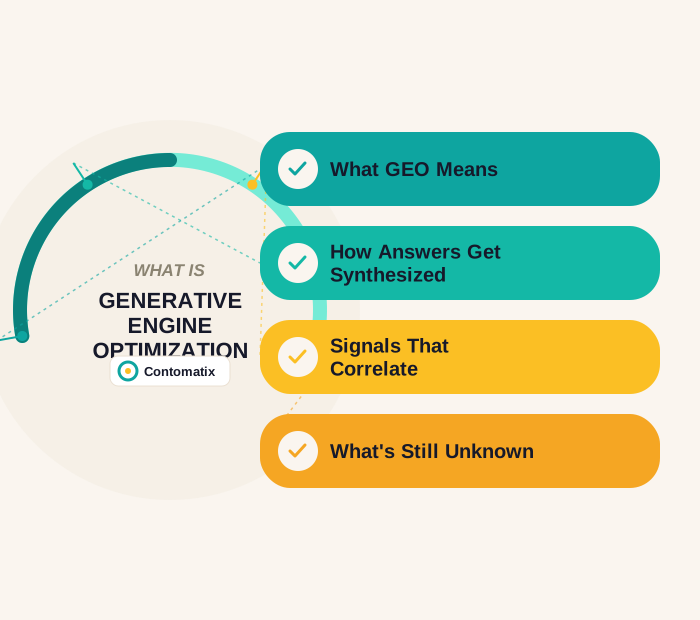
Generative engine optimization (GEO) is the practice of shaping content so it gets pulled into, and cited within, an AI-generated answer — the paragraph ChatGPT writes in response to a question, the summary Perplexity assembles from several sources, the synthesized block Google's AI Overviews shows above the regular results. It's a different target from classic SEO, which optimizes a page to rank, and it's a different target from answer engine optimization (AEO), which optimizes a passage to be lifted whole into a featured snippet or voice answer. GEO is about being one of the sources a model draws on and, ideally, names, when it writes something new in its own words.
It's also one of the least settled parts of SEO right now. The mechanics of classic ranking have been reverse-engineered and documented for two decades. GEO has existed as a named discipline for barely more than a year, the systems it targets change their retrieval and synthesis behavior without announcement, and nobody outside the model providers has full visibility into why one source gets woven into an answer and a near-identical one doesn't. This guide covers what's genuinely understood about GEO, what's reasonable inference, and what's still just industry speculation dressed up as a ranking factor.
GEO vs. AEO vs. Classic SEO: What's Actually Different
These three get used almost interchangeably in marketing copy, which causes real confusion, so it's worth being precise about the unit each one optimizes.
Classic SEO optimizes the page to rank in a list of results. Answer engine optimization optimizes the passage to be selected and shown directly — a featured snippet, a voice answer, an AI Overview's extracted quote. Generative engine optimization optimizes the claim to survive being paraphrased, synthesized, and possibly attributed inside a fully generated response, where there's no fixed snippet slot at all — just a paragraph the model chose to write, built from pieces of several sources it decided were reliable enough to draw on.
The practical difference shows up clearest in ChatGPT and Perplexity. Ask either one a question that needs current or specific information, and in most cases it runs a live retrieval step, pulls back a handful of candidate pages, and then an underlying language model writes an original answer informed by (not copied from) what it retrieved. Whether your page gets used in that synthesis, and whether the model decides to name you as it writes, is the thing GEO is trying to influence. That's mechanically different from winning a snippet position, even though the same underlying qualities — clarity, structure, credibility — tend to help with both.
For the AEO side of this specifically, our answer engine optimization guide goes deep on structuring content to be extracted verbatim. This guide focuses on the generative, synthesized-answer side instead.
How Content Actually Gets Into a Generated Answer
The mechanics, as publicly described by the major providers, generally break into two stages. First, a retrieval step: for queries that benefit from current or specific information, the system runs something functionally similar to a search, gathering a set of candidate pages or passages. Second, a generation step: a language model reads that retrieved material and writes an original answer, deciding which points to include, how to phrase them, and which sources (if any) to name or link.
This is why GEO isn't really "content optimization" in the classic sense of stuffing a page with a keyword. Your page isn't being shown to a user — it's being read by a model that's deciding what's worth repeating. That shifts the job from "rank this page" to "make this specific claim easy to lift, trust, and correctly attribute."
A few things follow from that. A page can be well-optimized for retrieval (indexed, relevant, matches the query) and still contribute nothing to the final answer if the model judges the actual content too vague, too hedged, or too similar to five other sources to be worth citing individually. And a page can influence an answer without ever being named — several providers now show generated answers with partial or no inline citation, which means GEO's payoff is sometimes an uncredited influence on what gets said rather than a visible mention.
What Genuinely Seems to Correlate With Being Cited
Treat everything in this section as "correlated, based on how these systems are known to work" rather than "guaranteed." Nobody outside the model providers can confirm a precise weighting.
Structure and extractability. This is the strongest, best-understood overlap with AEO. A claim stated plainly, in a self-contained sentence, near a heading that matches the actual question, is easier for a retrieval-and-synthesis pipeline to lift cleanly than the same claim buried in a paragraph of throat-clearing. This isn't GEO-specific wisdom — it's the same answer-first structure that helps with featured snippets, applied to a system that's summarizing rather than quoting.
Clarity and specificity. Vague, hedgy writing gives a model nothing concrete to repeat. A specific, well-formed claim is something a language model can restate with confidence; a paragraph full of "it depends" and "many factors" gets skipped in favor of a source that actually commits to something.
Being well-corroborated. A claim that shows up consistently across multiple independent, credible sources appears more "confirmed" to a system trying to avoid repeating something wrong than a claim that exists on exactly one page. This cuts against the old SEO instinct to chase originality at all costs — for GEO specifically, being one of several sources saying the same accurate thing can matter more than being the only one saying it.
Genuine expertise and sourcing. Content that cites its own primary sources, is attributed to a named author, and demonstrates real familiarity with the topic reads as more trustworthy to both human readers and, apparently, to the systems doing the synthesizing — this is the same E-E-A-T logic Google has applied to classic ranking for years, and there's no real evidence it stops mattering just because a language model is doing the reading instead of a human.
One of the more interesting attempts to study this rigorously is an academic paper that coined the term "generative engine optimization" and ran controlled experiments testing which content changes affected how often a page's content got used in generated answers — things like adding statistics, adding direct quotations from credible sources, and citing sources explicitly. It found that some of these interventions measurably changed visibility in generated answers, and that the effect varied a good deal depending on the topic and query type, which is itself a useful finding: there doesn't appear to be one universal trick that reliably raises citation odds everywhere. (Source, near the end of this guide, since it's an external link.)
What's Still Genuinely Unknown
Anyone selling total certainty here is overselling. Being honest about the gaps is more useful than pretending GEO is a solved discipline:
No provider publishes its retrieval or citation-selection criteria in detail. Everything above is inference from public documentation, controlled academic experiments, and observed behavior — not a disclosed ranking algorithm the way classic SEO eventually had years of leaked patents and public statements to work from.
Citation behavior isn't stable. The same query can return a differently sourced answer across sessions, model versions, or providers, which makes before/after case studies genuinely hard to trust unless they control for that variance carefully — and most published "we did X and citations went up" claims in the industry don't show that kind of controlled methodology.
The relationship between GEO and revenue is still thin. Getting cited by a chat assistant is a visibility outcome, not necessarily a traffic or conversion outcome, since many generative answers don't send a click at all. What that's actually worth to a given business is an open, business-specific question rather than something with an established industry benchmark.
Whether current techniques keep working is unclear. These systems are retrained and re-tuned on a rolling basis. A structural change that measurably helped citation odds six months ago isn't guaranteed to still help after the underlying model changes, which is a real difference from classic technical SEO, where the same fix (fixing a canonical tag, say) tends to keep working for years.
What This Actually Means for a Content Plan
Given the uncertainty above, the sensible approach isn't to chase GEO as a separate workstream with its own tactics list. It's to treat it as an extension of work that already has a stronger evidence base: get the technical and indexation fundamentals right, structure content so it's genuinely extractable (the AEO layer), and be a well-corroborated, clearly-sourced, genuinely expert source on the topics that matter to the business. Our AI SEO strategy guide lays out that full sequencing — crawlability first, extractable structure second, citation-worthy presence third — and GEO sits inside that third layer rather than being a separate campaign.
Concretely, that means auditing a page and asking: does it state its key claims plainly and specifically, near a heading that matches a real question? Does it cite real sources rather than hedging? Would an independent reader trust the author's expertise on this specific topic? Those are the levers with a real evidence base behind them. Chasing "GEO hacks" beyond that is mostly guesswork dressed up as a strategy.
Source for the controlled-experiment findings referenced above: Aggarwal et al., "GEO: Generative Engine Optimization" (arXiv, 2023 preprint, later published at ACM SIGKDD 2024).
Frequently Asked Questions
What is generative engine optimization (GEO)?
GEO is the practice of shaping content so it gets used in, and ideally cited within, AI-generated answers from systems like ChatGPT, Gemini, Perplexity, and Google AI Overviews — as opposed to ranking a page (classic SEO) or being extracted verbatim into a snippet (AEO).
What does GEO stand for?
Generative engine optimization. The term was coined in a 2023/2024 academic paper studying how content changes affected visibility in AI-generated, synthesized answers.
Is GEO the same as AEO?
No, though they overlap and the terms are sometimes used loosely as if interchangeable. AEO targets being extracted directly into a fixed slot, like a featured snippet or voice answer. GEO targets being used and paraphrased inside a fully generated, conversational response where there's no fixed slot at all. The underlying content qualities that help with each overlap heavily, even though the mechanics differ.
How is GEO different from regular SEO?
Regular SEO optimizes a page to rank in a results list a person browses. GEO optimizes a specific claim to be worth a language model repeating in an answer it writes itself, which depends more on clarity, specificity, and corroboration than on classic ranking factors like backlink volume alone.
Does GEO replace SEO or AEO?
No. It sits on top of both. A page that isn't indexed or crawlable won't be retrieved in the first place, and a claim that isn't stated clearly won't be extractable or citable regardless of how well the page otherwise ranks.
What actually helps with GEO right now?
Based on current evidence: clear, specific, self-contained claims near relevant headings; genuine sourcing and named authorship; and being corroborated by other credible sources saying the same accurate thing. None of these are guarantees, since no provider discloses its exact citation criteria.
Can you guarantee a citation in ChatGPT or Google AI Overviews?
No, and treat any claim that a tool or agency can guarantee this with real skepticism. Citation behavior varies across sessions and model versions, and no provider publishes the criteria in enough detail to promise a specific outcome.
Is generative engine optimization the same thing as LLM SEO?
The terms are generally used to describe the same underlying goal — being cited or used inside AI-generated answers — though "LLM SEO" is a more informal, marketing-driven label and "GEO" is the term that originated in academic research on the topic.
Related Reading
- For the full sequenced strategy GEO fits into, see our AI SEO strategy guide.
- For the mechanics of getting extracted into snippets and voice answers specifically, see our answer engine optimization (AEO) guide.
Contomatix builds content and citation-worthy presence as part of a sequenced AI SEO strategy — not a bolt-on GEO gimmick, but the same fundamentals of clarity, structure, and genuine expertise that hold up across Google, AI Overviews, and generative assistants alike.
See how our AI SEO service works →