Hiring a Bloomington SEO company starts with a disambiguation that costs businesses real money: there are three notable Bloomingtons — Indiana, Illinois and Minnesota. This guide is about Bloomington, Indiana, home of Indiana University and Monroe County, population 83,932 and up 4.81% since 2020.
If that is your city, the most important thing to test a provider on is not their case studies. It is whether they understand that a large share of the population leaves every May and a different set arrives every August.

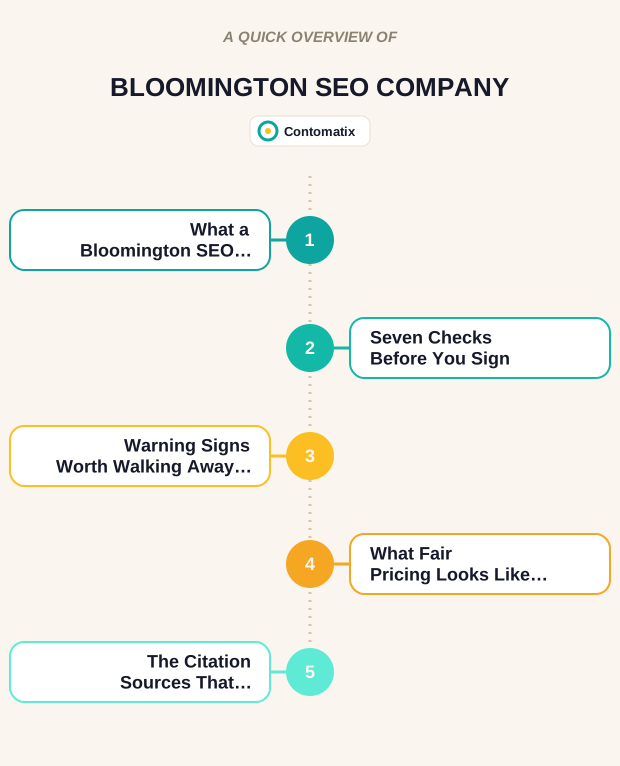
What a Bloomington SEO Company Has to Understand First
The academic calendar is the demand curve. Indiana University is the largest employer and the largest source of population churn. Search volume for restaurants, housing, salons, repairs, storage and moving does not move smoothly through the year here — it spikes in August, drops in May, and behaves differently again over winter break.
A provider who plans a flat twelve-month content calendar has not understood the market. The August intake needs content published in June and July, not in August when the searches are already happening.
Two audiences, not one. Students and permanent residents search differently for the same service. Students search on price, walkability and speed. Long-term residents search on trust, reviews and experience. Pages written for one convert badly for the other.
The employer base is concentrated and currently unsettled. Beyond the university, Cook Medical and Crane Naval Surface Warfare Center anchor the region, and Novo Nordisk announced roughly 400 job cuts at its local manufacturing site in March 2026. A provider pitching you on "the growing Bloomington economy" without knowing any of this is reading a template.
Seven Checks Before You Sign
- Ask which Bloomington they have worked in — a surprising number of remote agencies cannot say, or quietly mean Minnesota. It is a fast, fair filter.
- Ask how they would handle the academic calendar — a real answer talks about publishing ahead of August and planning around May. A vague answer means a generic plan.
- Ask for two client URLs in your industry — not logos. Open them and check whether they rank for what is claimed.
- Ask what month one contains — it should name the Google Business Profile, specific technical fixes and a content plan.
- Ask for link targets before placements go live — with traffic metrics. Refusal is the clearest warning sign in this industry.
- Check the notice period — three months is reasonable while work takes effect. Twelve months before any deliverable puts all the risk on you.
- Confirm you own the accounts — Analytics, Search Console and Google Business Profile in your name, with access granted to them.
Warning Signs Worth Walking Away From
Guaranteed rankings. Nobody controls Google's results. A guarantee is certainty being sold by someone who does not have it.
A price before seeing your site. A fixed number in the first email means a fixed package that was not built for you.
Refusing to name link sources. Almost always private blog networks — links that look fine in a report, do nothing, and can put the domain at risk.
Reports that are only rankings. Positions are an input. Ask how they connect to calls and enquiries.
What Fair Pricing Looks Like Here
This is a smaller market than Indianapolis, and pricing should reflect that. A single-location local business needing Google Business Profile work, citations and light content sits in the low hundreds per month. Competitive multi-location or student-housing work — one of the most contested niches in the city — runs $1,200–$3,000. Anything under about $300 a month is usually automated citation submissions and a monthly PDF.
Be skeptical of Indianapolis pricing applied unchanged to a market a fraction of the size.
The Citation Sources That Actually Matter
Ask whether a provider knows these, because they are the genuinely local ones:
- Greater Bloomington Chamber of Commerce — the most relevant local citation available.
- Bloomington Economic Development Corporation — bloomingtonedc.com, which publishes the county profile data the region runs on.
- Visit Bloomington — the tourism body, which matters for anything hospitality, food or visitor-facing.
- Indiana Secretary of State registration — the legal entity name every other citation has to match exactly.
- Monroe County records — the correct county on every listing.
Five accurate citations beat fifty automated ones. Google's guidelines for representing your business set the rules for what belongs in the profile itself.
Local vs. Indianapolis vs. Remote Providers
Local providers understand the calendar without being told and know the campus geography. Capacity is usually the limit.
Indianapolis agencies bring specialists, but you may be a small account, and their instinct is often to push Indianapolis-wide terms that are far harder to win than local ones.
Remote agencies can be excellent value, but the Bloomington disambiguation and calendar questions matter far more, because neither is obvious from a distance.
What to Do Before Hiring Anyone
Claim and complete the Google Business Profile, add service areas covering Ellettsville, Nashville and the wider Monroe County area, fill in every service with a description, get the Chamber listing right, and build a review request into how jobs close.
That is a meaningful share of the total benefit, and it means you can judge whether a provider is adding value or billing you for work you already did. Our agency versus freelancer comparison covers which model suits which situation.
Questions for the First Call
Five is enough: Which Bloomington have you worked in? How would you plan around the August intake? What happens in the first thirty days? Can I see link targets before they go live? What is the notice period?
How comfortable someone is answering these tells you most of what you need to know. For a sense of how we assess agencies generally, our hand-verified list for another university town shows the checks applied in practice.
Building a Content Calendar Around the Academic Year
Once the seasonality is acknowledged, the practical next step is mapping content publication dates backward from the demand spikes rather than forward from a generic monthly schedule. Content aimed at incoming students — housing, movers, apartment turnover services, orientation-week needs — needs to be published and indexed by June at the latest, since search volume for these terms climbs through July and peaks right before and during the August move-in window.
Content aimed at returning students and football weekends follows a different rhythm tied to the home game schedule each fall, which shifts demand for restaurants, parking, and short-term lodging on specific weekends rather than steadily across the semester. Winter break creates a third, smaller pattern — a temporary population drop that affects some service categories and barely touches others.
A single flat content calendar misses all three of these. A provider who maps deliverables against this actual rhythm, rather than a generic twelve-month cadence, is doing work that fits the market instead of a template.
Student-Facing vs. Resident-Facing Page Structure
Since students and long-term residents search with different priorities, it's worth building this split into your site structure rather than trying to serve both audiences from the same pages. A student-facing page should lead with price, walkability to campus, and speed of service or turnaround — the things a student comparing several options in a short window actually weighs. A resident-facing page should lead with experience, credentials, and reviews that reflect a longer relationship, since permanent residents are typically making a less time-pressured decision.
This doesn't necessarily mean doubling your entire site. For many businesses, it's enough to have distinct landing pages for the highest-volume services where the two audiences genuinely search differently, while letting less contested pages serve both audiences with more neutral language.
Vendor Evaluation: Reading Between the Lines of a Proposal
Beyond the seven checks already covered, pay attention to how a proposal is written. A proposal referencing "the college-town seasonal cycle" or naming the academic calendar unprompted shows real familiarity. A proposal that reads like it could apply to any mid-sized city — no mention of the university, the two audiences, or the employer concentration — is very likely templated, regardless of how confident the sales conversation was.
It's also worth asking directly how a provider would adjust the plan if enrollment or a major local employer's headcount shifted meaningfully during the engagement, given how concentrated Bloomington's economy is around a small number of large employers. A thoughtful answer here says more about how the provider actually thinks than any case study will.
Handling Off-Campus Housing and Student-Rental Search Terms
Off-campus housing and student-rental services deserve specific mention because the search behavior around them is unlike almost anything else in the local market. Demand concentrates into a narrow annual leasing cycle, decisions get made months ahead of the actual move-in date, and the buyers researching options — students and often their parents — are comparing listings across multiple platforms simultaneously rather than settling on the first result they find.
Content and page structure aimed at this audience should account for that lead time directly. Publishing availability and pricing information only close to the August intake misses the bulk of the decision-making window, which for many renters starts as early as the preceding fall or winter semester. Pages that clearly state lease terms, walking distance to campus, and what's included avoid a common frustration in this niche: generic listing pages that force a prospective renter to call just to get basic information that should have been on the page itself.
Because a meaningful share of the decision-makers here are parents rather than the students themselves, it's worth building at least some content around the questions a parent asks rather than assuming every page needs to speak directly to an eighteen-year-old renter — safety, lease guarantees, and proximity to campus services tend to matter more to that audience than the amenities a student-facing page might lead with.
Evaluating Content Samples for Real Quality
As with the vendor checks above, it's worth reading a writing sample closely rather than skimming it. Content that name-checks the university and the academic calendar in a generic way, without saying anything a Bloomington resident would recognize as specific, is a sign of a template rather than real local familiarity. Watch too for unsupported statistics or dollar claims stated as fact — a red flag regardless of the market, and one that's easy to miss when a sample otherwise reads smoothly.
Frequently Asked Questions
Which Bloomington does this guide cover?
Bloomington, Indiana — Monroe County, home of Indiana University, population 83,932. There are also well-known Bloomingtons in Illinois and Minnesota, and the market conditions are not the same.
How much should an SEO company here cost?
Low hundreds per month for a single-location local business; $1,200–$3,000 for competitive or multi-location work. Anything under about $300 is usually automated submissions rather than real work.
Why does the academic calendar matter so much?
Because demand is seasonal rather than steady. Content aimed at the August intake needs to be published in June and July. A provider planning a flat calendar will miss the year's biggest demand window.
Should I target students or permanent residents?
Decide deliberately — they search differently. Students weigh price, walkability and speed; long-term residents weigh trust and reviews. Trying to serve both on one page usually converts poorly for both.
Does the provider need to be based in Bloomington?
No. Remote providers can be excellent and often cost less. What matters is whether they understand the seasonality and the two-audience split.
Should I chase Indianapolis keywords?
Usually not at first. Those terms are contested by firms with larger budgets. Own Bloomington, Ellettsville and Monroe County first, then expand.
Can any agency guarantee first-page rankings?
No. Nobody controls Google's results, and a guarantee is a reliable signal to end the conversation.
How soon should I expect results?
Google Business Profile changes can show within weeks. Organic rankings generally take three to six months — and in this market, timing them to land before August matters as much as the work itself.
Related Reading
- For another Midwest and Great Plains market, see our guide to search engine optimization in Rapid City.
Contomatix is happy to give you a second opinion on a proposal you have already received — whether the pricing fits a market this size, and whether the plan accounts for the calendar. No obligation either way.
Get a free audit →