Hiring an SEO company Pearland Texas businesses can actually rely on is harder than it should be, because almost every provider says the same things. The pitch decks are interchangeable. The differences only show up in details you have to ask about.
This is the checklist we would use ourselves — including one test specific to this city that quietly separates providers who know the market from ones who copied a template.

Why Choosing an SEO Company Pearland Texas Businesses Trust Is Hard
This city sits inside the Houston metro, so the providers pitching you range from one-person operations to Houston agencies whose account managers have never driven down Broadway. Both can do good work. Both can also sell you a package built for a different market.
The economics make it worse. With a median household income of $118,842 and 130,677 residents, the area looks attractive on a spreadsheet, so it attracts remote agencies running volume outreach. Being pitched is not evidence of being understood.
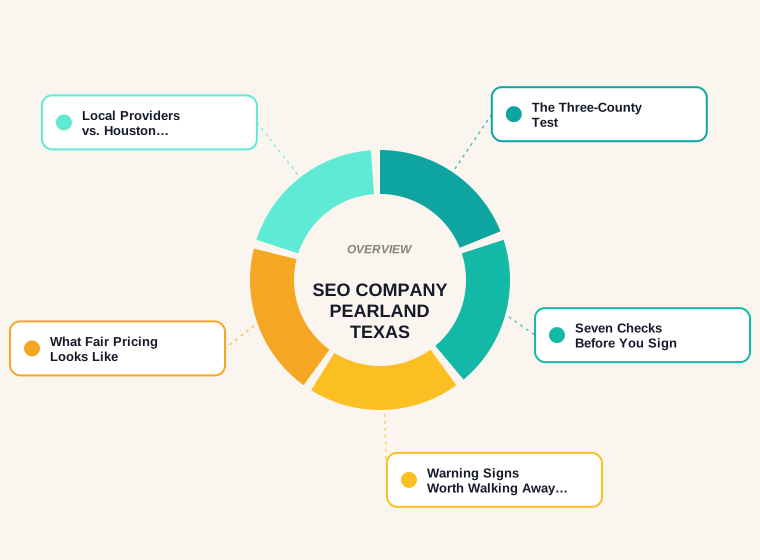
The Three-County Test
Ask any prospective provider one question: which county is my business in, and why does that matter for my citations?
The city spans three — most of it in Brazoria, with portions in Harris and Fort Bend. Someone who has worked here answers immediately and explains that county records, appraisal district listings and directory entries have to match the county you physically sit in. Someone running a template will not know, and will usually change the subject.
It is a small thing, but it is a reliable proxy for whether any real local work has been done.
Seven Checks Before You Sign
- Ask for two client examples in your industry — not logos, actual URLs. Then open them and check whether they rank for what is claimed.
- Ask what happens in month one — a real answer names the Google Business Profile, specific technical fixes and a content plan. A vague answer means the plan does not exist yet.
- Ask who does the work — the person in the meeting, or a subcontractor you will never speak to. Either is acceptable; being misled about it is not.
- Ask for the link target list before placements go live — with traffic metrics. Refusal is the clearest warning sign in this industry.
- Check the notice period — three months is reasonable while work takes effect. Twelve months before you have seen a deliverable is a lock-in dressed as a strategy.
- Confirm you own the accounts — Analytics, Search Console and Google Business Profile in your name, access granted to them. Never the reverse.
- Ask what the report will say — if the answer is only rankings, ask how those connect to calls.
Warning Signs Worth Walking Away From
A guaranteed number-one ranking. Nobody controls Google's results. A guarantee is certainty being sold that the seller does not have.
A price quoted before seeing your site. A fixed number in the first email means a fixed package, which means it was not built for you.
Refusing to name link sources. This almost always means private blog networks — links that look fine in a report, do nothing, and can put the domain at risk.
Reports with no commentary. A dashboard export is data. What you are paying for is someone explaining what changed and why.
Pressure to sign during the meeting. Urgency is a sales tactic, not a measure of service quality.
What Fair Pricing Looks Like
Rough ranges, honestly stated. A single-location local business needing profile work, citations and light content sits in the low hundreds per month. A competitive multi-location or service-area business runs roughly $1,500–$3,500. A B2B supplier selling into the life-sciences and energy cluster — Lonza alone employs 1,079 people locally — is a different program, closer to technical content marketing, and priced accordingly.
Anything under about $300 a month is usually automated citation submissions and a monthly PDF. It rarely moves anything.
Local Providers vs. Houston Agencies vs. Remote
Local providers know the neighborhoods — Shadow Creek Ranch, Silverlake, Southdown — and you can meet them. Capacity is usually the constraint.
Houston agencies bring specialists and depth, but you may be a small account, and they may push Houston-wide terms that are far harder to win than local ones.
Remote agencies can be excellent and often cost less, but the three-county test matters more, because nothing about this market is obvious from a distance.
No category is inherently better. The checks above matter more than the postcode on the invoice.
What to Do Yourself First
Before paying anyone: claim and complete the Google Business Profile, get the Chamber of Commerce listing right — 6117 Broadway St, Pearland, TX 77581, (281) 485-3634 — make sure name, address and phone match everywhere, and build a review request into how jobs close.
That is a meaningful share of the available benefit, and doing it first means you can tell whether a provider is adding value or charging you for what you already had. Our local search engine optimization guide for this market walks through each step, and Google's representing your business guidelines are the authority on what is permitted.
Five Questions for the First Call
What would you do in the first thirty days? Which county am I in and why does it matter? Can I see link targets before they go live? What is the notice period? What will the monthly report actually tell me?
The answers — and how comfortable someone is giving them — tell you most of what you need. For a wider view of what each engagement model realistically delivers, our agency versus freelancer comparison is a useful second read, as is our hand-verified list of Texas agencies, or our nearby guide to SEO companies in Sugar Land, TX.
How to Read a Sample Report Before You Sign
Ask any prospective provider to show you a redacted sample of an actual monthly report, not a description of what it includes. A genuinely useful report ties together at least three things: ranking movement for a defined set of terms, organic traffic trends from analytics, and lead indicators like calls, form fills, or booked jobs. A report showing only rankings, with no attempt to connect them to business outcomes, tells you the provider is measuring activity rather than results.
Also look at how much of the report is commentary versus raw exported data. A page of charts with no explanation of what moved and why is something you could generate yourself for free. What you're paying for is the interpretation.
Contract Terms Worth Reading Twice
The verbal pitch and the written agreement don't always match, and the agreement is what actually governs the relationship once you've signed it.
Auto-renewal windows. Know the exact date by which you'd need to cancel to avoid an automatic renewal, and put it on your own calendar rather than relying on a renewal notice to catch it in time.
What "ownership" actually covers. Confirm in writing that content written for you, any citations built, and access to Analytics, Search Console, and your Google Business Profile remain yours if you leave — not just verbally promised, but stated in the agreement itself.
Exclusivity language. Some agreements restrict the provider from working with a direct competitor in your area while you're under contract. Read exactly how "competitor" and "area" are defined rather than assuming it matches the spirit of what was discussed on the call.
Setting Expectations for a Fast-Growing Houston Suburb
A realistic timeline here looks roughly like this: the first four to six weeks are Google Business Profile cleanup, citation corrections across the county-specific sources mentioned above, and a technical audit — expect profile-level movement in this window, not ranking jumps. Months two and three typically bring new or rewritten content live and early movement on lower-competition terms. Competitive terms against well-funded Houston-metro competitors generally take longer, closer to the three-to-six-month range mentioned earlier, sometimes further out depending on how contested the specific keyword set is.
Because this area continues adding residents and businesses, new competitors enter the market on a rolling basis too. A provider should be able to describe how they'd revisit your keyword targets periodically rather than setting a strategy once and leaving it unchanged for a year.
Common Objections Agencies Raise, and How to Respond
A few pushbacks come up often enough during the vetting process that it's worth deciding your position on them before you're in the conversation.
"Our process is proprietary, so we can't share specifics." A legitimate agency can still describe its general approach, its typical first-month deliverables, and the categories of work involved without revealing a literal trade secret. A total refusal to describe process in any useful detail is different from reasonably declining to hand over a full playbook.
"We need exclusivity in your category to protect our own results." This can be a genuine, reasonable ask, particularly for a smaller agency serving a narrow niche — but it should come with something in return, like a lower rate or a defined scope, not just a one-sided restriction on you.
"You'll see results faster if you also run our recommended ad campaign." Paid media recommendations aren't inherently a red flag, but they're worth evaluating as a separate decision on its own merits, not bundled into the SEO conversation as pressure to spend more before you've seen whether the core service delivers.
"We can't share client URLs due to confidentiality." Reasonable for specific financial figures or contract terms, less reasonable for the existence of a ranking or a public URL that anyone could already find by searching. Ask for at least anonymized or aggregate examples if full transparency genuinely isn't possible.
Evaluating Content Samples for Real Quality
Writing samples from a prospective provider almost always look competent on a fast skim. The more revealing test is checking whether a sample says anything that couldn't apply equally to a business in a different city with the same name swapped in. Content that reads as interchangeable across markets is a sign of a templated production process, regardless of how polished the prose is.
Also check for unverifiable specificity — a precise statistic, a "clients typically see" claim, or a dollar figure stated as fact with no source. That kind of unsupported precision is a real liability for your own site's credibility, not just a style preference, and it's worth asking directly where a number like that comes from before it ends up published under your business's name.
Frequently Asked Questions
How much should an SEO company here cost?
A single-location local business typically sits in the low hundreds per month; competitive or multi-location work runs $1,500–$3,500. Anything under about $300 is usually automated submissions rather than real work.
Does the provider need to be based locally?
No. Remote providers can be excellent and often cost less. What matters is whether they understand the county split, the neighborhood terms and the Houston competition.
What is the three-county test?
Asking which county your business is in and why it matters. The city spans Brazoria, Harris and Fort Bend counties, and citations must match. Providers who have worked here know this; template operators do not.
Should I sign a twelve-month contract?
Not for a first engagement. Three months is reasonable for work to take effect. Twelve months before any deliverable puts all the risk on you.
Can an agency guarantee first-page rankings?
No. Nobody controls Google's results, and a guarantee is a reliable signal to end the conversation.
How do I check an agency's own results?
Look at what they rank for themselves, then open two named client sites and check whether those rank for the terms claimed. An agency invisible for its own market terms is worth questioning.
What if I sell B2B rather than to households?
Then local SEO is a small part of the answer. Selling into the manufacturing, energy or life-sciences firms here needs capability-led technical content, and you should hire for that skill specifically.
How soon should I expect results?
Google Business Profile changes can show within weeks. Organic rankings generally take three to six months. Anyone promising faster is either lucky or not being straight with you.
Contomatix is happy to give you a second opinion on a proposal you have already received — whether the pricing is fair, and what the plan is missing. No obligation either way.
Get a free audit →