Last updated: August 2026
Corpus Christi, Texas is a genuinely layered local economy sitting on a major Gulf Coast port. With roughly 316,964 residents, the city hosts petrochemical giants like CITGO and Flint Hills Resources, is home to Texas A&M University-Corpus Christi and Del Mar College, and draws real tourism traffic as a South Texas beach destination. For a Corpus Christi business, an SEO expert Corpus Christi businesses can actually rely on has to work across all three of those angles, not just one.
This guide covers what hiring an SEO expert in Corpus Christi actually involves in 2026, why this market rewards a locally-tailored approach over a generic Texas SEO template, and the concrete steps that move a business up the rankings and into real, booked business.

Why Corpus Christi Is a More Competitive Market Than It Looks
Three distinct buyer audiences share this city. Household-facing local businesses compete on ordinary local SEO fundamentals. Industrial suppliers selling into the port and petrochemical sector compete on capability, certifications, and safety record. Tourism and hospitality businesses compete on seasonal visibility for out-of-town searchers. Writing one page for all three usually serves none of them well.
Education and Health Services is the largest employment sector at 22.61% of employees, ahead of the port and petrochemical industries most people think of first — Texas A&M-Corpus Christi and Del Mar College are genuine economic anchors, not just schools. Median household income sits at $67,394 with a 17.14% poverty rate, worth knowing when deciding how to position pricing on service pages.
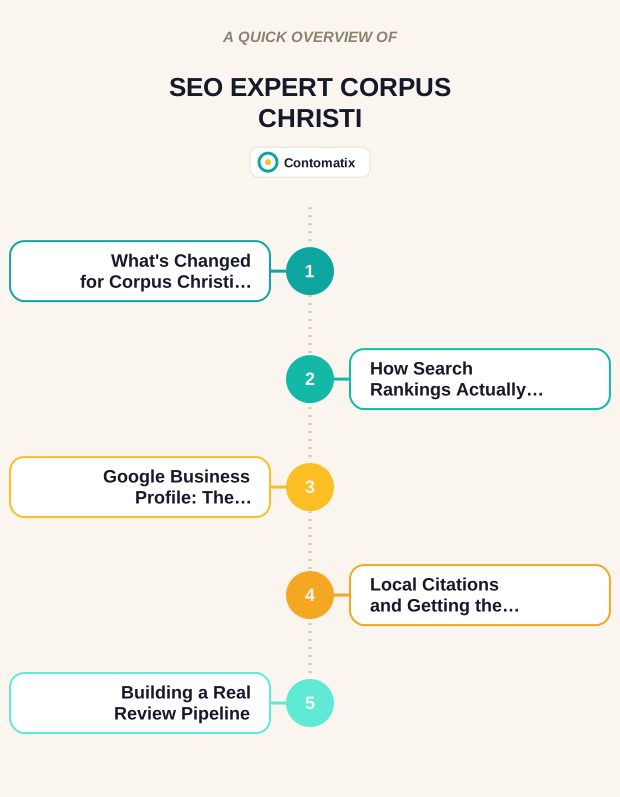
What's Changed for Corpus Christi SEO in 2026
The mechanics of SEO for Corpus Christi businesses haven't changed at their core, but two things are worth naming directly this year.
First, AI-generated answers are now a real part of how local searches get resolved. A searcher typing "best [service] in Corpus Christi" increasingly sees a synthesized answer above the traditional map pack, and the businesses named tend to be the ones with the clearest, most specific online information. We've covered how to structure content for that shift in our guide to answer engine optimization.
Second, tourism-season timing matters more than ever for hospitality and beach-adjacent businesses — content and Google Business Profile activity should be timed ahead of peak season rather than treated as flat year-round.
How Search Rankings Actually Work for a Local Business
For any Corpus Christi business targeting local customers, search visibility comes down to three factors Google actually weighs: relevance, distance, and prominence. Relevance is mostly about accurate categorization and content that actually matches search intent. Distance is largely fixed by the business's real location. Prominence is the slowest to build and the easiest to let slide — it accumulates through reviews, citations, local links, and consistent visibility over time.

What an SEO Expert Corpus Christi Businesses Hire Should Actually Deliver
- Google Business Profile optimization — accurate categories, service areas that include Portland and Flour Bluff where relevant, and regularly updated photos and posts
- Consistent NAP data (Name, Address, Phone) across the website, directories, and any local listings
- Locally-relevant keyword research — targeting how people actually search in and around Corpus Christi
- Proper on-page SEO — clean site structure, schema markup, and content genuinely built around local search intent
- A real review pipeline — steady, ongoing reviews rather than a single push that goes stale
Google Business Profile: The Highest-Leverage Fix
For most Corpus Christi businesses, the fastest realistic improvement is a properly maintained Google Business Profile. That means the correct primary category, accurate service-area settings, real and recent photos, and prompt responses to every review. For hospitality businesses, this is especially relevant given the seasonal tourism swings this coastline sees — a profile that looks abandoned before peak season costs real bookings.
Local Citations and Getting the Basics Right
Every directory listing and local mention should show the exact same business name, address, and phone number. The United Corpus Christi Chamber of Commerce, at 602 N. Staples Street, Ste. 150, Corpus Christi, TX 78401, (361) 881-1800, is the most relevant general local citation available, alongside correct Nueces County records.

Selling Into the Port and Petrochemical Sector: A Different Kind of SEO
If your business supplies CITGO, Flint Hills Resources or the broader Corpus Christi port economy, standard local SEO is close to beside the point. Those buyers search on capability, certifications and safety record, often through formal procurement — content built for that audience needs a completely different approach. Our guide to search engine optimization in Beaumont covers the same B2B-versus-local split in another Gulf Coast refining city.
Building a Real Review Pipeline
Reviews function as both a ranking signal and the biggest single factor in whether a searcher actually calls once they've found a business. A workable system asks for a review at the moment customer satisfaction is highest. Consistency beats volume — two or three genuine reviews every month builds a stronger long-term signal than a single push that goes quiet.
Measuring Whether It's Actually Working
Map-pack position for a single keyword is an incomplete picture. A more reliable set of metrics includes Google Business Profile insights, organic traffic to location-specific pages, the trend in review count and average rating, and actual booked jobs traced back to a local search.
DIY vs. Hiring It Out
A single-location, household-facing business can genuinely handle the Google Business Profile setup, the Chamber listing, name-address-phone consistency, and a review request built into how jobs close. Our agency versus freelancer comparison covers what paid help realistically delivers once you're ready for it.
Common Mistakes in This Market
- Writing one generic page for three different audiences — household customers, industrial B2B buyers, and tourists all search differently
- Ignoring tourism seasonality instead of timing content and profile activity ahead of peak season
- Treating industrial suppliers to the port and petrochemical sector like consumer-facing local businesses
- Inconsistent NAP data across directories, quietly undermining otherwise solid on-page work
- An abandoned Google Business Profile — set up once, never updated with current photos, hours, or posts
Is Hiring an SEO Expert Worth It for a Corpus Christi Business?
Given local income levels, SEO is considerably cheaper per lead than paid ads once it's established, since rankings keep generating calls without an ongoing per-click cost. A well-built organic position keeps generating calls for months or years with only ongoing maintenance cost.
Conclusion
Finding an SEO expert Corpus Christi businesses can actually rely on means recognizing a genuinely layered Gulf Coast economy — port and petrochemical, education and health services, and tourism all at once — and building the fundamentals that compound over time: a properly maintained Google Business Profile, consistent citations, locally-specific content, and a real review pipeline.
The same B2B-versus-local dynamic shows up in other Texas markets we've covered — see our guide to SEO in Mansfield, TX for how it plays out in a fast-growing DFW suburb.
Questions Worth Asking Before You Hire
Given the three-audience split this market has — household, industrial, and tourism — the most useful vetting question is simply which of the three a candidate has actually worked in before, rather than a generic list of SEO services.
- Ask them to describe your actual buyer. A household-facing plumber, a procurement officer at a petrochemical supplier, and a family planning a beach trip need completely different content. If the answer is generic, the strategy behind it will be too.
- Ask how they would handle the Portland and Flour Bluff service areas if you serve them. A provider unfamiliar with the surrounding communities is working from a template rather than genuine local knowledge.
- Ask what a first 90 days looks like, in specifics. Google Business Profile cleanup, citation audit, and a content plan tied to your actual buyer type is a reasonable answer. "We'll do SEO" is not.
- Ask who owns the work product — your website, your Google Business Profile, and your analytics access — once the engagement ends. This should never be in question.
Technical Site Health Worth Checking Directly
A Gulf Coast business site carries a few technical considerations that generic SEO advice tends to skip. Mobile page speed matters more here than the national average, since a large share of tourism-related searches happen on phones from people actively traveling. Structured data — LocalBusiness schema with accurate hours, service area, and contact information — helps search engines represent the business correctly, which matters especially around hurricane season when hours and availability can shift on short notice and need to be updated everywhere at once, not just on the homepage.
Image-heavy hospitality and tourism sites should also check actual load times rather than assuming a nice-looking gallery is harmless. A slow site loses mobile visitors regardless of how good the content underneath turns out to be.
Building Content That Actually Serves Three Different Buyers
Rather than one blended homepage message, the more durable approach is separating the site's structure around buyer type from the start: a household services section written in plain, local language; an industrial or B2B section that speaks in capability, certification, and procurement terms; and a visitor-facing section built around planning-stage questions rather than generic promotional copy. Each section should be genuinely distinct, not the same paragraph with different keywords swapped in — search engines and readers both notice the difference between real specificity and a reskinned template.
What Good Local Content Actually Looks Like in Practice
It helps to be concrete about the difference between a thin local page and one that genuinely earns its ranking. A thin page names the city a handful of times, lists services in a bulleted paragraph, and closes with a generic call to action. A page built to actually rank and convert answers the specific questions a Corpus Christi searcher has in mind: what the service costs locally, how long it typically takes, what makes this particular business qualified, and what a first visit or first call actually involves.
For the household-facing side of the business, that might mean a page structured around a real customer question — "how much does AC repair cost in Corpus Christi in summer" — answered honestly with a range and the factors that move it, rather than a vague "contact us for pricing." For the industrial and B2B side, it means naming specific capabilities, certifications, and capacity numbers a procurement buyer would actually search for, since that audience is comparing suppliers on documented specifics rather than warmth or approachability.
The same principle extends to format. A single long page trying to serve all three audiences at once tends to under-serve each of them; three shorter, more targeted pages — one per audience — consistently outperform one page trying to be everything.
Realistic Expectations for a First Year
Most of the visible movement in the first three months comes from Google Business Profile and citation fixes rather than new content ranking. Content built around the household, industrial, or tourism angles described above typically needs three to six months to gain meaningful organic traction, and longer for competitive commercial terms. Businesses that expect month-one results from new content are usually judging the work too early, while the profile and citation work in that same window is a fair thing to hold accountable on a shorter timeline.
How much does an SEO expert cost in Corpus Christi, TX?
Local packages for a single-location household-facing business typically run a few hundred dollars a month. Given local income levels, be skeptical of pricing imported from wealthier Texas metros.
Is local SEO relevant for a business supplying the port or refineries?
Only partly. Those buyers search on capability, certifications and safety record, often through formal procurement, which needs technical content rather than local optimization.
Should I target Portland and Flour Bluff too?
If you genuinely serve them, yes — list them as service areas alongside Corpus Christi.
What is the most relevant local citation source?
The United Corpus Christi Chamber of Commerce at 602 N. Staples Street is the most relevant general local citation.
Does tourism season affect SEO strategy here?
For hospitality and beach-adjacent businesses, yes — content and Google Business Profile activity should be timed ahead of peak season rather than treated as flat year-round.
How long does SEO take to show results?
Google Business Profile improvements can show within weeks. Broader organic rankings typically take three to six months.
Contomatix helps businesses build the Google Business Profile, citation, and content foundation that actually drives calls — not just rankings for their own sake. Want a free SEO audit for your business?
Get a free audit →