Last updated: August 2026
Hiring an international SEO consultant becomes necessary the moment a business tries to rank in more than one country or language and discovers that standard SEO advice mostly assumes a single-market, single-language site. Targeting the UK and the US with the same English-language pages, or expanding into a market that needs actual translation rather than just currency conversion, both require decisions that don't come up in typical domestic SEO — and getting them wrong is common enough that it's one of the most frequent audit findings across multi-market sites.
This guide covers what international SEO consulting actually involves in 2026, the technical decisions that matter most (domain structure, hreflang, localized content), and how to tell whether a business genuinely needs international SEO work or just better keyword targeting in its existing market.
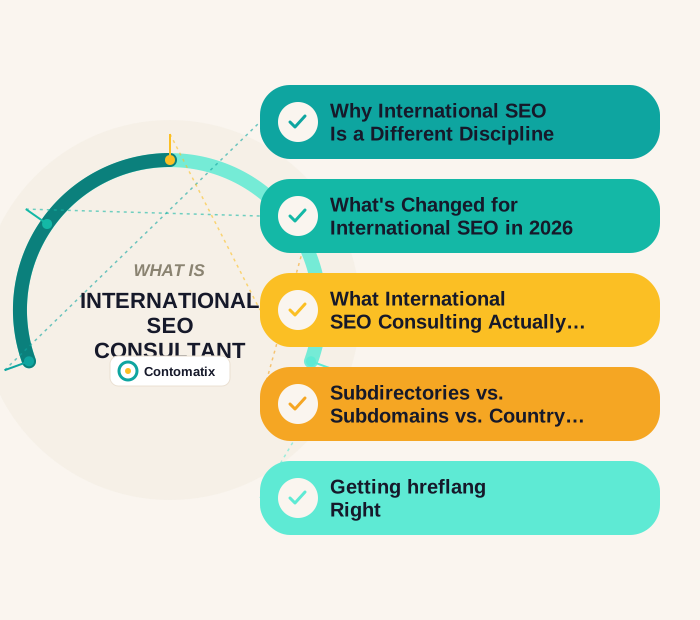
Why International SEO Is a Different Discipline
Domestic SEO optimizes one site for one search audience. International SEO has to decide, before any content gets written, how Google should understand which pages serve which country and language — and that decision (subdirectories, subdomains, or separate country-code domains) is expensive to reverse once a site has real content and links built on top of it.
The most common costly mistake is treating "UK English" and "US English" as interchangeable, then wondering why the UK version of a page never ranks in the UK — Google increasingly serves genuinely localized content (currency, spelling, region-specific terminology, and local citations) over a single generic English page, even when the language is nominally the same.
A second common mistake is duplicate content across language/country versions without proper hreflang tags — Google can end up indexing the wrong country version for a given search, or treating near-identical pages as duplicates and suppressing all but one.
What's Changed for International SEO in 2026
AI Overviews and AI assistants now pull from region-specific sources more aggressively than traditional search results did, which raises the cost of a poorly localized site — a generic, single-market page is less likely to be cited for a region-specific query than a page that's genuinely built for that market. We've covered the mechanics of that shift in our guide to answer engine optimization, and the same principle compounds across markets for an international site.

What International SEO Consulting Actually Involves
- Site architecture decisions — subdirectories (
/uk/), subdomains, or ccTLDs, chosen based on resourcing and existing domain authority, not a one-size-fits-all rule - Correct
hreflangimplementation — so Google serves the right country/language version to the right searcher instead of guessing - Market-specific keyword research — search terms, volume, and intent genuinely differ by country even within the same language
- Localized content — currency, units, regional terminology, and local citations, not machine-translated copy
- Market-relevant link building — links from sites with real authority and traffic in the target country, not just any high-DA site
Subdirectories vs. Subdomains vs. Country Domains
Subdirectories (example.com/uk/) are the most common recommendation for a growing site because they inherit the authority of the main domain rather than starting from zero. Subdomains (uk.example.com) are a middle ground, treated as semi-separate by Google but still under one root domain. Separate country-code domains (example.co.uk) send the strongest localization signal but effectively start a new SEO project from scratch — usually only worth it for a business with the resources to build authority in each market independently.
Whichever structure is chosen, the decision needs to happen before significant content investment, since migrating structure later means redirects, potential ranking loss, and rebuilding hreflang relationships across every page.

Getting hreflang Right
The most common hreflang mistake is one-directional tagging — page A points to page B as its alternate, but page B doesn't point back to page A. Google's guidance requires the relationship to be reciprocal on every page in the set, and a broken reciprocal link can cause the entire hreflang cluster to be ignored. A second common error is targeting language without country (en instead of en-GB and en-US) when the actual differentiation needed is regional, not linguistic.
Common International SEO Mistakes
- Treating one English page as sufficient for every English-speaking market, missing genuine regional search behavior and terminology differences
- Broken or one-directional hreflang tags, causing Google to serve the wrong country version or ignore the tags entirely
- Machine-translated content with no local review, which reads as untrustworthy to native speakers and often to Google's quality signals as well
- Building links only from high-DA sites regardless of country relevance, missing the local-authority signal that actually helps in-market rankings
- Choosing a domain structure reactively after content is already built, instead of deciding it upfront
DIY vs. Hiring an International SEO Consultant
A business expanding into one additional, closely related market (say, US to UK) with in-house content resources can often handle the basics — proper hreflang, localized spelling and currency — without outside help. Where a consultant earns their cost is in genuinely different markets: different languages, different search engines' market share, or a business that needs to prioritize which of several possible markets to enter first based on actual opportunity size rather than assumption.
Is an International SEO Consultant Worth It?
For a business already generating meaningful revenue in one market and looking at international expansion, the cost of getting site architecture wrong (a domain restructure two years in) is almost always higher than the cost of getting expert input before building. For a smaller business testing one adjacent market, the higher-leverage spend is usually market-specific keyword research over a full consulting engagement.
A Pre-Launch Checklist for a New Country or Language Version
Before a new market version of a site goes live, a short technical review catches the mistakes that are cheap to fix now and expensive to fix later:
- Confirm the URL structure decision is final before content is written at volume — subdirectory, subdomain, or ccTLD should not change once pages start earning links and rankings in that market.
- Verify hreflang tags are reciprocal across every page in the set, not just from the new market's pages back to the original, but in both directions on every page.
- Check that currency, units, date formats, and phone number formats match the target market's conventions throughout, not just on the homepage.
- Confirm the new version is genuinely localized, not machine-translated with a light edit — a native speaker familiar with the industry should review the content before launch, not just a general translator.
- Set up separate tracking in Search Console for the new market's section so performance can be measured independently rather than blended into sitewide totals.
- Build at least a small set of market-specific internal links between the new pages, rather than relying only on a top-level navigation link, so the new section has genuine internal linking depth from day one.
How to Prioritize Which Market to Enter First
When a business is deciding between several plausible next markets, the decision usually comes down to a few concrete, checkable factors rather than intuition: existing organic traffic already arriving from that country despite no dedicated content, the size and competitiveness of the search market for the core product category, and whether in-house resources exist for genuine localization rather than just translation. A market that already sends meaningful organic traffic to the generic version of a site is often the strongest first candidate, since it's evidence of real demand rather than a guess.
Ongoing Maintenance an International Site Needs
International SEO isn't a one-time setup — each market version needs its own ongoing attention. Keyword research should be refreshed periodically per market, since search behavior and terminology can shift independently across countries even for the same product. Hreflang relationships need re-checking after any site restructuring, since it's easy for a URL change in one market to silently break the reciprocal tag pointing to it from another. And content freshness matters per market too — a page that's kept current in the original market but left untouched in a secondary one will visibly lag in relevance over time.
Search Engine Market Share Varies More Than Most Businesses Expect
Domestic SEO advice generally assumes Google dominates, which holds in many markets but not all of them. A business expanding into a market where a different search engine carries meaningful share needs to budget separate research time for that platform's own ranking factors, webmaster tools, and submission process, rather than assuming Google-focused work automatically transfers. Skipping this check is one of the quieter reasons an otherwise well-executed international SEO project underperforms in a specific market — the content and technical work were sound, but built entirely around the wrong search engine's preferences for that region.
Budgeting for Ongoing Local Review, Not Just Initial Translation
A one-time translation budget covers the launch, but genuinely competitive international content needs a recurring line item for local review — a native speaker checking new content, seasonal campaigns, and any terminology shifts on an ongoing basis, not just at launch. Businesses that budget generously for the initial localization but nothing for upkeep tend to watch a market-specific site slowly drift out of date relative to competitors who keep reviewing and refreshing content locally. Treating this as an ongoing cost of doing business in that market, rather than a one-time project expense, is what actually sustains the investment made at launch.
Coordinating International SEO With Existing Paid Search Campaigns
A business already running paid search in a new market before organic content is ready should keep both teams aligned on the same keyword and localization decisions, rather than letting paid and organic pursue separate keyword lists independently. Paid search often surfaces genuine local search-term data faster than organic keyword research alone, since it generates real click and conversion data almost immediately, and feeding that data back into the organic content plan avoids duplicating research that's already been paid for once through the ad platform.
Related reading: our guide to hreflang for Spanish covers which language and region codes to use for Spanish sites.
Related reading: our guide to an international SEO audit covers how to check hreflang, targeting and indexing across markets.
Should I use subdirectories or a separate country domain for international SEO?
Subdirectories are usually the safer starting point since they inherit your existing domain's authority. Separate country domains send a stronger localization signal but essentially restart SEO from zero in that market.
Do I need separate content for the UK and US if both are in English?
Yes, in most cases. Google increasingly rewards genuinely localized content — spelling, currency, terminology, and local citations — over a single generic English page.
What is the most common hreflang mistake?
One-directional tagging, where page A references page B as an alternate but page B doesn't reference page A back. The relationship needs to be reciprocal across the entire set.
Is machine translation good enough for international SEO?
No. Machine-translated content without local review tends to read as untrustworthy to native speakers and often underperforms genuinely localized content in search results.
How long does international SEO take to show results?
Similar to domestic SEO — a few months for initial movement, longer for a brand-new country-code domain that's effectively starting from zero authority.
Can I expand into multiple countries at once?
It's possible but resource-intensive. Most international SEO consultants recommend prioritizing one or two markets based on real opportunity size before expanding further.
Related Reading
- Before restructuring domains, get the basics right — is a sitemap even important for SEO? Here's the honest answer.
- Running an online store instead? Our Shopify SEO consultant guide covers the platform-specific issues to fix first.
Contomatix builds the on-page, link building and content foundation that actually moves rankings — not just a checklist audit. Want a free review of where your site stands right now?
Get a free audit →