A plumber can be the best in the county and still watch the phone stay silent, while a mediocre competitor down the road books three jobs a day — because that competitor shows up first when someone searches "plumber near me" at 11pm with a burst pipe. Digital marketing for tradesmen is the entire difference between those two outcomes: it's the discipline of making sure the right person finds you, trusts you, and calls before they call anyone else.
This guide covers what that actually means for plumbers, electricians, carpenters, roofers, HVAC techs, landscapers, and every other skilled trade — what genuinely moves the needle, what most agencies get wrong, and how to build a steady pipeline of work instead of a feast-or-famine cycle of referrals.
The trades that get this right tend to look calm from the outside — a steady, predictable stream of booked jobs rather than a scramble every time a big project wraps up. That calm is rarely an accident. It's almost always the result of a Google Business Profile that's actually maintained, a website built to convert rather than just exist, and a review pipeline that never really stops.
None of this replaces being good at the trade. It just makes sure being good at the trade actually gets rewarded — because right now, in almost every trade, the business that wins the search wins the job, regardless of who does better work.

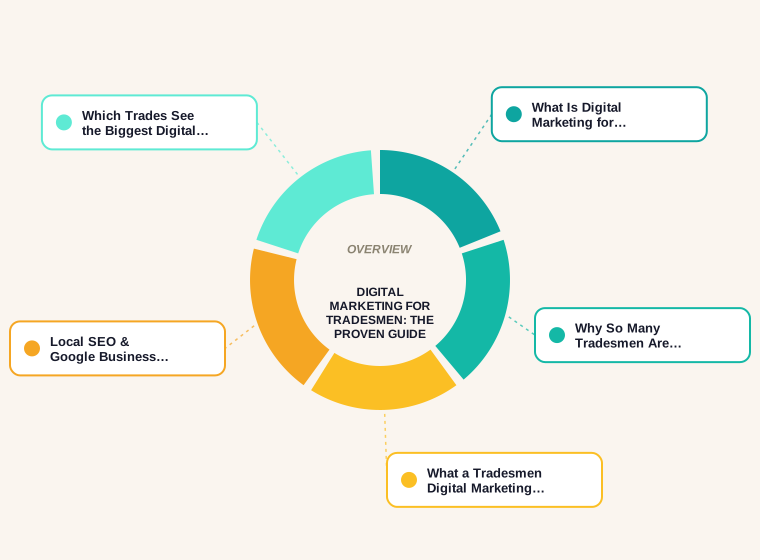
What Is Digital Marketing for Tradesmen?
It sounds broader than it is in practice. For a trades business, "digital marketing" rarely means running a large brand campaign — it means a handful of specific, ongoing tasks done consistently well, aimed squarely at the moment someone nearby has a problem and starts searching for help.
It's the application of local SEO, website design, reviews management, and paid ads specifically to how homeowners actually search for and choose a tradesperson — usually urgently, usually locally, and usually based on trust signals built in the first ten seconds of looking at a website or a Google listing.
It's different from marketing a retail brand or a SaaS product in one crucial way: most searches are hyper-local ("electrician in [city]") and many are urgent ("emergency plumber"). Win the map pack for those searches and the phone rings. Lose it, and it doesn't matter how good the actual work is — nobody ever finds out.
Why So Many Tradesmen Are Invisible Online
Most trades businesses were built entirely on word of mouth — a good reputation spreading through a neighborhood, repeat customers, referrals from other contractors. That's not a flaw; for decades it was the only marketing that mattered. But it also means most trades websites, if they exist at all, are five-year-old single pages with a phone number and a stock photo of a wrench.
That gap is the opportunity. In almost every trade and almost every city, the competition for online visibility is far weaker than the competition for actual skill — which means a modest, consistent investment in digital marketing can put a smaller business ahead of bigger, more established competitors who never bothered.
What a Tradesmen Digital Marketing Agency Actually Does
Strip away the jargon and the job breaks into five parts: getting the business showing up in the local map pack and organic search, building a website that turns a visit into a phone call within seconds, keeping a steady stream of strong reviews, deciding how much of the budget goes to ads versus organic, and reporting on all of it in numbers that matter — calls and booked jobs, not clicks nobody can spend.
If you're based in West Yorkshire specifically, our wider Leeds digital marketing guide covers the local market conditions — competition, typical budgets, and what a good agency pitch looks like there — in more depth than a trade-specific guide can.
Local SEO & Google Business Profile
For a trades business, the local map pack is worth more than almost anything else on the page. Three things decide whether you're in it:
- A fully built-out Google Business Profile — correct trade category, accurate service area, real job photos (not stock images), and posts updated regularly instead of abandoned after setup.
- Consistent NAP data (name, address, phone) across every directory. Google cross-checks this, and mismatched listings quietly cap how far a business can rank.
- Service-area pages for every town or suburb actually served — a roofer covering eight towns needs eight pages, each built around that specific town and service, not one generic "service area" page trying to rank everywhere at once.
Good keyword research applied to a trade means treating "water heater repair" and "water heater installation" as genuinely different searches with different intent — and building separate pages for each rather than cramming both into one. The same logic applies to urgency: "emergency plumber" and "plumber near me" behave like different searches with different expectations, and a page written for one rarely satisfies the other.
One detail smaller trades businesses often miss: Google weighs proximity heavily for local-pack results, which means a business physically based just outside a target town can genuinely struggle to rank there no matter how good the content is. Service-area pages, consistent citations, and — where it makes sense — a secondary local address or service hub can offset this over time.
Which Trades See the Biggest Digital Marketing Wins
Not every trade benefits equally, and the differences are worth knowing before setting a budget. Emergency-driven trades — plumbing, electrical, HVAC repair, garage door repair — see some of the fastest returns, because a large share of searches are urgent, high-intent, and happen the same day a job is booked. A single well-optimized "emergency plumber [city]" page can start producing calls within weeks.
Project-based trades — roofing, remodeling, landscaping, fencing — see slower but often larger wins, since the sales cycle is longer and involves more research, comparison, and sometimes multiple quotes. Here, content and reviews matter more relative to raw local SEO speed, because the homeowner is genuinely shopping rather than reacting to an emergency.
Seasonal trades — HVAC, roofing, landscaping, snow removal — carry an extra layer: search demand itself swings hard with the season, and a content and ad calendar that ignores this consistently wastes budget chasing keywords nobody is searching in the off-season, while missing the narrow windows when demand actually spikes. We've covered the seasonal side of this in detail in our SEO for HVAC companies guide.
A Website Built to Get the Phone Ringing
A tradesman's website has exactly one job: get a homeowner who's mildly stressed and comparing three options to call in under fifteen seconds. That means a clickable phone number in the header on mobile, real before-and-after job photos instead of stock imagery, and a quote form that asks three questions, not fifteen.
On-page structure matters just as much as design — one clear page per service, fast load times (most searches for trades happen on a phone, often from someone standing in front of the actual problem), and schema markup so Google can surface ratings and service area directly in the search result.
A mistake worth naming directly: many trades websites are organized around how the owner thinks about the business — one page listing every service the company has ever offered — rather than how a homeowner actually arrives. Someone searching "sump pump installation" wants a page about sump pump installation, with pricing signals, timeline, and a clear next step, not a paragraph buried inside a long list of unrelated services.

Content That Keeps the Phone Ringing Between Jobs
Most trades websites are three pages and a phone number — a missed opportunity, because homeowners research before they call: "is a flickering light dangerous," "how much does a water heater replacement cost," "do I need a permit for this." Answering those questions ranks a business for searches competitors never touch, and every answer is a natural place to link back to the relevant service page.
This compounds with guest posting and link building on local news sites, home-improvement blogs, and community pages — the same kind of editorial backlinks that build authority for any local business, aimed specifically at the trade and the towns actually served.
Reviews: The First Thing Every Homeowner Checks
Before letting a stranger into their home to touch wiring, pipes, or a roof, homeowners check reviews — almost always before they check the website. A steady stream of recent, specific reviews ("fixed our breaker panel same day, explained everything clearly") consistently outperforms a large pile of old, generic five-star ratings.
The businesses that do this well build a simple ask-for-a-review step into the job-completion process, and respond to every review — good or bad — because that response is public proof of how problems get handled.
Timing matters more than most trades businesses realize: asking for a review immediately after the job, while the relief of a fixed problem is still fresh, produces dramatically higher response rates than a generic follow-up email sent days later. A short text with a direct review link, sent by the technician before they've even left the driveway, consistently outperforms any automated system sent hours afterward.
Paid Ads vs. SEO for Trades — Where Each Wins
Google Ads and Local Services Ads generate leads this week; SEO generates leads for years without paying per click. A new trades business with open job slots usually needs paid ads to survive the first few months while SEO and reviews build up in the background — then ad spend gets dialed back as organic rankings start carrying more of the load. Neither replaces the other; they solve different problems on different timelines.
Local Services Ads deserve a specific mention for trades: unlike standard Google Ads, they run on a pay-per-lead model and display a Google Guarantee badge once a business passes background checks and license verification — a trust signal that matters enormously to a homeowner deciding who to let into their house, and one that's genuinely hard for competitors to fake.
The trades that waste the most ad budget are the ones running Google Ads with no landing page built for the specific service being advertised, sending every click to a generic homepage instead. A visitor who clicked "emergency water heater repair" and lands on a page about the company's full list of services, with no clear next step, is a click paid for and immediately lost.
Common Mistakes Tradesmen Make With Digital Marketing
Most of the wasted budget in this space comes down to a handful of repeated mistakes, all avoidable with the right context going in — and most share a common root: treating digital marketing as a one-time setup task rather than an ongoing part of running the business, the same way keeping the truck stocked or a license current is ongoing.
- An incomplete or abandoned Google Business Profile. This is usually the single fastest fix available, and most competitors have one too — leaving it half-finished is leaving free visibility on the table.
- One generic services page instead of one page per service and area. A single "services" page trying to rank for plumbing, drain cleaning, and water heaters across six towns will consistently lose to focused, specific pages.
- Treating the website as a digital business card. No clear call-to-action, no quote form, no reason for a visitor to do anything but leave.
- Ignoring reviews until there's a bad one. By then it's too late to have built the cushion of recent, positive reviews that would have kept it from mattering as much.
- Spending on ads with no landing page built to convert. Sending paid traffic to a slow, unclear homepage wastes most of the budget before it has a chance to work.
A Realistic 90-Day Roadmap
Here's roughly how a properly sequenced digital marketing effort should unfold in the first three months — a useful benchmark whether it's being done in-house or evaluated as an agency proposal:
- Weeks 1–2 — Audit and profile fixes. Full Google Business Profile cleanup, technical site audit, and a keyword map built around the specific services and towns actually served.
- Weeks 3–6 — Priority pages and technical fixes. Site speed and mobile fixes, plus the first batch of service-and-area-specific pages targeting the highest-intent searches identified in the audit.
- Weeks 6–10 — Content and review system. The first how-to and cost-guide articles go live, and a simple review-request process gets built into the job workflow.
- Weeks 10–13 — Measurement and adjustment. Enough data exists to see which pages and keywords are gaining traction, which calls are converting to booked jobs, and where the next quarter's effort should go.
Local SEO for trades tends to move faster than most B2B categories — meaningful map-pack movement is possible within weeks of a proper Google Business Profile fix, though building out full topical authority still takes a few months of consistent work.
How to Track What's Actually Working
The single biggest measurement mistake in trades marketing is tracking website visits instead of phone calls, since most conversions for a trades business happen by phone, not through a form. Call tracking — a dedicated tracking number shown only to visitors from a specific source (Google organic, a specific ad, a specific directory listing) — is the difference between guessing which channel produces jobs and actually knowing.
Beyond call volume, the number that matters most is booked jobs per channel, not calls per channel. A source producing fifty calls that convert poorly is worth less than a source producing fifteen calls that convert well, and without tracking both ends of that funnel, budget tends to drift toward whatever looks busiest rather than whatever actually pays.
A simple monthly report that any trades business owner should expect from an agency: calls by source, booked jobs by source, current Google Business Profile ranking for the top five target searches, and review count and average rating trend. Anything more complicated usually exists to look impressive rather than to inform a decision.
Signs a Tradesman Needs Digital Marketing Help
- New work comes almost entirely from referrals, and the pipeline is unpredictable month to month.
- A competitor with worse reviews consistently outranks the business in the map pack.
- The website gets the occasional visit but almost no calls or quote requests.
- There's no time to keep up with the Google Business Profile, reviews, or content — and it shows.
What to Look for in a Tradesmen Marketing Agency
Ask for examples of other trades or local home-service clients, not just logos from unrelated industries. Ask how reporting works — call tracking and booked jobs beat a PDF full of impressions. And confirm ownership of the Google Business Profile and website stays with the business, regardless of whether the agency relationship continues.
A specific red flag worth watching for: any agency that manages the Google Business Profile under its own login rather than granting the business owner manager access. If the relationship ends and the business can't get into its own listing, months of review history and optimization effectively become hostage to the agency — a completely avoidable risk with the right access setup from day one.
It's also worth asking directly how a prospective agency would handle the seasonal swings covered earlier — a generic answer or blank stare is a sign they haven't actually worked the trade before, regardless of what the sales pitch claims.
Related reading: our guide to lawn care SEO covers seasonal service pages and service-area targeting for lawn businesses.
What does digital marketing for tradesmen actually involve?
Local SEO, Google Business Profile management, a website built to convert visits into calls, review generation, and often paid ads — all aimed at the specific, local, often urgent way homeowners search for a tradesperson.
How much should a trades business spend on marketing?
Most established trades businesses budget somewhere between 5–10% of revenue on marketing, split between SEO/content, website upkeep, and paid ads. Newer businesses often lean more heavily on paid ads while SEO builds up in the background.
Is SEO or Google Ads better for a trades business?
They solve different problems. Ads generate leads immediately but stop the moment spending stops. SEO takes longer to build but keeps generating calls without an ongoing per-click cost. Most growing trades businesses eventually run both.
How fast does local SEO work for a tradesman?
Google Business Profile fixes can move map-pack rankings within weeks. Competitive keyword rankings across a full service area typically take a few months of consistent work to build out fully.
Do I still need a website if most of my work comes from referrals?
Yes — referrals dry up unpredictably, and even a homeowner who gets a name from a friend almost always looks the business up online before calling. A weak or missing website loses that trust check even when the referral itself was strong.
What's the fastest way to get more calls as a tradesman?
Fully completing and actively maintaining the Google Business Profile is usually the single fastest lever available — it's free, and most competitors have an incomplete or outdated one.
Do online reviews really affect ranking, or just reputation?
Both. Review count, rating, and recency are direct ranking factors in Google's local algorithm, on top of being the first thing most homeowners check before calling.
How do I choose the right marketing agency for my trade?
Look for direct experience with trades or local home-service businesses, transparent reporting tied to calls and booked jobs rather than generic traffic, and confirmation that the Google Business Profile and website remain owned by the business regardless of the outcome of the engagement.
Should I run digital marketing myself or hire an agency?
It depends on time more than skill — the fundamentals (Google Business Profile upkeep, review requests, basic content) are learnable, but most trades business owners are already running jobs and crews all day. An agency earns its cost when the owner's time is worth more spent on the trade than on marketing upkeep.
Does digital marketing work the same for a one-person operation as a larger crew?
The fundamentals are identical, but the pace differs — a one-person operation can only take so many jobs regardless of how many calls come in, so the priority often shifts from maximizing lead volume to maximizing lead quality and pricing power instead.
Related Reading
- Roofers face similar trade-specific demand swings, as shown in our guide to roofing SEO in Wichita.
Contomatix works with tradesmen and local home-service businesses on exactly this — local SEO, link building, content, and reporting built around real calls and booked jobs. Want a free audit of where your business stands online right now?
Get a free audit →