Last updated: September 2026
A freelance invoice template has one job: get money into your account without a second email. Most of the ones circulating online fail at it, because they were built for a company with an accounts department rather than for one person billing a client who has never paid them before.
This guide is the template we actually use, field by field, with a worked example produced in our free generator, the three ways to line-item different kinds of work, the payment terms that shorten the wait, and the 2026 tax rule that changed what American freelancers should expect from clients this year.
The Nine Fields a Freelance Invoice Must Have
Strip a freelance invoice down and nine things have to be on it. Anything else is decoration.
- The word "Invoice". Not "Statement", not "Summary". Accounts payable software and the humans using it both sort on that word.
- Your name and address. Your legal or trading name, whichever you contract under, plus an address the client can put on file.
- Your contact email. The one you monitor, not the one on your website's contact page.
- The client's legal name and address. The entity on the contract, not the marketing brand and not your day-to-day contact's personal details.
- A unique invoice number. Never repeated, never reused, and never left blank, because you will need it in every follow-up email.
- Issue date and due date. Both, spelled out. "Due on receipt" is an opinion; "Due 8 October 2026" is a date a finance system can schedule.
- Line items with quantity, rate and amount. One line per unit of work, described the way the client described it when they hired you.
- Subtotal, any tax, and the total due. The total should be the largest number on the page and impossible to misread.
- How to pay you. Bank details, a payment link, or whatever the client's process needs. An invoice without payment instructions is a request for a phone call.
Two more are optional but worth adding: a purchase order or project reference if the client uses one, and a short note about late payment terms. Neither takes space, and both remove a reason for the invoice to sit in someone's drafts folder.
The Template, Filled In
Here is that structure in our free invoice generator, filled with a typical freelance month: hourly design work, one fixed-fee build and a reimbursed cost.
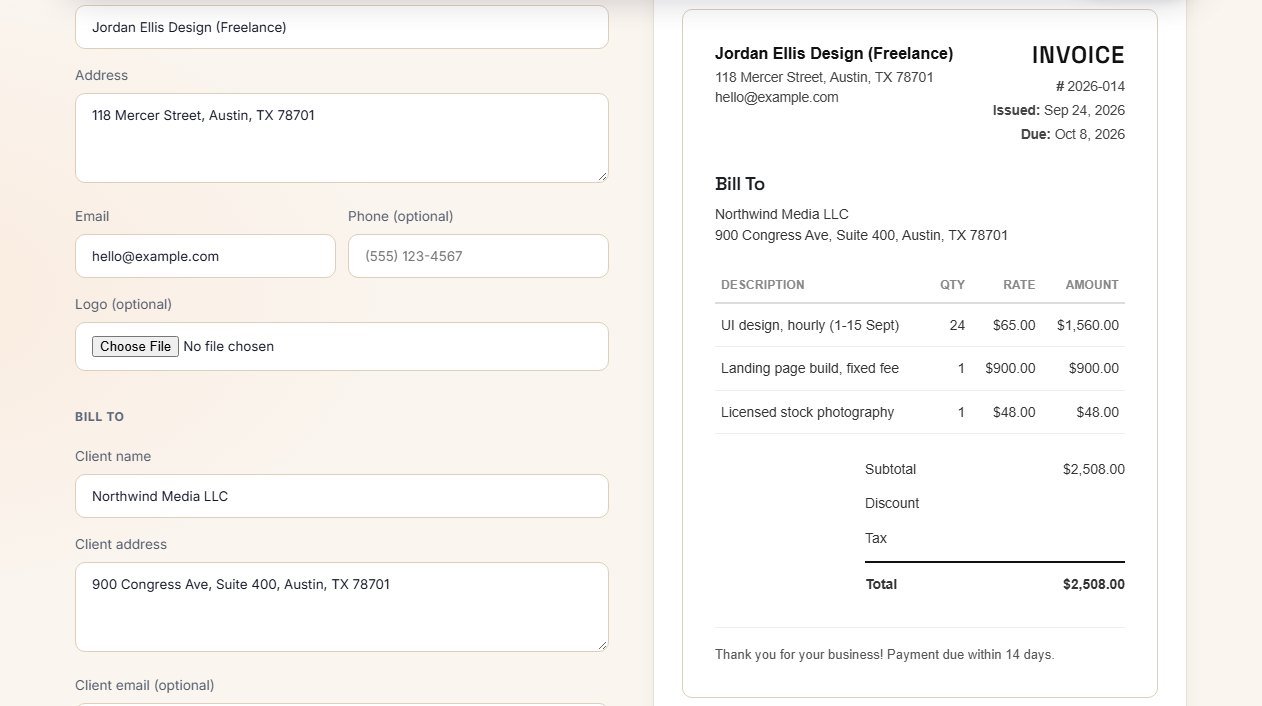
Three details in that example are deliberate. The sender name carries "(Freelance)" so the client's finance team knows they are paying an individual rather than a vendor with a supplier record. The client is the LLC rather than the marketing team's name. And the due date is a real date fourteen days out, not a phrase.
Nothing in the tool is stored on a server, so there is no account to create and nothing to cancel later. If you want the full walkthrough of how it handles logos, currencies and tax, we published a hands-on review of the free invoice generator separately.
Three Ways to Line-Item Freelance Work
The template never changes. What changes is how you write the description column, and that depends on how you sold the work.
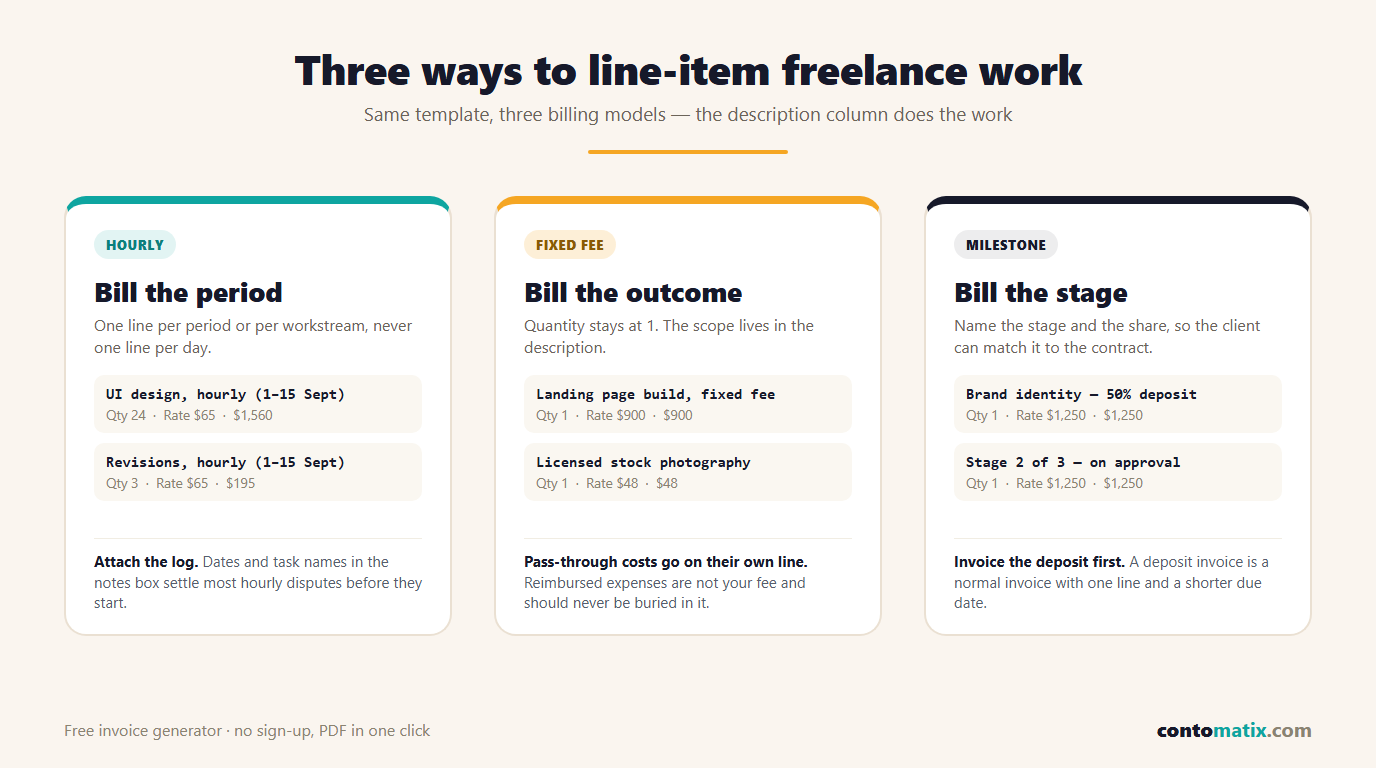
Hourly work goes on one line per period or per workstream, with the hours as the quantity. Twenty-three separate daily lines make an invoice look like a timesheet and invite line-by-line questioning. If the client wants that detail, put the daily log in the notes or attach it, and keep the invoice itself readable.
Fixed-fee work keeps the quantity at one and puts the scope in the description: "Landing page build, fixed fee" rather than "Design work". If the scope changed mid-project, the change goes on its own line with its own agreed price, never quietly folded into the original number.
Milestone work names the stage and the share: "Brand identity, 50% deposit" or "Stage 2 of 3, on approval". Anyone approving the payment can then match your line to the contract in seconds, which is usually the difference between same-week and same-month payment.
Reimbursed costs always get their own line. Bundling a $48 stock photo licence into your fee makes your rate look higher than it is and makes the expense impossible for the client to account for properly.
Invoice Numbering That Still Works in Year Three
Numbering is where most freelancers create a problem for their future self. Two formats hold up.
- Sequential:
0001,0002,0003. Simple, though the count is visible to the client, which some freelancers dislike early on. - Year-based:
2026-001,2026-002. Resets each January, sorts correctly in any folder, and makes year-end reconciliation trivial.
Whichever you pick, three rules apply. Never reuse a number, even for a corrected invoice. Never skip numbers deliberately to look busier. And if you invoice several clients, resist the urge to give each one its own series unless a contract demands it, because merged numbering is far easier to reconcile against a bank statement.
For a corrected invoice, issue the next number in the sequence, reference the original in the notes, and tell the client in plain language which one to pay.
Payment Terms That Actually Shorten the Wait
Terms are the most underused lever a freelancer has, and they cost nothing to change.
- Net 14 rather than net 30. Most small and mid-sized clients pay on the date you set, not on a policy. Asking for fourteen days is normal and rarely questioned.
- A deposit before work starts. Typically 25% to 50% for new clients or projects worth more than a few thousand. The deposit invoice is an ordinary invoice with one line and a short due date.
- A stated late fee. Whether you ever charge it matters less than the fact that it is written down. Check what your state or country allows before you pick a figure, and keep it reasonable.
- The payment method the client already uses. Bank transfer for most, a card or payment link if you are billing a small business owner personally. Every extra step is another day of delay.
Send the invoice on the day you finish the work, not at month end. The fastest-paid invoices are the ones that arrive while the work is still fresh in the client's mind.
What the Client Actually Receives
The PDF is the part that gets forwarded to finance, so it has to stand on its own without your covering email.
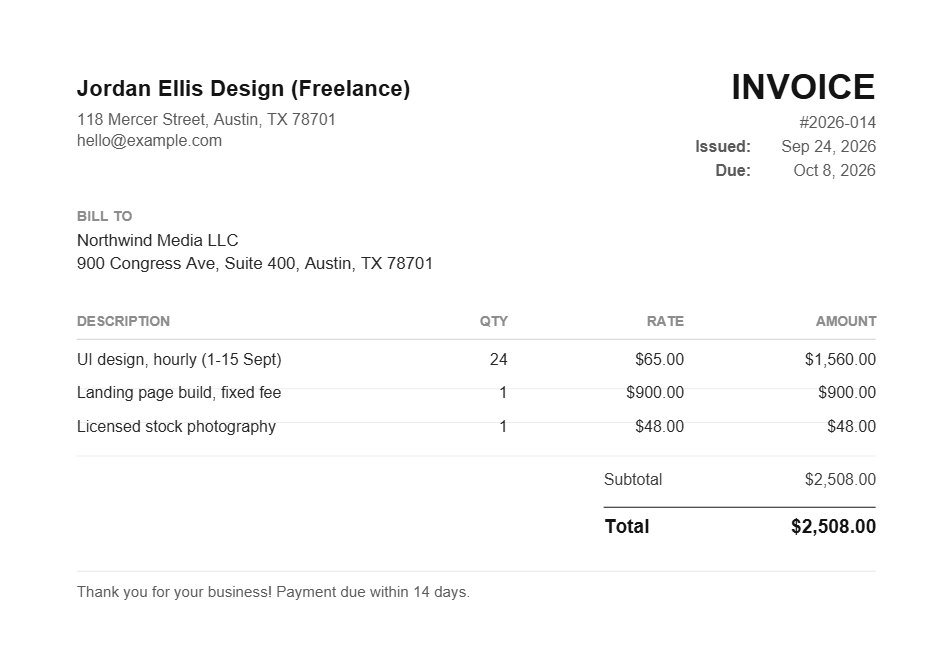
Name the file for the person receiving it, not for yourself: Invoice-2026-014-Northwind-Media.pdf is searchable in an inbox six weeks later, and invoice-final-v2.pdf is not.
Attach it as a PDF, never as an editable document, and put the invoice number, the amount and the due date in the email body as well. Half the delays in freelance payment come from an attachment nobody opened.
The 2026 Tax Change US Freelancers Should Know
If you invoice American clients, one long-standing number changed this year, and it affects what paperwork you should expect.
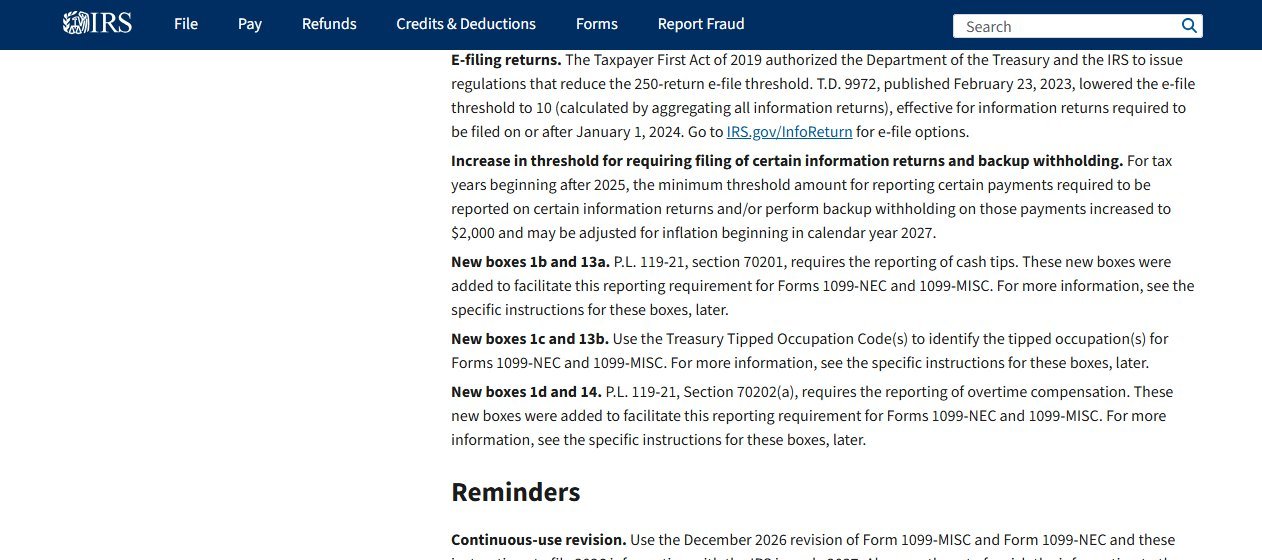
The instructions for Forms 1099-MISC and 1099-NEC state that for tax years beginning after 2025, the minimum threshold for reporting these payments increased to $2,000, and may be adjusted for inflation from calendar year 2027. The previous figure was $600.
Two practical consequences for a freelancer:
- A client who paid you $1,500 during 2026 may not send you a 1099-NEC at all. That does not make the money untaxed. Your own records become the primary evidence of what you earned, which is exactly what a numbered, dated invoice trail is for.
- New clients will still ask for a Form W-9 before your first payment. Fill it in once, keep a copy, and send it with your first invoice rather than waiting to be chased for it.
None of this is tax advice, and the rules differ outside the United States. Check your own position with an accountant before making decisions based on a threshold.
How Long to Keep Your Invoices
Because the tool stores nothing, the archive is yours to keep, and there is a published standard for how long.
The IRS guidance on how long to keep records ties retention to the period of limitations for the return: generally three years, six years if you did not report income that amounts to more than 25% of the gross income shown on the return, and seven years if you claim a loss from worthless securities or a bad debt deduction. Records for a return you never filed should be kept indefinitely.
In practice, a folder per year, a PDF per invoice and one spreadsheet listing number, client, date, amount and payment date covers everything you are likely to be asked for. Back it up somewhere that is not only your laptop.
Chasing a Late Payment Without Losing the Client
Assume the first late payment is an oversight, because it usually is. Three short emails, spaced out, recover most of them.
Day one after the due date. "Hi [name], invoice 2026-014 for $2,508 was due yesterday. I have attached it again in case it needs re-sending. Could you confirm it is in the payment run?"
Day seven. Reply in the same thread, put the payment details in the body of the email, and ask to be put in touch with whoever handles payments directly.
Day fourteen. State the late fee if you have one, give a date by which you need payment, and say what happens next: pausing work, holding files, or handing over. Keep it factual and short.
What not to do: chase on the due date itself, apologise for asking, or bury the request at the end of a long project update. Asking to be paid for work you delivered is an administrative message, not a confrontation.
Invoicing International Clients
Cross-border work adds three questions to the same template.
- Which currency? Bill in the currency named in your agreement. Our generator supports eight, and the symbol or currency code appears on every line so nobody has to guess.
- Who absorbs the transfer fees? Say so on the invoice. "Bank charges payable by sender" is one line that prevents a short-payment argument later.
- Does the client need extra identifiers? Some countries require a tax number or registration number on the invoice before their finance system will accept it. Ask before the first invoice, then keep it in your notes field permanently.
Expect international payments to take longer than domestic ones, and set the due date accordingly rather than being surprised by it every month.
Mistakes That Delay Payment
- Vague descriptions. "Consulting, September" invites questions. "Homepage copy, 3 rounds, approved 18 Sept" does not.
- Sending it to one person. Your day-to-day contact may not be able to pay you. Ask early who receives invoices, and copy them in.
- No due date. An invoice without a date is scheduled by the client, and the client is not in a hurry.
- Editable file formats. Send a PDF. A document anyone can alter is one finance teams treat with suspicion.
- Changing your number format mid-year. It breaks your own reconciliation and makes duplicates easy.
- Rolling several months into one invoice. Large unexpected totals get referred upwards, and referrals take weeks.
Quick Recap
- Nine fields, every time: the word invoice, both parties, a unique number, issue and due dates, line items, totals and payment instructions.
- Line-item hourly work by period, fixed fees by outcome and milestones by stage, and keep reimbursed costs on their own line.
- Year-based numbering, never reused, never skipped.
- Net 14, a deposit for new clients, and the invoice sent the day the work is finished.
- Send a PDF named for the recipient, with the number, amount and due date repeated in the email.
- For 2026, the US information-return threshold is $2,000, so your own invoice archive matters more than a form arriving in January.
The fastest way to start is to open the invoice generator, fill in the nine fields once and download the PDF. It takes about three minutes, and the next invoice takes one.
Frequently Asked Questions
What should a freelance invoice include?
The word "Invoice", your name, address and email, the client's legal name and address, a unique invoice number, the issue and due dates, itemised lines with quantity and rate, the subtotal, any tax, the total due, and clear payment instructions.
Do I need a company to send an invoice?
No. A sole trader or self-employed individual can invoice under their own name. Use the name you contract and bank under, and add your trading name if you have one.
How do I number freelance invoices?
Pick one format and keep it. Year-based numbers such as 2026-001 sort cleanly and reset each January. Never reuse a number, and issue a new number rather than editing an old invoice.
What payment terms should a freelancer use?
Net 14 suits most freelance work, with a deposit of 25% to 50% for new clients or larger projects. State the due date as an actual date rather than writing "due on receipt".
Should I charge a late fee?
Stating one is worth it even if you rarely apply it. Check what your state or country permits, keep the percentage modest, and put the terms on the invoice itself rather than mentioning them only after a payment is late.
How do I invoice for hourly work?
Use one line per period or workstream with the hours as the quantity and your rate as the rate, then keep the detailed log in the notes or as an attachment. A readable invoice is approved faster than a reproduced timesheet.
Can I invoice a deposit before starting work?
Yes. A deposit invoice is a normal invoice with a single line such as "Brand identity, 50% deposit", its own number and a short due date. The balance is invoiced at the agreed later stage.
Will my US clients still send me a 1099 in 2026?
Only above the new threshold. The IRS instructions for Forms 1099-MISC and 1099-NEC state that for tax years beginning after 2025 the reporting threshold rose to $2,000. Smaller totals may not generate a form, and your income is still reportable either way.
How long should I keep freelance invoices?
The IRS ties retention to the period of limitations: generally three years, six years where unreported income exceeds 25% of the gross income shown on the return, and seven years for a worthless securities or bad debt claim. Keep a PDF of every invoice for at least that long.
Is a PDF invoice legally acceptable?
For ordinary freelance work in most countries, yes, provided it contains the required details and is not altered afterwards. Some jurisdictions add rules for sales tax or VAT invoices, so check your local requirements before you start billing.
What currency should I invoice international clients in?
The currency in your agreement. State it clearly on every line, say who covers transfer fees, and expect the payment itself to take longer than a domestic one.