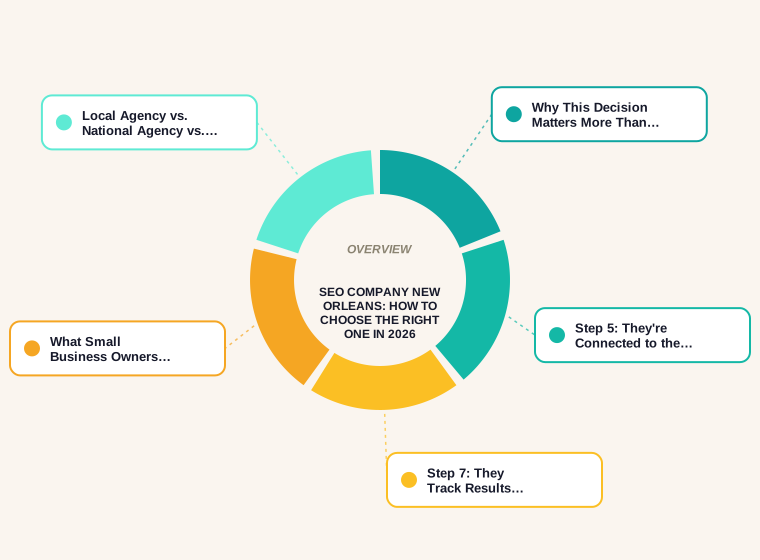
Choosing an SEO company in New Orleans is a decision that affects a lot more than a monthly invoice. This is a market that doesn't behave like most other cities: tourism-driven search spikes tied to specific annual events, a handful of industries with brutally contested rankings, and an independent local economy that Google still hasn't fully mapped correctly. Picking the wrong agency here usually doesn't look like a scam — it looks like generic, city-agnostic work applied to a genuinely unusual local market, which quietly underperforms for months before anyone notices why.
Below is a step-by-step way to evaluate an SEO company in New Orleans before signing anything, built around what actually separates an agency that understands this specific market from one running the same generic playbook it would in any other city.
Why Choosing an SEO Company in New Orleans Matters More Than You Think
An SEO engagement is typically a months-long commitment, not a one-off purchase, and switching agencies partway through means losing momentum on work that hasn't fully compounded yet. In a market with New Orleans' specific mix of seasonal demand and neighborhood-level competition, a wrong choice doesn't just waste a few months of budget — it can mean missing an entire festival season's worth of search demand while a poorly matched agency figures out the market on your dime. Getting this decision right upfront is considerably cheaper than fixing it six months in.
Step 1: They Plan Around Mardi Gras, Jazz Fest, and Festival Season — Not Just Keywords
Tourism-driven search patterns set New Orleans apart from most local markets. Mardi Gras, Jazz Fest, and the French Quarter Festival each create massive, predictable seasonal spikes in search volume for hospitality, dining, and entertainment terms. An agency that treats New Orleans like any other city misses this entirely, publishing generic content on a flat annual schedule instead of building specifically around when demand actually peaks.
A company that gets this right plans content and campaign timing around the city's actual event calendar, not a generic 12-month content plan copied from a template used everywhere else. Millions of visitors come through the city each year specifically for these events, and each one produces a distinct, predictable surge in search demand for a fairly narrow set of categories — hotels and short-term rentals, parade-route restaurants and bars, costume and bead shops during Carnival season, and event-adjacent entertainment listings during Jazz Fest specifically.
This matters for more than just content publishing dates. Ad spend, review-request timing, and even staffing recommendations for a hospitality client should shift around these predictable spikes — a restaurant or hotel search campaign that runs flat through the year is leaving obvious, predictable demand on the table during the exact weeks when search volume (and willingness to book at a premium) is highest. An agency that can point to a specific plan for how visibility should ramp before Jazz Fest weekend, for instance, is demonstrating real local knowledge rather than a generic seasonal-marketing platitude.
The lead time matters as much as the event date itself. Search demand for hotels and event-adjacent categories typically starts climbing weeks before a major festival, well before the event itself begins, which means content and Google Business Profile updates need to go live in advance rather than scrambling to catch up once the surge is already underway. An agency working off a generic content calendar with no built-in lead time for New Orleans' specific event schedule will consistently be a few weeks behind the actual demand curve, missing the highest-value search window each time.
Step 2: They Know Which Local Industries Are Actually Contested
New Orleans' organic competition is thin at the top and uneven underneath. In healthcare, major systems dominate the most valuable search terms outright. National booking platforms control French Quarter lodging searches. Personal injury law is aggressively and expensively contested. A company that doesn't know this landscape going in will set unrealistic expectations for a client trying to compete in one of these already-saturated categories, rather than steering strategy toward achievable, high-value local terms instead.
The right response to a heavily contested category usually isn't walking away from ranking ambitions entirely — it's narrowing the target. A personal injury firm competing directly against the market's most aggressive spenders on "New Orleans personal injury lawyer" has a much more realistic shot at a specific practice-area or neighborhood-level term than the flagship phrase everyone else is already fighting over. An agency that recommends this kind of realistic narrowing, rather than promising to win the unwinnable head-on term, is showing genuine strategic judgment rather than just selling optimism.
Step 3: They Understand the City's Independent Business Economy
New Orleans' identity is built substantially on independent, locally-owned businesses — retail along Magazine Street and Freret, hospitality in Bywater and Marigny, trades across Mid-City and Uptown, and service businesses out toward Metairie and the North Shore. This is exactly the segment of the local economy where Google Business Profiles are routinely incomplete and schema markup is nearly absent — which is precisely where a genuinely local-focused agency finds the most immediate, achievable ranking opportunity, since the local pack itself is comparatively wide open once the basics are actually done properly.
Each of these neighborhoods also has a genuinely distinct character that generic city-wide content misses. A retail boutique on Magazine Street competes on a very different set of search terms and customer expectations than a service business out toward the North Shore, even though both fall under the same broad "New Orleans business" umbrella. An agency treating the entire metro as one undifferentiated market — rather than a collection of genuinely different neighborhood economies — is missing the specificity that actually drives local relevance signals in Google's ranking algorithm.
Step 4: They Treat Google Business Profile as Foundational, Not an Afterthought
For a local business competing in a specific New Orleans neighborhood, a properly built Google Business Profile — correct category, accurate service area, real photos, active weekly updates — is often the single highest-leverage fix available, and it's routinely the first thing a credible local agency addresses rather than jumping straight to content or link building. An agency proposing a strategy that never mentions Google Business Profile specifically is either skipping the highest-impact work or doesn't understand how local search actually functions here.
Beyond the basics, a handful of specific, often-skipped fields matter more in a tourism-heavy market like New Orleans than they would elsewhere: accurate holiday and event-specific hours (a restaurant with wrong hours during Mardi Gras week loses real, high-value walk-in traffic), the "Services" and "Attributes" sections populated with actual offerings rather than left blank, and a steady stream of genuinely recent photos rather than a handful uploaded once at setup. A profile that looks actively maintained reads as more trustworthy to both a searcher and to Google's own prominence signal than one that was set up once and forgotten. Category selection deserves particular attention too — a bar that primarily serves food should still list a food-related secondary category, and a tour operator running both walking tours and airboat excursions needs categories reflecting both, since an incomplete category setup can quietly exclude a business from searches it should realistically be showing up for.
Step 5: They're Connected to the Local Business Community
The New Orleans Chamber of Commerce has grown to more than 1,400 members since its founding in 2004 and hosts more than 75 events annually — real infrastructure supporting a genuinely active local business community, not a sleepy market with a fixed set of players. An agency with real local ties (chamber involvement, relationships with local publications, familiarity with neighborhood associations) tends to build genuinely local citations and links that carry more relevance weight than generic national directory submissions ever will.
This kind of local connectivity also tends to surface faster, more accurate information than a purely remote agency working from generic research. Knowing which local publications actually cover which neighborhoods, which chamber events draw the right kind of business owners for a given client's industry, and which community organizations carry genuine trust in a specific part of the city isn't something a template or a generic local-citation checklist can replicate — it comes from actually operating inside that local business community, even in a limited capacity.
Step 6: They Can Explain Realistic Timelines, Not Overnight Promises
Local SEO in a competitive, tourism-driven metro like New Orleans is a compounding process, not an instant switch. A company that promises page-one rankings within days, without qualifying that against your specific industry's competitive density, is either inexperienced or being deliberately misleading. A credible agency sets expectations based on your actual competitive category — a personal injury firm and a Mid-City coffee shop are not competing on the same timeline or difficulty level, and a good agency will say so directly.
A realistic rough framework looks something like this: the first 30-60 days typically involve Google Business Profile cleanup, citation audits, and foundational on-page fixes with limited visible ranking movement yet. Meaningful map pack and organic movement for less-contested local terms usually starts showing up in the 60-120 day range. Highly contested categories — the healthcare, hospitality, and legal segments already mentioned — can take considerably longer, sometimes six months or more, before consistent top-tier visibility becomes realistic. An agency that collapses all of that into a single "you'll rank in 30 days" promise regardless of category is either inexperienced with this specific market or being straightforwardly dishonest about how competitive certain New Orleans industries actually are.
Step 7: They Track Results Beyond Just Rankings
Rankings alone don't pay the bills — calls, bookings, and foot traffic do. A New Orleans SEO company worth hiring tracks actual business outcomes tied to local search: phone calls generated from the Google Business Profile, direction requests, and website conversions from local traffic, not just a monthly ranking report showing position changes with no connection to whether the business is actually getting more customers.
Call tracking specifically deserves more attention than it typically gets, particularly for hospitality and service businesses where a phone call often carries more immediate booking intent than a web form submission. Without a dedicated tracking number tied to local search traffic specifically, a genuinely strong-performing keyword can look like dead weight in a standard analytics report simply because the resulting call never gets attributed back to the search that generated it. Setting this up properly before a campaign starts, rather than trying to reconstruct attribution months later, avoids drawing the wrong conclusions from incomplete data.
Seasonal reporting matters here too, in a way it doesn't in most other markets. A flat month-over-month report that doesn't account for the predictable dip after Mardi Gras or the spike around Jazz Fest makes it genuinely hard to tell whether a campaign is actually working or simply riding the city's natural tourism calendar. An agency that adjusts its reporting benchmarks around these known seasonal patterns is giving a client an honest picture of performance; one that doesn't is making it easy to either take undeserved credit during a natural high season or unfairly look like it's underperforming during a predictable seasonal lull.
What Small Business Owners Should Take Away From This
Small businesses make up 99.5% of Louisiana's economic base and employ more than half the state's workforce, and a meaningful share are women-owned and BIPOC-led enterprises building a business in a genuinely competitive tourism economy. For that majority of New Orleans businesses, local SEO isn't a luxury marketing line item — it's one of the few channels that lets an independent business compete for visibility against larger, better-funded players without an equivalent ad budget.
That competitive reality is amplified by the sheer volume of visitors passing through the city every year looking for exactly the kind of independent dining, entertainment, and shopping experiences New Orleans is known for. A tourist searching for "best po'boys near me" or "live jazz tonight" while standing in the French Quarter has no existing brand loyalty to lean on — the business that shows up clearly, with accurate hours, real photos, and recent reviews, wins that moment regardless of how long it's been operating or how well-known it is among locals. That's a genuinely different opportunity than most local SEO markets offer, where search behavior skews much more heavily toward existing local residents with pre-existing brand awareness.
It's also worth noting that this same tourist-driven search behavior cuts against businesses that neglect their online presence in a way that's more punishing than in a typical residential market. A local resident might still find a favorite neighborhood spot through word of mouth despite a thin online presence; a visitor with zero local knowledge has no fallback beyond what search results and Google Maps actually show them in the moment — which means the cost of an incomplete or outdated online presence is measured directly in lost tourism revenue, not just a slower-than-ideal growth curve.
Solid keyword research and consistent on-page SEO work, applied with the New Orleans-specific context above rather than a generic template, is what actually separates a business that shows up when it matters from one that doesn't. We've seen this same "generic template versus genuinely local context" gap play out in other markets we've covered — see our guide on local SEO in Edmonds, WA for how the same underlying principle applies to a much smaller, single-industry-dominant local market.
Local Agency vs. National Agency vs. Freelancer
A local New Orleans agency typically brings the neighborhood-level and seasonal knowledge covered above, but can vary widely in size, process maturity, and available resources. A national agency often brings more structured reporting, larger teams, and more advanced tooling, but may need to be pushed specifically to apply that capability to New Orleans' particular market quirks rather than a one-size-fits-all national playbook. A freelancer can offer flexibility and a lower price point, but rarely has the bandwidth to handle technical SEO, content, and link building all at a consistently high level for a business with real growth ambitions.
There's no universally correct answer among the three — a small, single-location neighborhood business and a multi-location hospitality brand with national marketing needs are genuinely different buying situations. What matters is matching the option to your actual scale and how much hands-on local market knowledge your specific business needs versus process and capacity.
What to Expect in Your First 90 Days
The first 30 days with a new SEO company should mostly involve groundwork: a technical and Google Business Profile audit, a competitive review specific to your category, and a prioritized plan — not yet visible ranking movement. Days 30-60 typically bring citation cleanup, on-page fixes, and the first batch of content or outreach work going live. By day 90, you should be seeing early directional signals — some keyword movement, early citation and review growth, and a clearer picture of which of your target terms are realistically winnable in the near term versus the ones that will take longer given New Orleans' specific competitive landscape.
An agency unwilling to lay out something resembling this timeline, or one promising dramatic ranking movement inside the first 90 days regardless of your industry, is either new to this specific market or setting expectations it can't actually back up.
Common Mistakes Businesses Make When Choosing an SEO Agency
The most frequent mistake is picking based on price alone, without checking whether the agency actually understands New Orleans' seasonal and neighborhood-specific dynamics — a cheaper generic package that ignores Mardi Gras and Jazz Fest seasonality can end up costing more in missed high-demand weeks than a properly-scoped local engagement would have. A close second is skipping reference checks with genuinely comparable local businesses, and simply trusting a polished pitch deck instead. Signing a long-term contract without a clearly defined 90-day checkpoint is another common trap, since it removes the natural opportunity to course-correct early if the fit isn't right.
How Contomatix Helps New Orleans Businesses
Contomatix approaches a New Orleans engagement the same way outlined throughout this guide: real keyword research built around your specific neighborhood and competitive category (not a generic city-wide template), on-page SEO work that accounts for seasonal search patterns tied to the city's event calendar, and reporting that ties back to actual calls and bookings rather than ranking positions alone. We're upfront about realistic timelines for contested categories like healthcare, hospitality, and legal, and we'd rather tell you honestly what's achievable in 90 days than promise something we can't deliver.
Final Thoughts
If you're evaluating an SEO company for your New Orleans business, ask directly how they'd handle your specific seasonal patterns, your specific competitive category, and your Google Business Profile — vague answers to any of those three questions are a reliable warning sign. It's also worth asking for examples of work with genuinely comparable local businesses — not necessarily direct competitors, but businesses facing a similar mix of neighborhood-level competition and tourism-driven demand — since an agency's experience in a completely different type of market doesn't automatically transfer to New Orleans' specific mix of seasonality and neighborhood-level competition. Get in touch and we can walk through what a realistic local SEO plan actually looks like for your business and neighborhood.
How much does an SEO company cost in New Orleans?
Costs vary by business size and competitive category — a Mid-City service business and a French Quarter hospitality brand competing against national booking platforms face very different levels of required investment.
How long does it take to see SEO results in New Orleans?
It depends heavily on the industry. Independent local businesses in less-contested categories can see meaningful movement in a few months, while highly competitive categories like personal injury law or French Quarter hospitality take considerably longer.
What makes New Orleans SEO different from other cities?
Tourism-driven seasonal search spikes (Mardi Gras, Jazz Fest, French Quarter Festival), a mix of heavily contested industries alongside a wide-open independent business segment, and a strong local business community are all specific to this market.
Is Google Business Profile really that important for New Orleans businesses?
Yes — many independent New Orleans businesses have incomplete profiles and no schema markup, making a properly optimized Google Business Profile one of the highest-leverage, lowest-cost improvements available.
Which New Orleans industries are hardest to rank in?
Healthcare (dominated by major hospital systems), French Quarter lodging (dominated by national booking platforms), and personal injury law are among the most aggressively contested local categories.
Do I need different SEO strategies for different New Orleans neighborhoods?
Yes. Magazine Street retail, Bywater and Marigny hospitality, Mid-City and Uptown trades, and Metairie service businesses each face different local competition and customer expectations, so a single generic city-wide strategy tends to underperform compared to neighborhood-specific targeting.
Should my New Orleans business worry about tourist search traffic?
For hospitality, dining, and entertainment businesses, yes — tourists have no existing brand loyalty and rely entirely on what search results and Google Maps show them in the moment, making an accurate, complete online presence directly tied to lost or won revenue.
What's the biggest local SEO mistake New Orleans businesses make?
Treating the city as one undifferentiated market with a flat, generic content calendar — missing both the neighborhood-level differences between areas like Magazine Street and Metairie, and the seasonal search spikes tied to Mardi Gras, Jazz Fest, and other major annual events.
Related Reading
- For another Southeast market example, see our guide to SEO in Savannah.