Last updated: October 2026
SEO for startups is a different job from SEO for an established brand. You have a new domain, no backlinks to speak of, a team of three people who are also doing sales and support, and a product that may still change shape next quarter. The usual advice about seo for startups, which assumes a big content budget and a year of patience, does not fit that situation.
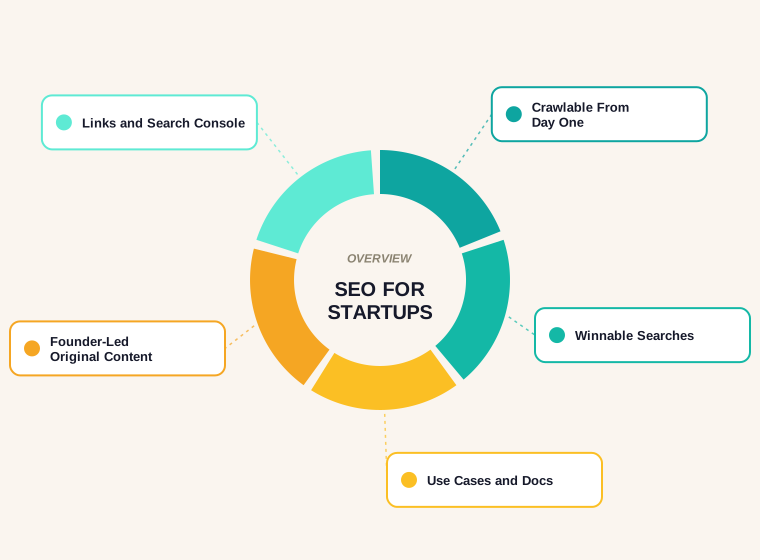
This guide is about order of operations. It covers what to get right on day one, which searches a young company can realistically win, how to structure a product site so it keeps earning, what to avoid because it can hurt you, and a plain plan for your first 90 days. It does not quote prices or promise results, because neither can be honestly predicted for a company you have not met.
Why SEO for Startups Starts From a Weaker Position
An established competitor has years of indexed pages, links from other sites and people who already search for its name. A startup has none of that, so it cannot win by publishing the same articles on the same broad topics. A new site that tries to rank for a head term against companies with a decade of authority will spend months producing pages that sit on page six.
The good news is that search is not one contest. Narrow, specific searches have far less competition, and a new company often knows more about those narrow problems than anyone else, because it was founded to solve them. The strategy below leans on that advantage rather than pretending the gap in authority does not exist.
Day One: Make the Site Crawlable and Indexable
Before any content strategy, check that Google can actually reach and read your pages. Most seo for startups problems begin here. Teams lose more time to this than to anything else, usually through a mistake nobody noticed.
The classic one is the staging site. Teams often block crawlers on a pre-launch build with a site-wide noindex tag or a robots.txt rule, and then forget to remove it when the real site goes live. Google's documentation notes that when it finds a noindex tag, it will drop that page entirely from search results. There is a second trap: for noindex to work, the page must not be blocked in robots.txt, because a blocked crawler never sees the tag. Whichever way you are using them, check both on the live domain, and check that the staging copy is not publicly reachable under a different address.
The second common problem is the JavaScript framework. Many product sites are single-page apps, and Google can handle them, but only if you follow the rules. In its JavaScript SEO basics, Google explains that it crawls a page, queues it for rendering, and then indexes the rendered HTML. It also says Googlebot finds links by parsing the href attribute of HTML links, which means navigation built from click handlers with no real link will not be followed.
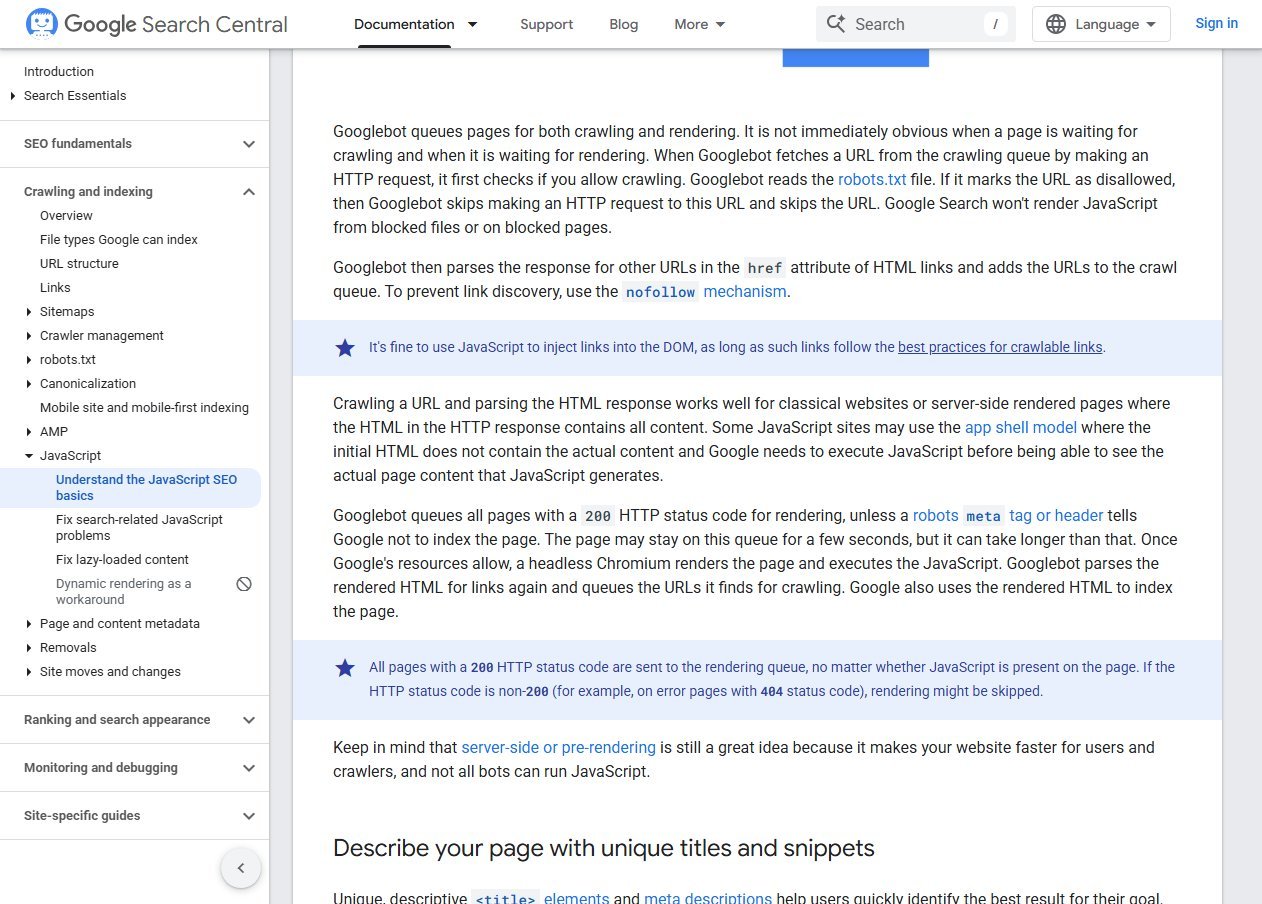
The same page recommends server-side or pre-rendering as a good idea because it makes a site faster for users and crawlers, and because not every bot can run JavaScript. If your marketing pages are rendered only in the browser, ask your developers whether the important ones can be served as plain HTML.
A short technical pass on day one is enough. Open the URL Inspection tool in Search Console for your homepage, one product page and one blog post. Check that each is indexable, that Google sees the content you expect in the rendered version, and that the canonical URL is the one you want. Then submit a sitemap. If any page fails, fix it before writing a word of new content.
Pick Battles a New Site Can Win
The most useful rule for seo for startups is to choose searches where intent is clear and competition is thin, instead of searches that merely have high volume. Three kinds tend to fit a young company.
- Problem-aware searches. People describing the pain your product removes, in their own words, before they know a product category exists.
- Category and alternative-style searches. People comparing approaches in your space, such as how a manual process differs from an automated one, or what to look for when choosing a tool for a specific job. You can write these honestly about your own category without naming or attacking anyone.
- How-to searches from real expertise. Practical guides on tasks your team does every day, where you can show actual steps rather than a summary of other articles.
Bottom-of-funnel pages deserve early attention because a small number of the right visitors is worth more than a large number of the wrong ones. A page that explains who your product suits, how it compares in approach to other ways of solving the problem, and what a buyer should check before deciding will attract people who are close to a decision. That is a better use of a first article than a broad definition of your industry.
To find these searches, work from questions customers actually ask in sales calls and support tickets, then validate them with a keyword tool. Our guide to keyword research tools compares ways to do that, including free options that suit a small team. When you review the results, prefer lower-competition phrases with a clear need behind them, even if each one shows modest volume.
Structure a Product Site as an SEO Asset
A SaaS or product site usually starts with a homepage, a pricing page and a blog. That is a thin base. Several other page types earn search traffic in their own right, and they tend to be easier to rank than blog posts because the intent is specific.
- Use-case pages. One page per job your product does or per kind of customer it serves, each written around the real situation rather than a list of features.
- Integration pages. If your product connects to other tools, a page for each connection can match searches from people who already use those tools and want them to work together.
- A help centre or documentation. Support articles answer very specific questions, and people who search for them are often existing or prospective users with a real task in hand.
- A glossary or explainer section. Short, accurate definitions of terms your buyers use, linked to the relevant use-case pages.
Keep the structure shallow and the URLs readable. Every important page should be reachable from at least one other page with a normal link, and your navigation should show Google, and visitors, how these areas relate. Link from blog posts to the use-case pages they support, and from those pages back to deeper guides. This internal linking also tells search engines which pages you consider central. For the on-page basics, such as titles, headings and internal links, our on-page SEO checklist covers the details.
Make Your Brand Findable by Name
For a new company, the first search that matters is often the company name itself. If someone hears about you from a podcast, a customer or an investor, they will type your name into Google. Make sure that search leads to your site and not to a similar brand, an unrelated page, or nothing at all.
Pick a name that is distinct enough to search for, claim the same handle on the platforms your audience uses, and keep the name, description and logo consistent across your site and profiles. Give your homepage a clear title that includes the name, and give your About page real information about who the company is and who runs it. Then search your own name in a private window every few weeks. Branded impressions are also one of the cleanest early signs that people are hearing about you.
Use What Only a Founder Knows
Founders have an advantage that agencies and large competitors cannot copy: first-hand experience. You have tried approaches that failed, you have seen how customers actually behave, and you hold data nobody else has, such as how people use your product or what questions come up most often.
Turn that into content. Write about the mistake you made and what you changed. Share the pattern you see across your own customers, with the numbers your company really holds, and be clear about how small or recent the sample is. Explain the process your team follows in detail that a generic article could not include. Google's guidance on helpful, people-first content asks whether a page shows first-hand expertise and depth of knowledge, and a founder writing from the work is the most direct way to show that.
It also makes the writing easier to defend. A post built on something your company did is hard to imitate and gives other sites a reason to cite you.
What Not to Do
A few tactics look efficient for a small team and are worth ruling out early, because they can damage a site that has little reputation to fall back on.
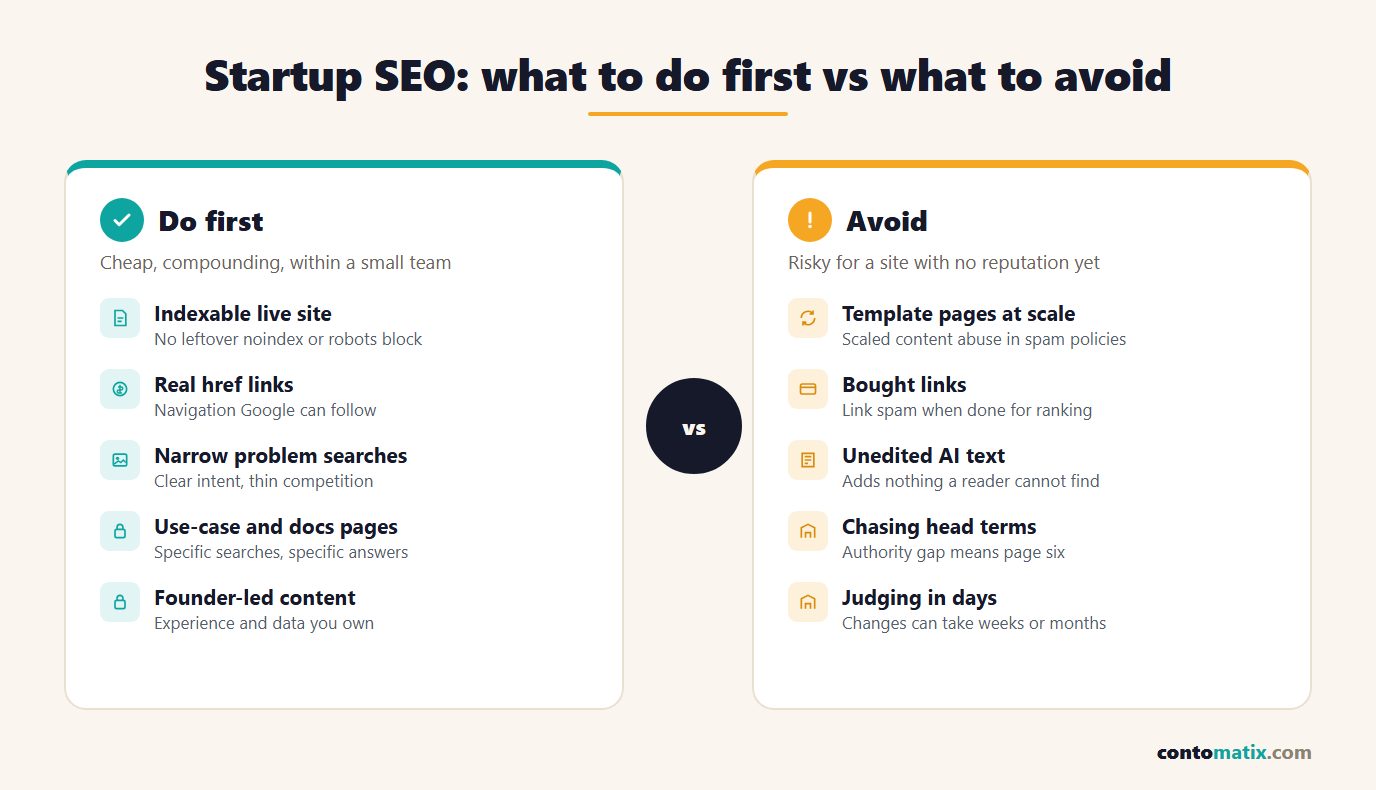
Do not publish pages at scale without value. It is tempting to generate hundreds of near-identical pages from a template, for every city, every integration or every keyword variant. Google's spam policies define scaled content abuse as generating many pages for the primary purpose of manipulating rankings and not helping users, and list using generative AI tools to create numerous pages without user value as an example. Templates are fine when each page carries something useful and distinct; they are not when only the keyword changes.
Do not buy links. The same policies list buying or selling links for ranking purposes as link spam. Paid placements are acceptable when marked as advertising, but they will not build the kind of authority you are after.
Do not publish AI-spun content. Using AI to help draft or edit is not the problem. Publishing unedited, generic text that adds nothing a reader could not find elsewhere is. If a page contains no experience, no data and no opinion from your team, it has no reason to exist. Our overview of an AI SEO strategy explains where automation helps and where it hurts.
Earn Links With Resources and Real PR
Links are still one of the main ways a new site gains authority, and the safest way to earn them is to create something people want to reference. For a startup, three approaches work without breaking any rules.
- A useful free resource or tool. A calculator, template, checklist or small utility that solves one problem for your audience. People link to tools that save them time, and the resource brings in searches on its own.
- Original data. Anything you can measure from your own product or a small survey of your customers, published with the method stated. Journalists and bloggers cite numbers they cannot get elsewhere.
- Real PR. Expert comments for reporters, speaking at events, guest articles on publications your buyers read, and newsletters in your industry. The goal is to be a credible source on a narrow topic.
Each of these is slow, and each compounds. A free resource keeps attracting links long after you publish it, while a purchased link stops doing anything the moment it is removed or flagged.
Measure With Search Console, Not Guesswork
Search Console is free and shows how Google sees your site, so set it up on day one. For an early-stage company, track a simple chain: impressions, then clicks, then signups.
Impressions tell you whether Google is showing your pages for the searches you targeted. Clicks tell you whether your titles and descriptions earn attention. Signups, which you measure in your analytics, tell you whether the people who arrive are the right ones. If impressions rise but clicks do not, rewrite titles. If clicks rise but signups do not, the page is attracting the wrong visitors or failing to answer them.
Watch the queries report, too. It shows the exact phrases that triggered your pages, including ones you never targeted, and those are often the best ideas for your next article. Do not judge individual pages in the first few weeks, since early data is thin and noisy.
How Long Does It Take?
Nobody can give an honest number, and you should be wary of anyone who does. Google's own SEO Starter Guide says that every change takes some time to show up, with some taking effect in a few hours and others several months. It suggests waiting a few weeks before judging whether a change helped.
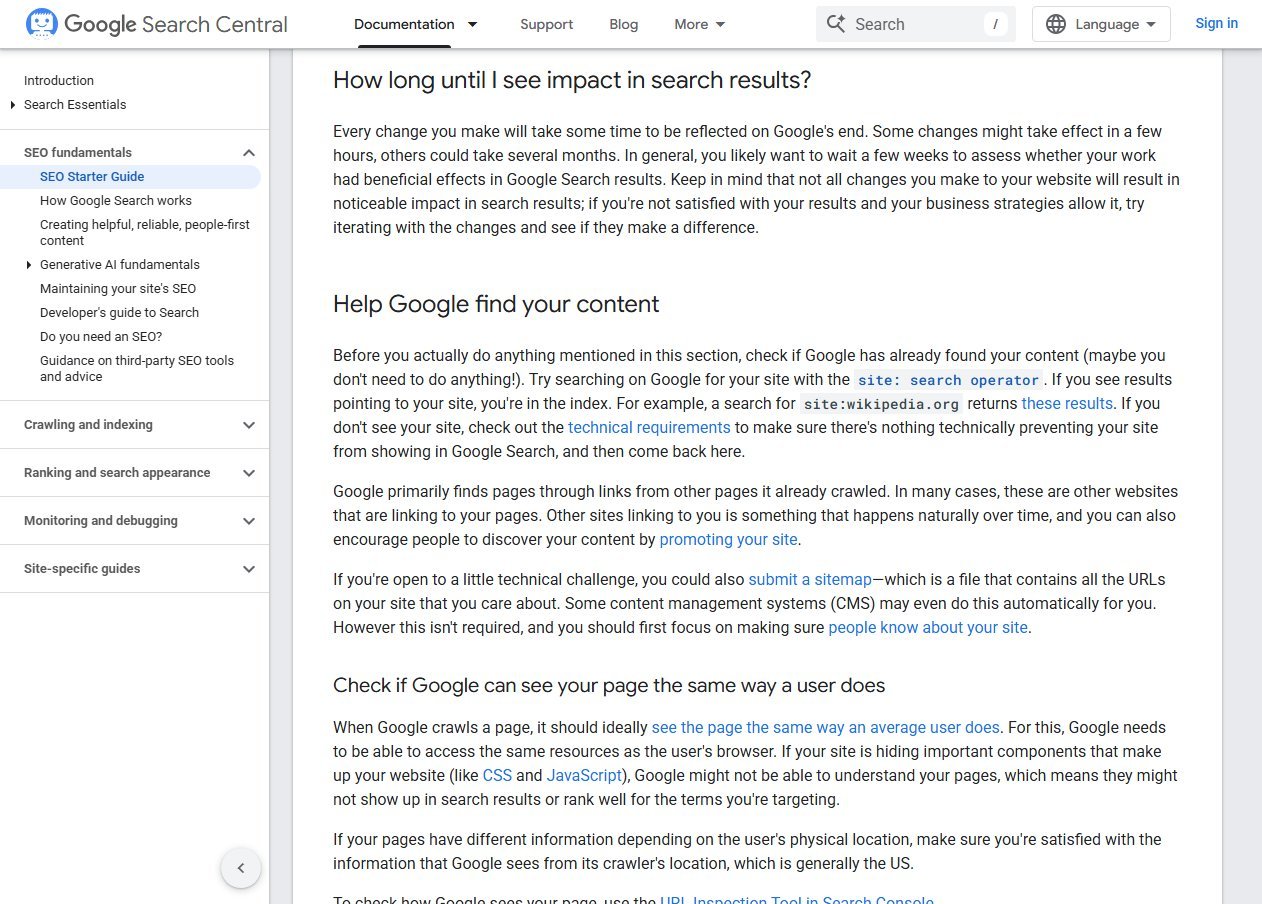
For a new site, a realistic pattern is that indexing and branded searches come first, then impressions for narrow phrases, then clicks, then the slower growth that comes from links and accumulated content. Plan for the long version and treat early movement as encouragement, not proof.
Your First 90 Days: A Simple SEO for Startups Plan
This is the order that makes sense for a small team doing seo for startups on a tight schedule. Adjust it to your product, but resist the urge to skip the first month.
- Days 1 to 14: foundations. Remove any staging noindex or robots.txt block, confirm crawlable links, set up Search Console and analytics, submit a sitemap, and inspect your key pages with URL Inspection.
- Days 15 to 30: core pages. Write or tighten your homepage, About page, and one page for each main use case. Make sure your name search leads to your site.
- Days 31 to 60: first content. Publish a small number of problem-aware and how-to articles from real experience, plus one comparison-style page about approaches to your problem. Link each to a relevant use-case page.
- Days 61 to 90: assets and review. Ship one free resource or original data piece, pitch it to relevant publications, and review Search Console for the first real signal. Double down on what is getting impressions.
A Short Checklist Before You Start
- Search your live domain for a leftover noindex tag or a site-wide robots.txt block.
- Confirm that key navigation uses real links with an href, not only click handlers.
- Verify the site in Search Console and submit a sitemap.
- List ten questions customers ask, and check each against a keyword tool.
- Draft one use-case page for your main customer type.
- Write one article from your own experience that nobody else could write.
- Decide which free resource you could build that your audience would link to.
- Agree a rule against buying links and publishing templated pages without value.
Quick Recap
- Check crawlability first: remove leftover noindex tags and robots.txt blocks, and use real links with an href.
- Choose narrow, problem-aware, bottom-of-funnel and how-to searches that a new site can win.
- Use use-case pages, integration pages and a help centre as search assets.
- Make sure people can find you by name, and build on what only you know as a founder.
- Avoid scaled pages without value, bought links and unedited AI content.
- Earn links with free resources, original data and real PR.
- Track impressions, clicks and signups in Search Console, and give changes weeks, not days.
If you would like a second pair of eyes on your foundations, Contomatix helps early-stage teams set up their first technical and content priorities.
Frequently Asked Questions
When should a startup start doing SEO?
From day one for the technical basics, since a blocked or unreadable site cannot earn anything later. Content and link work can follow once you know your audience and the problems you solve.
Is SEO for startups worth it at the early stage?
It can be, if you target specific searches and have patience, because the results build slowly and keep working. If you need customers next month, pair it with channels that move faster.
What is the biggest technical SEO mistake startups make?
Leaving a noindex tag or robots.txt block from a staging build on the live site. Check both, and the page source of your key pages, right after launch.
Does Google index JavaScript sites?
Yes. Google crawls, renders and then indexes pages, but it finds links through HTML elements with an href, and it does not render JavaScript on pages blocked by robots.txt.
Should a startup write comparison pages?
Yes, written honestly about approaches and criteria for your own category. You do not need to name or criticise other companies to help a buyer decide.
Do integration and use-case pages help SEO?
They often match specific searches with clear intent, which can be easier to win than broad topics. Each page needs real, distinct content rather than a swapped template.
Is programmatic SEO safe for a new site?
Only when every page offers real value. Google's spam policies treat many pages generated mainly to manipulate rankings, without helping users, as scaled content abuse.
Is it okay to use AI to write startup content?
As a drafting or editing aid, yes. Publishing generic, unedited output with no experience or data from your team adds little and risks breaking spam policies if produced at scale.
How do startups get backlinks without paying?
By publishing something worth citing: a useful free tool, original data from your own product, or expert commentary placed through real PR. Buying links for ranking is link spam.
How long does SEO take to work for a startup?
Google says changes can take from a few hours to several months to show, and suggests waiting a few weeks before judging them. Expect the compounding effects to take longer.


