Last updated: September 2026
The short answer: there's no separate Google penalty for duplicate content — Google's Search Central team said as much directly back in 2008, and John Mueller has repeated it every year since. But "no penalty" doesn't mean "no cost." Duplicate content still hurts you through three distinct, unglamorous mechanisms: it splits the ranking signals that should be concentrated on one URL, it can waste crawl budget on larger sites, and — the part almost nothing written on this topic covers — it fragments which version of your content actually gets credited when an AI engine answers a question instead of showing ten blue links.
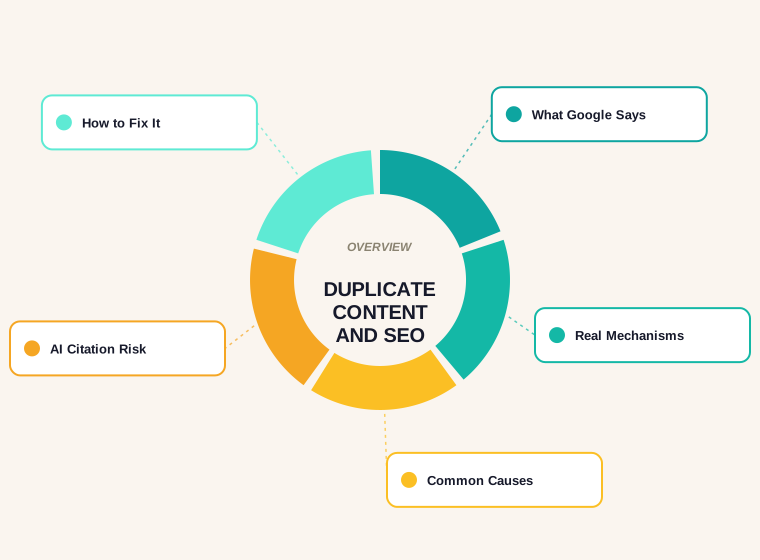
What Google Actually Says (Not What SEO Blogs Say Google Says)
Most articles on this topic assert Google's position without linking to it. Google's own canonicalization documentation is blunt about it: "Some duplicate content on a site is normal and it's not a violation of Google's spam policies." The problem Google actually describes is a user-experience and measurement problem, not a punishment: "having the same content accessible through many different URLs can be a bad user experience... and it may make it harder for you to track how your content performs."
The "duplicate content penalty" phrase itself traces back to an urban legend Google directly addressed in a 2008 Search Central Blog post literally titled "Demystifying the duplicate content penalty." There's no algorithm that detects two similar pages and docks them both. What actually happens is closer to triage: Google's systems cluster near-identical URLs together, pick the one they judge "objectively the most complete and useful," and largely ignore the rest for ranking purposes. You don't get punished. You get filtered out of the running — which, from a traffic standpoint, feels identical to a penalty even though the mechanism is completely different.
The Real Mechanisms — Not "It's Bad," But Specifically How
This is the part most duplicate-content articles skip in favor of vague warnings. Here's what's actually happening under the hood.
Signal splitting, not devaluation. Google's consolidation documentation describes canonicalization as combining "properties of the URLs in the cluster, such as link popularity... to the representative URL." Read that carefully: it's not that duplicate pages get devalued — it's that whatever authority they've individually earned (backlinks, internal links, engagement) gets scattered across multiple URLs instead of concentrated on one. Ten links pointing at three different versions of the same page is weaker than ten links pointing at one version, even though the total link count is identical.
Crawl budget dilution — but only at a scale most small sites never reach. Google's own crawl budget documentation is specific that this mainly matters for large sites — realistically, sites in the range of 10,000+ unique URLs. If you run a five-page brochure site or even a few-hundred-post blog, crawl budget is not your bottleneck. Where this becomes a genuine problem is faceted or filtered navigation on e-commerce and directory sites: a handful of filter combinations (color × size × price range × sort order) can multiply one category page into thousands of near-identical, individually crawlable URLs. That's the actual crawl-budget killer in 2026 — not the "printer-friendly version" example every article on this topic still uses.
Canonical signal confusion. Google explicitly ranks its own signals by strength: a 301 redirect or a correctly implemented rel="canonical" tag is a "strong signal," while sitemap inclusion alone is a "weak signal." When these signals disagree with each other — your sitemap lists one URL, your internal links point to another, and no canonical tag exists at all — Google has to guess, and Mueller has noted it tends to default toward the most restrictive signal available. You can lose control of which URL ranks without ever intending to create duplicate content at all.
Where Duplicate Content Actually Comes From
The obvious causes — www vs. non-www, http vs. https, copied/syndicated content — are covered everywhere. These get skipped far more often, and cause more real damage:
- Tracking parameters. Every
?utm_source=,?gclid=, or session ID appended to a URL is technically a new, separately indexable address serving identical content. A page shared across five ad campaigns can generate five crawlable duplicates before anyone notices. - Staging and dev environments left crawlable. A staging subdomain that was never blocked in
robots.txt, or a dev copy that got indexed before launch and was never cleaned up, is one of the most common accidental-duplication causes in practice — and one that rarely comes up in duplicate-content explainers because it's an operational mistake, not a content mistake. - Trailing slashes and case sensitivity.
/page,/page/, and/Pagecan all resolve as separately crawlable URLs on a misconfigured server, each one a technically distinct duplicate of the same content. - Faceted navigation (covered above) — the single largest source of duplicate URLs at scale, and the one classic articles on this topic almost never mention because it's a large-site problem, not a blog problem.
- Pagination and hreflang interactions. Google's documentation gives international/paginated content its own canonical handling rules, and getting this wrong creates duplicate clusters across language or page-number variants that are easy to miss in a routine content audit.
A Number You'll See Everywhere on This Topic — and Why We're Not Repeating It
Nearly every article on duplicate content cites some version of the claim that "25–30% of the web is duplicate content." We looked for where that number actually comes from. It doesn't trace to any citable, current Google study — it's an old estimate that's been repeated by SEO blogs for over a decade without anyone re-verifying it. We're flagging it here specifically because building an argument on an unsourced stat is exactly the kind of thing that erodes trust once a reader checks it — and if you're citing this article as a source yourself, you shouldn't inherit an urban legend along with the good information.
What We Actually Found Fixing This on Our Own Site
This isn't theoretical for us. Auditing our own city-guide post series recently, we found that 27 posts covering different local markets shared a large block of identical boilerplate — the same disclosure paragraph, the same "how we vet a list" methodology section, the same closing FAQ answers, reused across every post with only the city name swapped. Two posts that happened to land five positions apart in our own list were, in places, over 27% textually identical to each other.
The fix wasn't deleting content — most of that boilerplate was genuinely useful, just repeated. We rewrote it into several genuinely different versions of the same guidance and assigned them so no single wording repeated across more than a handful of posts, and moved the fully generic sections into one dedicated reference page that the individual posts link to instead of restating. Worst-case similarity between any two posts in the series dropped from over 50% to under 30%, and the pages this affected most were, unsurprisingly, ones targeting closely related keywords — exactly the pattern Google's own guidance would predict causes signal splitting.
The relevant enforcement mechanism here isn't the old "duplicate content penalty" myth — it's Google's scaled content abuse policy, expanded in the March 2024 update, which targets content "generated for the primary purpose of manipulating search rankings" and is explicitly method-neutral: it doesn't matter whether the repeated content is AI-generated, human-written, or templated. A human writer copy-pasting the same boilerplate across 27 pages is treated the same as a script doing it. That's the real 2026 risk with duplicate content produced at scale, and it's a different, more serious mechanism than classic accidental duplication.
Duplicate Content and AI Citations: A Different Kind of Damage
This is the part genuinely missing from older duplicate-content content. Classic organic ranking dilution is gradual — your rankings soften, they don't vanish. AI answer engines appear to behave more like a binary switch: when a question gets answered directly by ChatGPT, Perplexity, or an AI Overview instead of a list of links, only one source (sometimes none, credited or not) gets the citation. Early industry observation suggests these systems don't always consolidate duplicate or syndicated content the way rel="canonical" consolidates it for organic search — each accessible copy can be evaluated as a separate potential source rather than folded into one representative URL.
If getting cited by AI tools specifically is a priority, see our guide to getting cited by ChatGPT for the broader picture beyond just duplicate content. The practical risk: your page can be handled correctly by Google's classic canonicalization system — right canonical tag, right redirect, textbook implementation — and still lose the AI citation slot entirely to a higher-authority domain that republished or closely paraphrased your content. We'd treat the specific numbers circulating about this as directional rather than settled fact; the mechanics are new enough that no one, including us, has fully mapped them yet. But the asymmetry itself — organic dilution is gradual, AI-citation loss looks closer to all-or-nothing — is worth planning around now rather than after it costs you visibility you can't easily trace back to a cause.
How to Actually Fix It
The right fix depends on why the duplicate exists, not a single universal answer:
- Two URLs, one should stop existing: a 301 redirect. This is the strongest possible signal and the right call for merged pages, retired URL structures, or www/https consolidation.
- Two URLs, both need to keep working: a
rel="canonical"tag pointing at the preferred version — the right tool for tracking-parameter variants, print versions, or syndicated copies you've licensed out. - A whole section shouldn't be indexed at all:
noindex, not canonical — internal search results pages and faceted-navigation combinations are the classic case; canonical tags don't stop crawling the waynoindexplus a crawl directive can. - Stack your signals instead of picking one: a self-referential canonical tag on every page (even ones with no known duplicate yet), a clean sitemap, and consistent internal linking all reinforcing the same preferred URL. Google explicitly says combining methods increases the odds it honors your preference over its own judgment.
Source: Google Search Central — Canonicalization
Related Reading
- For these fixes implemented properly across a whole site, see our guide to what a technical SEO agency actually does.
Is there really a Google penalty for duplicate content?
No — Google addressed this directly in a 2008 post titled "Demystifying the duplicate content penalty" and has repeated the position every year since. What happens instead is that Google's systems select one version of duplicate content to rank and largely ignore the others, which produces a similar traffic outcome to a penalty without there being a punitive algorithm behind it.
Does duplicate content hurt crawl budget for a small website?
Usually not meaningfully. Google's own documentation frames crawl budget as a concern mainly for large sites — realistically 10,000+ unique URLs. A typical small business site or blog isn't at real risk from crawl budget dilution; faceted e-commerce navigation and large content portals are where this actually bites.
What's the difference between a canonical tag and a 301 redirect for duplicate content?
A 301 redirect actually moves visitors and search engines to the new URL and should be used when the old URL shouldn't exist anymore. A canonical tag lets both URLs keep working for users while telling search engines which one to treat as authoritative — the right choice when you need the duplicate to remain accessible (tracking parameters, print versions, legitimately syndicated copies).
Can duplicate content get your site removed from Google entirely?
Accidental duplicate content, on its own, does not. Deliberate, large-scale duplication designed to manipulate rankings can fall under Google's spam policies, including the scaled content abuse policy expanded in 2024 — that policy applies regardless of whether the repeated content is AI-generated, human-written, or templated.
Does duplicate content affect whether AI Overviews or ChatGPT cite my site?
It appears to, though the mechanics are newer and less mapped than classic organic ranking. Early industry observation suggests AI answer systems don't always consolidate duplicate or syndicated content the way canonical tags do for organic search, meaning a page handled correctly for Google's classic ranking system can still lose an AI citation to a duplicate hosted elsewhere.